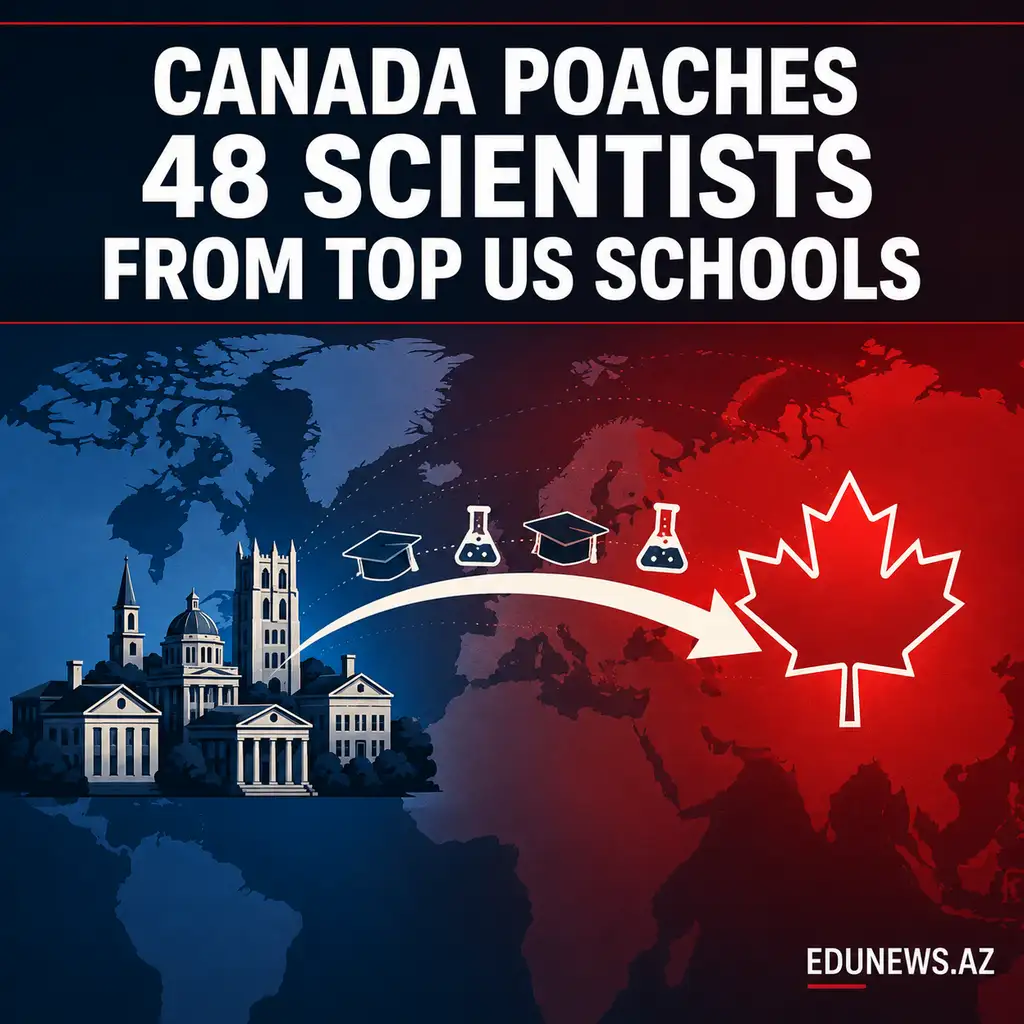
Canada Poaches 48 Scientists From Harvard, MIT and Yale in a Single Announcement — and Calls It Just the Beginning
VANCOUVER — Twenty-one Canadian universities announced Thursday they had hired 64 leading researchers in the first intake of a new national recruitment program — 48 of them lured directly away from elite US institutions including Harvard, MIT, Yale, and Cornell, with the remaining 16 arriving from a dozen other countries. The hiring push is backed by $504 million in federal funding spread over eight years, plus another $37 million earmarked specifically to recruit 63 additional "emerging leaders" over the coming year. This is described as only the first wave.
The timing and framing leave little ambiguity about what's driving it. Industry Minister Mélanie Joly, announcing the recruits at the University of British Columbia in Vancouver, put it directly: "While certain countries are cutting research and turning their back on academic freedom, we're doubling down on science." She didn't need to name which country she meant. The Canada-bound exodus from US institutions began building last year as the Trump administration rolled out policies targeting foreign students, academic freedom, and funding tied to equity-related research — and it has now produced a recruitment haul large enough that even the researchers involved are describing their departures in explicitly political terms, a notable break from a profession that has traditionally stayed out of partisan discourse.
Among the new hires: Peter Caravan, a molecular imaging scientist who left a radiology professorship at Harvard Medical School to join UBC, told the university there was a "personal dimension" to the move — he did his PhD at UBC decades ago before building his career in the US. Kevin Hall, a nutrition scientist who left the US National Institutes of Health after accusing federal officials of censoring his research on ultraprocessed foods, has landed at the University of Ottawa. Philip Zamore, headed to McGill University's medical faculty along with five other new recruits, offered perhaps the starkest justification of the batch: "If scientists don't stand up for truth, no one will."
What makes this moment different from the ordinary churn of academic hiring is the scale and the coordination. This isn't individual universities poaching individual stars — it's a centrally funded, federally coordinated national strategy, and Canada isn't alone in running one. The European Union has launched a $583 million initiative aimed at the same displaced talent pool, and the UK is investing roughly $70 million over five years toward a similar goal. Multiple wealthy democracies are now running simultaneous, well-funded campaigns to absorb researchers stepping away from US institutions — treating America's research funding turmoil not as a crisis to sympathize with from a distance, but as a direct, actionable recruitment opportunity.
Canada's own science establishment has been signaling this shift for months before Thursday's announcement made it concrete. Mona Nemer, Canada's chief science adviser, told CBC earlier this year that university leaders and professors were already reporting a noticeable uptick in interest from scientists working or training in the US, even without hard data yet to quantify it. Quebec's immigration minister, Jean-François Roberge, was even more explicit back in the spring, saying the province was actively recruiting scientific talent wary of what he called "the climate-skeptic directions that the White House is taking," framing the moment simply: "every crisis brings opportunities." Frédéric Bouchard, a philosopher of science at the Université de Montréal who helped author a 2023 federal panel report on Canada's research capacity, has argued the turmoil creates a genuine responsibility for Canada to build "a strong and generous science capacity" rather than simply reacting opportunistically.
Not everyone reads the story the same way, even within Canada. Some commentary responding to the announcement has pushed for more transparency on exactly how the recruitment numbers break down and what specific expertise is being brought in, rather than treating "we out-recruited Harvard" as self-evidently a win without further detail. That's a fair, if secondary, critique — the headline fact remains that a G7 country just publicly, deliberately, and successfully recruited talent away from the three or four most prestigious research universities in the world, funded by government money specifically allocated for that purpose, and said clearly it intends to keep doing it.
For higher education systems well outside North America — Azerbaijan included — the Canada story is worth watching less as an isolated news item and more as an early data point in a larger, still-unfolding realignment: when a dominant research superpower experiences sustained internal disruption to its science funding and academic-freedom environment, other countries with the fiscal capacity to act don't wait politely on the sidelines. They build a national program, put real money behind it, and start making calls. Whether Azerbaijan or any other smaller system has the resources to compete in that specific arena is a separate question — but the strategic lesson on offer, that a rival's institutional weakness can become another country's institutional strength almost overnight if the funding and political will exist, applies well beyond just Canada and the US.