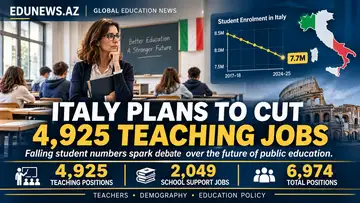

Italy Plans to Cut Nearly 5,000 Teaching Jobs as Student Numbers Fall: A New Challenge for Schools
As Italy faces a declining student population, the government plans to eliminate thousands of teaching positions. Education unions warn that demographic change should be an opportunity to improve classroom conditions, not reduce investment in schools.
By Rasim Abdurahman
Education Editor, Edunews.az
November 8, 2026
Italy Announces Thousands of Planned School Job Cuts
Italy is preparing to reduce the number of teachers and school support staff as the country faces a continued decline in its student population.
Under the Italian government's draft 2027 budget, approved by the Cabinet in October, a total of 6,974 school positions are scheduled to be eliminated from the 2027–2028 academic year.
The planned reductions include:
4,925 teaching positions
2,049 administrative, technical and support staff positions
The decision has triggered criticism from teachers' unions, school principals and opposition politicians, who argue that falling student numbers should create an opportunity to improve education quality rather than justify further reductions in school staffing.
According to Reuters, the government expects the measures to generate savings of approximately €336 million over 2027 and 2028.
Why Is Italy Reducing Its Teaching Workforce?
The main reason behind the planned cuts is Italy's demographic decline.
The country has one of the lowest birth rates in Europe, resulting in fewer children entering the education system.
Official figures show that the number of students enrolled in Italian primary and secondary schools declined from approximately 8.4 million in the 2017–2018 academic year to 7.7 million in 2024–2025.
That represents a reduction of around 700,000 students in seven years.
The government argues that school staffing levels must be adjusted to reflect changing enrolment figures and demographic realities.
However, critics say that fewer students do not automatically mean schools need fewer teachers and support professionals.
Education Unions Warn of Consequences
The proposed reductions have raised concerns among Italy's education community.
School principals and teachers' organisations argue that demographic decline could be used to improve the quality of public education.
With fewer students, schools could potentially introduce smaller classes, provide more individual attention and strengthen support for students who experience learning difficulties.
Instead, critics argue, reducing the number of teachers could make it harder for schools to provide additional educational support and maintain effective teaching conditions.
The Italian Labour Union (UIL) has argued that falling enrolment should be an opportunity to reduce class sizes and improve educational quality.
School leaders have also warned that the consequences may extend beyond classroom teaching, particularly if administrative and technical staff numbers are reduced.
Nearly 15,000 School Positions Could Be Eliminated Over Three Years
The latest proposal follows earlier staffing reductions introduced under Italy's 2025 budget.
Those measures included:
5,660 teaching positions scheduled for reduction;
2,174 non-teaching positions scheduled for reduction.
Combined with the latest draft budget, the total number of planned reductions could reach approximately 14,808 school positions across the three school years from 2025–2026 to 2027–2028.
This includes more than 10,500 teaching positions and over 4,200 administrative, technical and support positions.
The scale of the proposed reductions has intensified debate about how Italy should respond to its shrinking school-age population.
Is Italy Facing a Teacher Shortage?
The situation is more complicated than a simple shortage of teachers.
Italy's declining student population has changed the overall balance between teachers and pupils. A parliamentary document published on November 4 cited an analysis by the Italian Observatory on Public Accounts, which found that between 2015 and 2024, the number of students in state schools decreased by 10%, while the number of teachers increased by 16%.
The document also noted that Italy's teacher-to-student ratio was above both the OECD and European Union averages across all levels of education.
However, this national picture does not necessarily mean every school has enough teachers.
Recruitment difficulties, temporary contracts, regional differences and the distribution of teachers across different subjects can create staffing problems even when the overall national workforce is relatively large.
This distinction is important: Italy's current debate concerns how teachers are recruited, distributed and funded, as well as how the education system should adapt to demographic change.
A Demographic Crisis That Could Reshape Education
Italy's experience highlights a challenge that other countries with ageing populations and declining birth rates may eventually face.
When fewer children enter schools, governments must decide how to reorganise education systems without compromising quality.
Possible approaches include:
Reducing class sizes rather than simply cutting teaching positions;
Strengthening individual learning support;
Investing in teacher training and professional development;
Improving support for students with special educational needs;
Reorganising schools while protecting access in rural and declining-population areas.
The central challenge is ensuring that demographic change does not result in weaker educational opportunities.
Edunews Analysis
Italy's planned school staffing reductions raise an important question for education policymakers around the world: should a decline in student numbers lead to lower education spending, or should it create an opportunity to improve the learning environment?
Fewer students could allow schools to provide more individual attention, smaller classes and stronger academic support.
However, achieving these improvements requires careful planning and sustained investment.
The Italian debate also demonstrates why national teacher statistics should be interpreted carefully. A country may have a relatively high overall number of teachers per student while still experiencing recruitment and distribution difficulties in particular regions or subjects.
The real challenge is not simply determining how many teachers a country needs. It is ensuring that every student has access to a qualified teacher, effective support and a high-quality learning environment.
Sources
Reuters — As Demographic Crisis Bites, Italy Cuts School Staff — November 2, 2026.
The Straits Times — As Demographic Crisis Bites, Italy Cuts School Staff — November 2, 2026.
Italian Chamber of Deputies — Parliamentary Documents, November 4, 2026 — parliamentary questions concerning school staffing reductions and teacher workforce data.
Seoul Economic Daily — Italy Moves to Cut 7,000 School Jobs as Student Numbers Fall — November 7, 2026.
Editorial Note: The proposed staffing reductions are part of Italy's draft 2027 budget and remain subject to parliamentary consideration. The article distinguishes between the overall national teacher-to-student ratio and potential local recruitment or distribution difficulties.