AI Is Transforming Education: UNESCO Calls for Human-Centred Learning
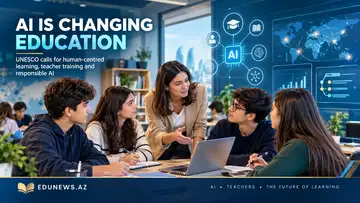
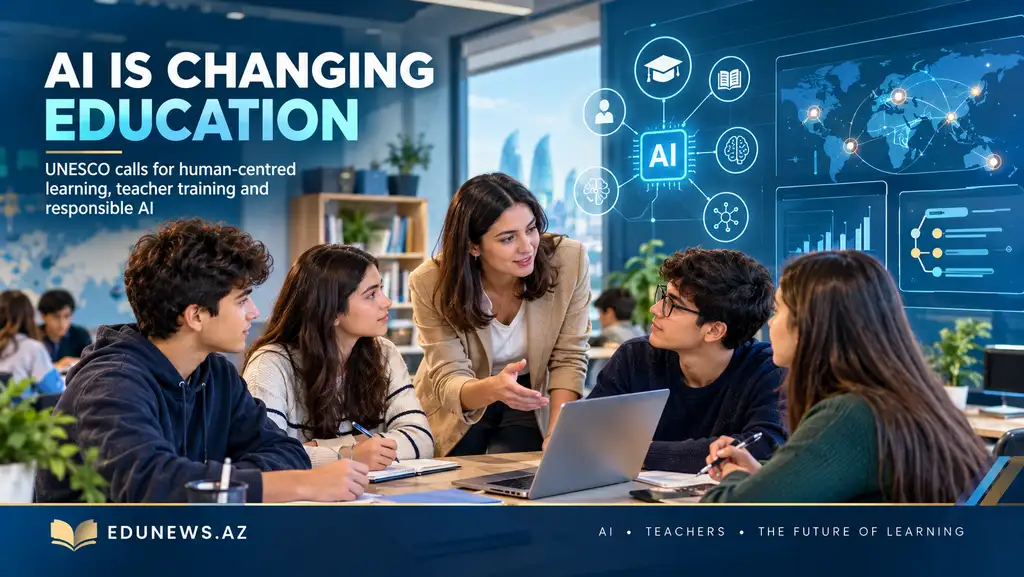
UNESCO’s latest initiatives highlight the importance of human thinking, teacher training and responsible technology use as artificial intelligence becomes increasingly integrated into education.
Author: Rasim Abdurahman
Education Editor, Edunews.az
Date: October 24, 2026
Artificial Intelligence Is Reshaping Education
The rapid adoption of artificial intelligence in education is transforming everything from teachers’ professional responsibilities to the ways students learn.
UNESCO’s initiatives and discussions in 2026 highlight that while AI creates new opportunities for education, its integration must protect human thinking, teachers’ professional roles and students’ rights.
According to UNESCO, during Digital Learning Week in Paris on September 8, representatives from more than 25 countries and education ministers called for education to remain a human right and a common public good in the age of AI.
The event brought together more than 1,500 participants, with thousands more joining online.
The declaration emphasized public responsibility, teachers’ decision-making authority and the protection of students’ rights as key priorities for integrating AI into education.
Source: UNESCO – Education Ministers Call for Education to Remain a Common Good in the Age of AI
UNESCO Survey: Academics Report Growing AI Use Among Students
Findings from UNESCO’s second annual higher education survey, presented during Digital Learning Week, indicate that generative AI has become increasingly common in students’ academic activities.
According to the survey:
93% of participating academics believe students use generative AI to complete assignments.
63% report observing a decline in students’ cognitive skills.
These findings reflect concerns among academics about the impact of AI on education. However, the survey does not establish that AI use directly causes a decline in students’ thinking abilities. Instead, the figures represent academics’ observations and perceptions.
The survey also found that most respondents considered AI use acceptable for certain academic tasks when appropriately disclosed.
Less than 1% supported a complete ban on AI, while approximately 2% supported unrestricted use.
The findings highlight the growing importance of clear institutional policies, academic integrity and responsible AI use in universities.
Source: UNESCO – Digital Learning Week 2026
AI Should Support Teachers, Not Replace Them
UNESCO’s approach emphasizes that artificial intelligence should be used as a tool to support teachers’ professional activities rather than replace them.
Teachers can use AI to assist with preparing learning materials, analysing information and identifying individual learning needs.
However, educational decisions, student assessment and guidance throughout the learning process should remain connected to teachers’ professional judgement.
UNESCO’s 2026 declaration highlights the importance of involving teachers in decisions about selecting and implementing AI systems, as well as strengthening their professional preparation for emerging technologies.
The organization also emphasizes that AI systems should be appropriate for students’ ages and developmental needs.
Educational institutions should pay particular attention to data protection, safety and evaluating whether AI tools deliver meaningful educational benefits.
Source: UNESCO – Artificial Intelligence in Education
Teacher AI Skills Are Becoming a New Priority
On September 28, 2026, UNESCO’s Institute for Information Technologies in Education (UNESCO IITE) published an analytical report titled Teacher AI Competency Frameworks.
The report provides recommendations for policymakers on developing national AI competency frameworks for teachers and supporting continuous professional development.
According to UNESCO IITE’s October 12 update, the organization and UNESCO-ICHEI have also introduced short, self-paced online courses in Russian on generative AI for higher education teachers.
These initiatives aim to help educators develop more than basic technology skills.
Teachers also need to understand how to evaluate AI-generated information, recognize its limitations and apply it responsibly in educational settings.
Source: UNESCO IITE – Artificial Intelligence in Education
AI in Technical and Vocational Education: Preparing Students for New Skills
UNESCO’s practical guide, Integrating AI in TVET: A Practical Guide for Institutions, published on October 21, 2026, examines how artificial intelligence can be integrated into technical and vocational education and training.
The guide explores several areas:
Updating curricula and assessment methods;
Developing AI competencies among teachers and students;
Promoting ethical and responsible AI use;
Evaluating AI applications in safety-critical occupations;
Establishing institutional AI strategies and governance mechanisms.
UNESCO argues that these approaches can help education providers respond to changing labour market requirements and improve the relevance of vocational education.
Source: UNESCO-UNEVOC – Integrating AI in TVET
Azerbaijan Expands Cooperation on AI in Education
Azerbaijan is also expanding cooperation on integrating artificial intelligence into its education system.
According to the Ministry of Science and Education of Azerbaijan, a three-year Memorandum of Understanding between the ministry and OpenAI was signed on September 22, 2026, to expand the use of AI technologies in education.
The cooperation includes plans to:
Organize AI training for teachers and education professionals;
Develop education management systems using AI technologies in mathematics, science and reading;
Support teachers in lesson preparation and student assessment;
Develop methodological approaches to safe and responsible AI use in educational institutions;
Build local capacity for AI training.
The ministry stated that this was the second Memorandum of Understanding signed between the parties.
Source: Azerbaijan Ministry of Science and Education – Cooperation with OpenAI
Edunews Analysis
Artificial intelligence in education is not simply a question of introducing new technology.
The central issue is how AI affects learning, changes teachers’ responsibilities and influences students’ ability to think independently.
UNESCO’s recent initiatives focus less on banning AI and more on ensuring that its use is purposeful, responsible and properly governed.
For educational institutions, the challenge is not simply adding AI tools to classrooms. It is determining whether those tools improve actual learning outcomes.
AI should do more than provide students with ready-made answers. It should also support their ability to ask questions, investigate information, compare evidence and develop independent conclusions.
Conclusion: Artificial intelligence will play an increasingly important role in the future of education. However, its success should not be measured by how widely the technology is used, but by how effectively it helps teachers and students become more capable, independent and responsible learners.
Sources
UNESCO – Education Ministers Call for Education to Remain a Common Good in the Age of AI — September 2026.
UNESCO – Artificial Intelligence in Education — AI policy, human-centred approaches and competency frameworks.
UNESCO IITE – AI in Education — Teacher competencies and AI training initiatives.
UNESCO-UNEVOC – Integrating AI in TVET: A Practical Guide for Institutions — October 21, 2026.
Azerbaijan Ministry of Science and Education – Cooperation with OpenAI — September 22, 2026.
Editorial Note: This article is based on publicly available information from UNESCO, UNESCO IITE, UNESCO-UNEVOC and the Ministry of Science and Education of Azerbaijan. Survey findings reflect academics’ observations and should not be interpreted as experimental evidence establishing a causal relationship between AI use and declining cognitive skills.