
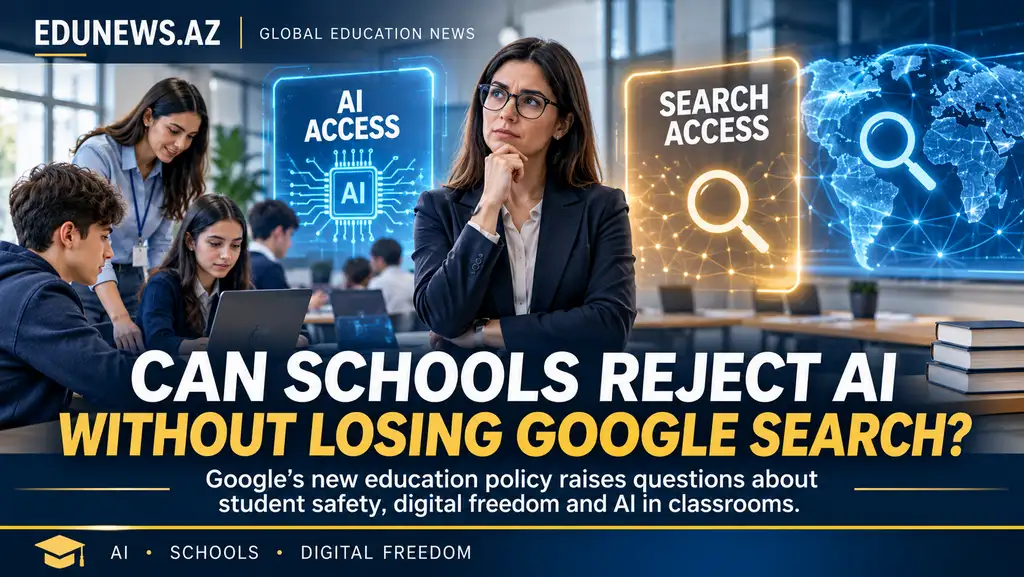
Google’s New AI Policy Raises Questions: Can Schools Reject AI Without Losing Access to Search?
The technology giant is giving schools more control over AI tools, but a controversial connection between artificial intelligence and Google Search is raising concerns among educators and policymakers.
By Rasim Abdurahman
Education Editor, Edunews.az
November 8, 2026
Google Introduces New AI Controls for Schools
Google has announced changes to how its artificial intelligence tools are made available to school students, giving administrators greater control over which products can be used in classrooms.
The announcement, published on November 3, comes amid growing concerns about the impact of generative AI on children's learning, critical thinking and online safety.
Under the updated approach, school administrators will be able to enable or disable individual Google products, including Gemini, Gemini Notebook and Google Search, for K-12 student accounts.
According to Google, these tools will be switched off by default until school administrators explicitly activate them.
However, a significant concern has emerged: because Google's Search service is increasingly integrated with AI, schools that choose to reject AI altogether could also lose access to Google Search.
The issue was highlighted in a November 5 report by The Associated Press, bringing the debate over technology companies' influence in education back into focus.
Why Is Google Changing Its Approach?
Google's announcement follows criticism from educators, parents and child development experts after the company enabled its Gemini chatbot for many school-age users of Google Classroom in August.
The decision raised questions about whether students were adequately protected and whether AI tools were being introduced into classrooms faster than schools could develop appropriate policies.
In its November 3 announcement, Google said it was introducing Guided Learning features to help students work through problems instead of simply receiving answers.
The company describes Guided Learning as an approach that encourages students to think critically through questions, explanations and step-by-step guidance.
Google says the feature is designed to support active learning and more productive study habits.
The company also stated that administrators would have greater control over which AI products are available to students.
Source: Google – Designing Responsible AI for Learning
Educators Raise Concerns About AI and Student Learning
Although AI tools can help students understand complex subjects, educators remain concerned about their potential misuse.
Generative AI can produce essays, solve mathematical problems and summarize academic materials within seconds. While these capabilities may support learning, they can also encourage students to rely on ready-made answers instead of developing their own reasoning skills.
Another concern is the effect of early and uncontrolled exposure to AI on children's development, privacy and ability to evaluate information independently.
The Associated Press reported that New York City and Los Angeles had introduced temporary restrictions on generative AI tools in elementary and middle schools while reviewing safety concerns and developing policies.
These developments reflect a wider debate: should schools embrace AI as an essential educational tool, or should they limit its use until its long-term effects are better understood?
Critics Question the Link Between AI and Google Search
One of the most controversial aspects of Google's announcement is the relationship between access to AI and access to its search engine.
According to the Associated Press, because AI is integrated into Google Search, schools that opt out of AI altogether could also lose access to Google Search.
The announcement attracted criticism from educators and policymakers.
Former Federal Trade Commission Chair Lina Khan argued that linking search access to AI adoption could put pressure on schools to accept technology they might otherwise choose to restrict.
Children's advocacy representatives also questioned whether the approach gives schools enough freedom to protect students from unwanted AI exposure.
The debate is no longer limited to whether AI belongs in classrooms. It increasingly concerns who controls the technology, how schools make decisions and whether educational institutions can maintain meaningful independence from major technology providers.
Source: Associated Press – Google Will Cut Off Search Access for Students at Schools That Reject AI
What Does This Mean for the Future of Education?
Google says its goal is to make AI more useful for learning while giving schools control over how its products are used.
However, the controversy highlights several challenges that education systems around the world must address:
Student protection: How can schools ensure that AI tools are appropriate for children's ages and learning needs?
Critical thinking: How can educators prevent students from becoming overly dependent on AI-generated answers?
Digital independence: Should schools be able to reject AI without losing access to other essential digital services?
Teacher involvement: How much influence should teachers and school administrators have over the technology used in classrooms?
Data privacy: What safeguards should protect students' personal information when using AI-powered platforms?
These questions are becoming increasingly important as technology companies expand their presence in education.
Edunews Analysis
Google's announcement illustrates a growing tension in modern education: schools want the benefits of digital technology, but they also need the freedom to decide how and when it is introduced.
AI can support personalized learning, provide additional explanations and help teachers manage educational activities. Yet these benefits should not come at the expense of independent thinking, student safety or institutional autonomy.
The central question is not whether artificial intelligence will become part of education. It already is.
The more important question is whether schools will have enough control to determine the conditions under which students use it.
Education should benefit from technology, not become dependent on a single technology provider.
Sources
The Associated Press — Google Will Cut Off Search Access for Students at Schools That Reject AI, November 5, 2026.
Google Official Blog — Designing Responsible AI for Learning, November 3, 2026.
Editorial Note: This article is based on Google's official announcement and reporting by The Associated Press. Statements concerning criticism of Google's policy are attributed to the individuals and organizations that made them. The article does not suggest that all schools have lost access to Google Search or that the new policy has already been implemented everywhere.