
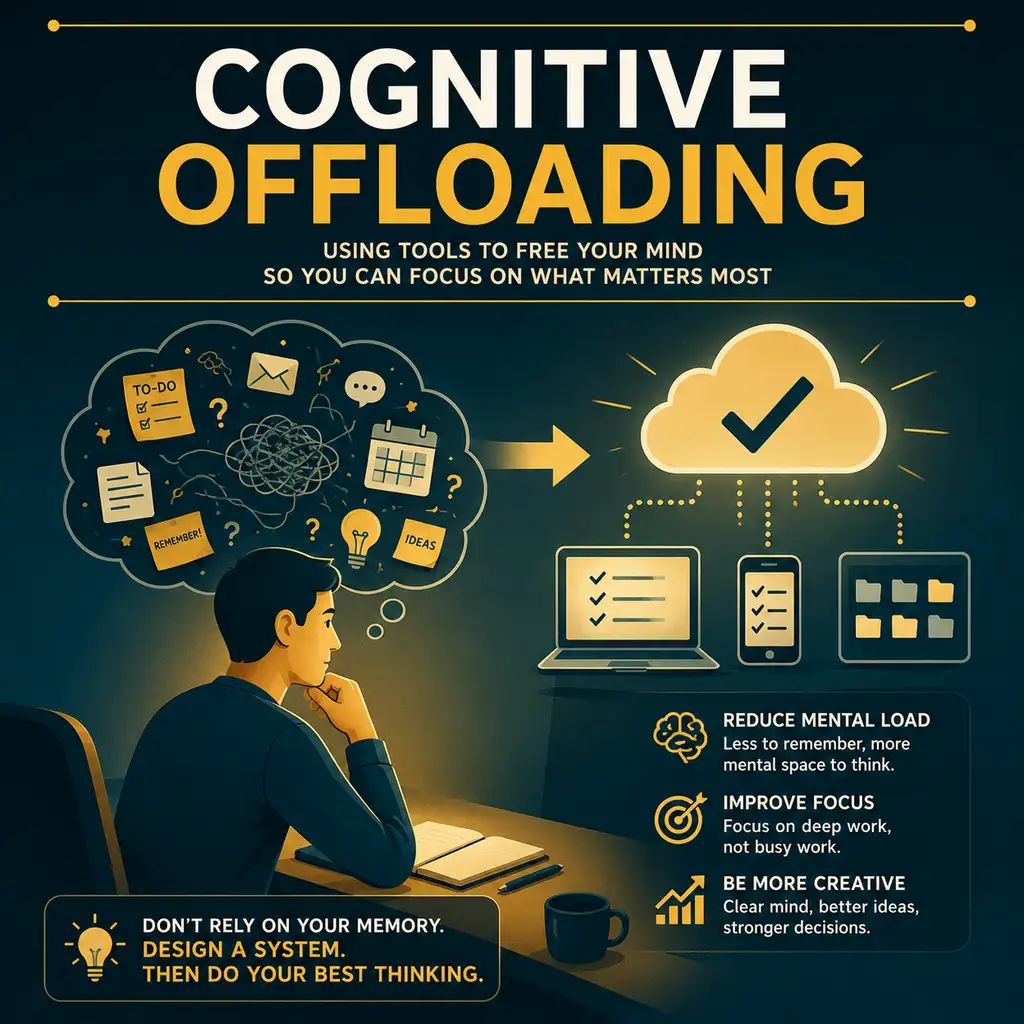
Cognitive Offloading: The Real Reason "Just Ask ChatGPT" Might Be Costing You More Than It Saves
Here's a small, honest experiment. Try to remember the last time you actually worked through a hard problem — a tricky email, a tough decision, a piece of writing that wasn't obvious — without opening a chatbot first. If you had to think for a second before answering, you're not alone, and that pause is exactly what this article is about.
Researchers have a name for what's happening, and it's older than ChatGPT by decades: cognitive offloading. It simply means using something outside your own brain to reduce the mental work a task would otherwise require. You've been doing it your whole life — a shopping list is cognitive offloading. So is a calculator, a GPS, a search engine. None of that is new or alarming on its own. What's new is the scale, the speed, and — according to a growing pile of 2026 research — the specific kind of thinking that generative AI lets us skip.
The "Doom Loop" Brookings Is Warning About
A Brookings Institution report published this year didn't mince words: the risks of AI in schools currently outweigh the benefits, and the mechanism driving that imbalance is a kind of feedback loop. Students start using AI. They discover it gives good answers. Because it works, they let it do more of the thinking. The more it does, the less practiced their own reasoning becomes — and the less practiced it becomes, the more they need the AI next time. Rebecca Winthrop, one of the report's authors, described the endpoint bluntly: kids using generative AI that hands them the answer "are not thinking for themselves. They're not learning to parse truth from fiction. They're not learning to understand what makes a good argument."
What makes this land differently than the usual generational technology panic — the ones we heard about calculators, then Google, then Wikipedia — is that the kids themselves seem to sense it. In one 2026 study, 65% of surveyed students said they were worried the trend would lead to cognitive decline. One student summed up the whole appeal, and the whole problem, in a single sentence researchers keep quoting back: "It's easy. You don't need to [use] your brain."
The Study That Actually Measured It
Anecdotes are easy to dismiss. Controlled experiments are harder to. In 2026, Cambridge University Press & Assessment teamed up with Microsoft Research to run exactly the kind of study this debate needed: a randomized controlled trial with 405 secondary school students, ages 14-15, across seven schools in England. Some students took notes by hand while studying history passages. Others relied on AI assistance instead. Three days later, everyone was tested on what they remembered.
Handwritten notes beat AI-only assistance on every single measure — retention, comprehension, and free recall. Not by a small margin in one category. Across the board. The researchers' warning about what happens next is the part that should actually worry you: "If sustained AI use erodes the motivation and persistence that drive long-term learning, these effects will accumulate over years, and by the time they are visible, they will be difficult to reverse." In other words, the cost of offloading isn't the missed answer today. It's the erosion you don't notice happening — right up until you do.
Before You Panic: It's Genuinely Not That Simple
Here's the twist that rarely survives into a headline, and it's important enough that leaving it out would make this article dishonest. A meta-analysis covering 51 separate studies — most involving students from secondary school through university — found that incorporating ChatGPT into structured educational contexts produced large improvements in learning performance, not declines. Young adults using AI in a deliberate, scaffolded way showed higher academic self-efficacy and lower anxiety, not the opposite.
The distinction researchers keep landing on isn't "AI good" versus "AI bad." It's mode of use. AI that replaces your thinking — write this for me, solve this for me, just tell me the answer — reliably correlates with the offloading harms described above. AI used as a structured support after a genuine first attempt — check my reasoning, explain this differently, quiz me on what I just tried to learn — correlates with the opposite outcome entirely. Same tool. Opposite result. The variable isn't the technology. It's the sequence: did you think first, or did you skip straight to the answer?
So What Do You Actually Do With This?
Not "delete ChatGPT." That ship has sailed, and pretending otherwise helps nobody — least of all students who'll graduate into workplaces where AI fluency is now a baseline expectation, not an optional skill. The more honest, useful takeaway is a simple sequencing rule, one that shows up again and again across the research whether it's framed for a 15-year-old or a working adult: attempt first, ask second. Struggle with the problem — genuinely struggle, past the point where it's comfortable — before you open the chatbot. Use AI to check your reasoning rather than to generate it from scratch. Treat the moment of difficulty not as an obstacle to route around, but as the actual mechanism by which your brain gets better at the next hard thing.
It's a small discipline. It's also, based on everything researchers are finding right now, the entire difference between AI making you sharper and AI quietly, patiently making you dependent on it.