
A Kid Clicking Happily Through an App Isn't Learning, America's Top Psychology Body Says — and AI Makes the Illusion Worse
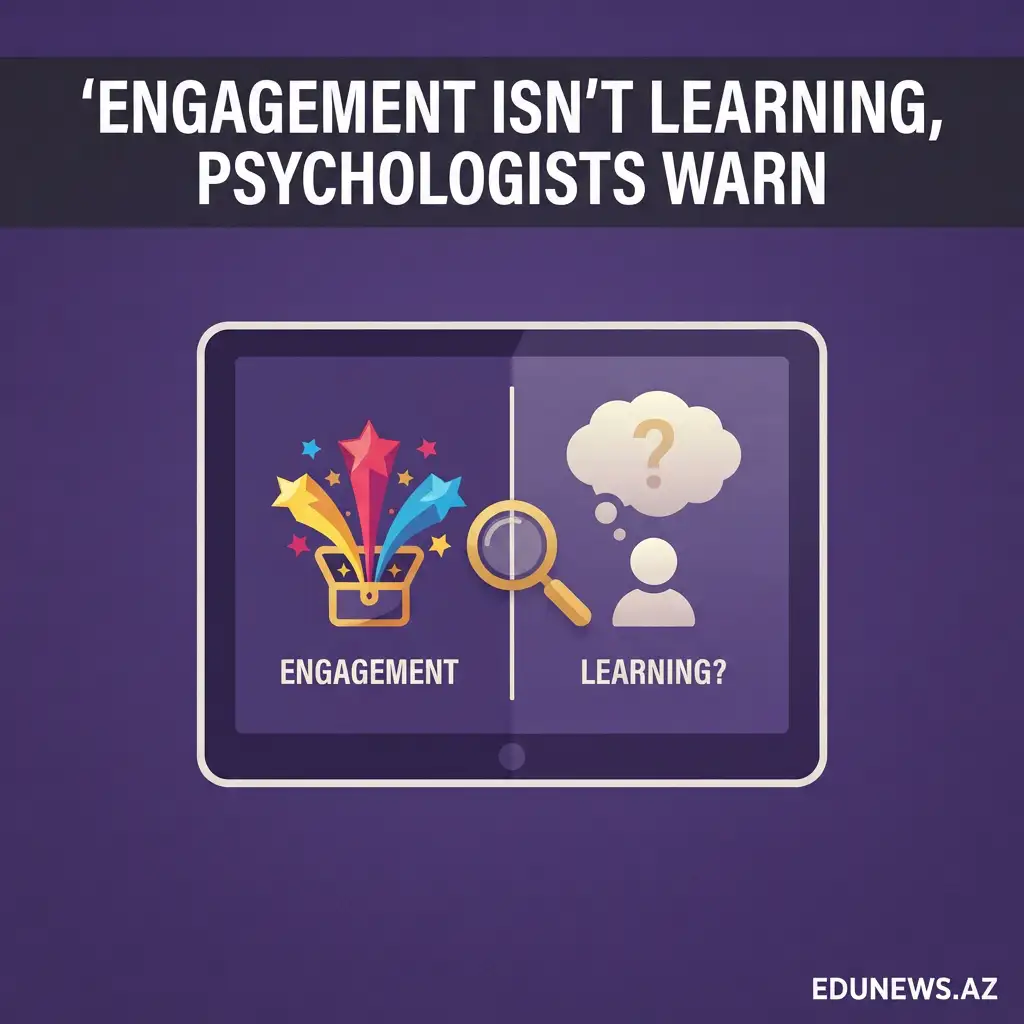
WASHINGTON — The American Psychological Association published its "Expert Report on Children's and Adolescents' Learning with Educational Technology" on September 3, delivering a message that cuts directly against how most schools and parents currently judge whether an app is working: a child clicking frequently, responding to animations, or collecting in-app rewards is not evidence that learning is happening. "The real test of learning happens after the app is closed," the report states — a line that reframes engagement metrics, the primary way most EdTech products currently prove their value to schools and parents, as fundamentally the wrong thing to be measuring.
The report, compiled by a multidisciplinary panel of cognitive and educational psychologists, learning scientists, and ed-tech researchers, synthesizes evidence across educational apps, games, intelligent tutoring systems, generative AI tools, and digital learning platforms used by children and adolescents aged 5 to 18. Its central argument is that a student's ability to apply what they've learned outside the app — in a different context, on a different kind of problem, without the scaffolding the software provided — is a far stronger signal of genuine learning than time-on-app, completion rates, or how enjoyable a student found the experience. Nicole Barnes, APA's executive lead psychologist for education, offered a concrete diagnostic test any teacher or parent can run themselves: "Close the app. Ask the student to explain. Ask the student to solve a new problem, or to apply the skill in a different setting." If a student can't do that, Barnes argues, whatever success or engagement the app was showing may simply reflect that the student became skilled at navigating that specific platform — not that they learned the underlying material.
Generative AI tools receive particular scrutiny in the report, and the warning here connects directly to research covered extensively on this site over recent months: AI tools, the APA says, pose a distinct risk because they can improve a student's immediate performance — a polished essay, a correctly solved problem — without building the underlying knowledge or skill that performance is supposed to represent. That's essentially the same mechanism this site examined in July's coverage of "cognitive offloading" research and again in September's reporting on studies showing AI tends to grade essays higher than human teachers do, rewarding surface-level linguistic polish over demonstrated understanding. The APA report adds institutional, professional-association weight to what had previously been a more scattered collection of individual academic studies: multiple independent lines of psychological and educational research are now converging on the same underlying concern, using different methods and different research teams, which is generally how a field moves from "some researchers are worried about this" to "this is now regarded as an established risk."
Notably, the report stops well short of endorsing the blanket screen-time bans and device restrictions that have spread rapidly across individual US states and districts this year — a pattern this site has tracked closely, from "bell-to-bell" phone policies to state legislatures debating restrictions. Barnes was explicit that the report's origins actually predate the current generative-AI debate entirely, tracing back to her own experience during pandemic-era remote learning in 2020, watching over her son's shoulder as he played what turned out to be an assigned "homework" game that, on inspection, wasn't producing anything resembling the learning it had presumably been marketed as delivering. That origin story matters for how the report positions its recommendations: rather than treating all screen time as interchangeable and inherently risky, APA argues the responsibility for proving a product actually works belongs to the companies building it and the schools purchasing it — shifting the burden of evidence onto vendors rather than asking families to simply minimize exposure to technology categorically.
The ten recommendations spanning families, educators, policymakers, and developers converge on a few consistent themes: prioritize tools that build durable, transferable knowledge rather than flashy engagement features; make meaningful adult involvement part of how any EdTech product actually gets implemented in a classroom or at home, rather than treating the software as a self-sufficient replacement for instruction; and invest in research capacity that can keep pace with how quickly the underlying technology keeps changing, since a study evaluating one generation of AI tools may say little about the next one arriving eighteen months later. That research-velocity problem is a real, structural constraint — much of the specific evidence base APA had to draw on for this report predates the current wave of generative AI tools by design, since rigorous longitudinal research on any new technology's actual learning outcomes necessarily takes years to produce, while the technology itself changes on a cycle measured in months.
The report lands in a US policy environment that has, this same year, alternated between contradictory signals: the same federal education officials publicly urging districts to judge classroom technology by evidence of results rather than screen time alone — guidance covered previously on this site — are operating in the same national conversation as Google's rapid, largely unilateral expansion of Gemini access to K-12 students, OpenAI's newly launched "ChatGPT for Teens," and dozens of individual state legislatures independently drafting AI-in-schools rules with little coordination between them. APA's report doesn't resolve that fragmentation on its own, but it does offer something the broader policy conversation has mostly lacked so far: a single, evidence-synthesizing reference point that both AI skeptics and AI enthusiasts in the education debate can point to, since its core finding — engagement is not learning, and proof of actual learning outcomes is the responsibility of whoever is selling or deploying the tool — cuts against both uncritical EdTech adoption and simple blanket restriction in equal measure.