Azerbaijan Posts the Second-Biggest Improvement Worldwide in Today's PISA 2025 Results — But Its Own Minister Is Urging Caution
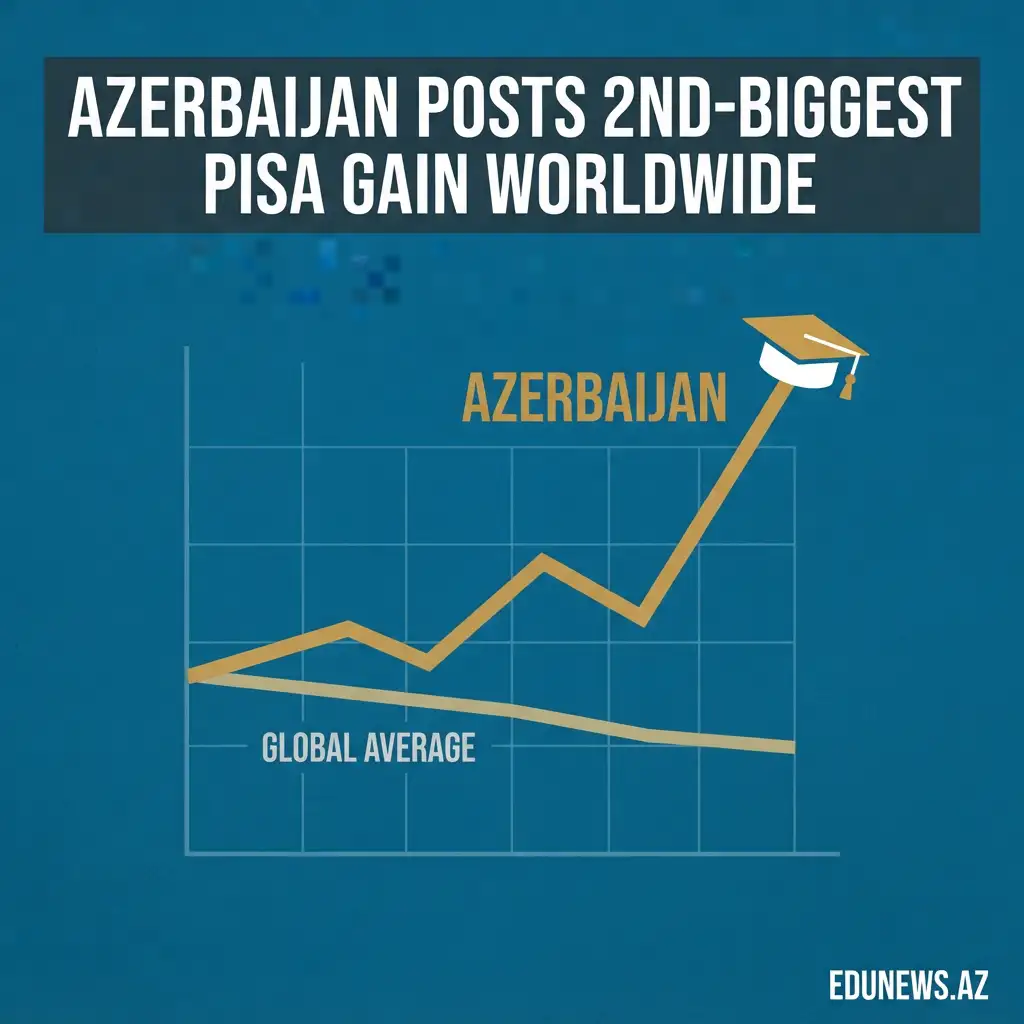
PARIS/BAKU — The OECD released the first results of PISA 2025 today, and Azerbaijan's numbers stand out sharply from the global picture: while the OECD average posted its lowest recorded performance yet in science, reading, and mathematics since the assessment began in 2000, Azerbaijan ranked as the second-highest-improving education system among all participating countries and economies. More than 7,432 Azerbaijani 15-year-olds took part in this cycle, part of a global sample of over 760,000 students across 91 countries and economies representing roughly 33 million teenagers.
The scale of the global decline this cycle gives Azerbaijan's improvement extra weight by contrast. Across 23 OECD countries tracked over time, reading has been sliding since it peaked around 2012, science has eroded more gradually over the past decade, and mathematics has fallen especially sharply since 2018 — meaning PISA 2025 landed at the worst average point in the assessment's 25-year history at almost exactly the moment Azerbaijan posted one of the strongest improvement trajectories in the entire dataset. Science remained PISA's focal domain this cycle, alongside reading and mathematics as core domains, with a newly introduced computational problem-solving assessment testing how well 15-year-olds can use modelling and programming tools to build and design digital solutions — a skill area roughly two-thirds of OECD students managed to clear at a baseline proficient level, with about a quarter reaching the two highest tiers.
Azerbaijan's Minister of Science and Education, Emin Amrullayev, presented the results today with a notably measured tone that avoided treating the headline ranking as a finished victory lap. "The significance and implications of the announced results for our education system will become clearer over time," Amrullayev said, adding a specific timeline that reframes how the numbers should be read: "We will feel the impact of the PISA results more clearly in 10-15 years." That framing — explicitly rejecting a same-day triumphalist reading of a single test cycle in favor of a decade-plus horizon — lines up closely with research covered previously on this site about how PISA scores actually function: they're statistically modeled estimates built from partial, rotated test items and complex sampling weights, not simple averages, and single-cycle jumps can reflect real underlying improvement, statistical noise, or some mix of both that only becomes clear once multiple cycles are compared against each other.
There's a structural detail in how Azerbaijan appears in PISA's own data tables worth noting for context: OECD reporting has previously listed "Baku (Azerbaijan)" as a distinct participating entity in some prior cycles, a pattern PISA also uses for China's wealthiest provinces (reported as "Beijing, Shanghai, Jiangsu and Zhejiang" rather than all of China) and other sub-national or city-specific samples — the exact methodological wrinkle explored in depth on this site's earlier PISA explainer, where Shanghai's historically top-ranked results drew sustained academic criticism for excluding migrant children and the vast majority of China's less-wealthy provinces. Whether this cycle's Azerbaijan sample reflects a genuinely nationally representative cohort or carries similar sub-national considerations is a detail worth Azerbaijani education researchers and journalists confirming directly against the OECD's full technical documentation, released alongside today's headline results, rather than assuming from the topline "second-highest improvement" framing alone.
This cycle's top performers globally were led by the Chinese jurisdictions of Beijing, Shanghai, Jiangsu and Zhejiang together with Singapore, with Macao, Singapore, and the same Chinese provinces posting the highest mean scores recorded — 572, 563, and 560 points respectively. Estonia, Japan, Korea, Macao, Chinese Taipei, and the United Kingdom rounded out the group of consistently strong performers this cycle. Azerbaijan's story in today's release isn't about cracking that top tier — it's about direction and speed of movement rather than absolute position, a genuinely different and, by most education economists' framing, more useful signal for a developing education system to chase than trying to leapfrog directly into contention with Singapore or Beijing on raw score alone.
For Azerbaijan's education policy conversation specifically, today's release arrives at a moment already thick with related developments this site has covered throughout the year: a new financing model covering 70% of some students' tuition, expanded doctoral specialties, a Ministry decision to integrate rather than isolate AI instruction in schools, and — perhaps most relevant of all to how today's PISA news should be read — a live domestic debate over whether Azerbaijan's own State Examination Center should begin incorporating PISA-style applied-reasoning questions into its national exams, a proposal reported on this site's sister coverage just days before today's results landed. If that shift moves forward, today's PISA release won't just be a one-off international comparison — it will become a direct reference point for how Azerbaijan redesigns its own domestic testing in the years ahead, making Minister Amrullayev's 10-to-15-year framing look less like a rhetorical hedge and more like an accurate description of how long this specific policy feedback loop actually takes to complete.