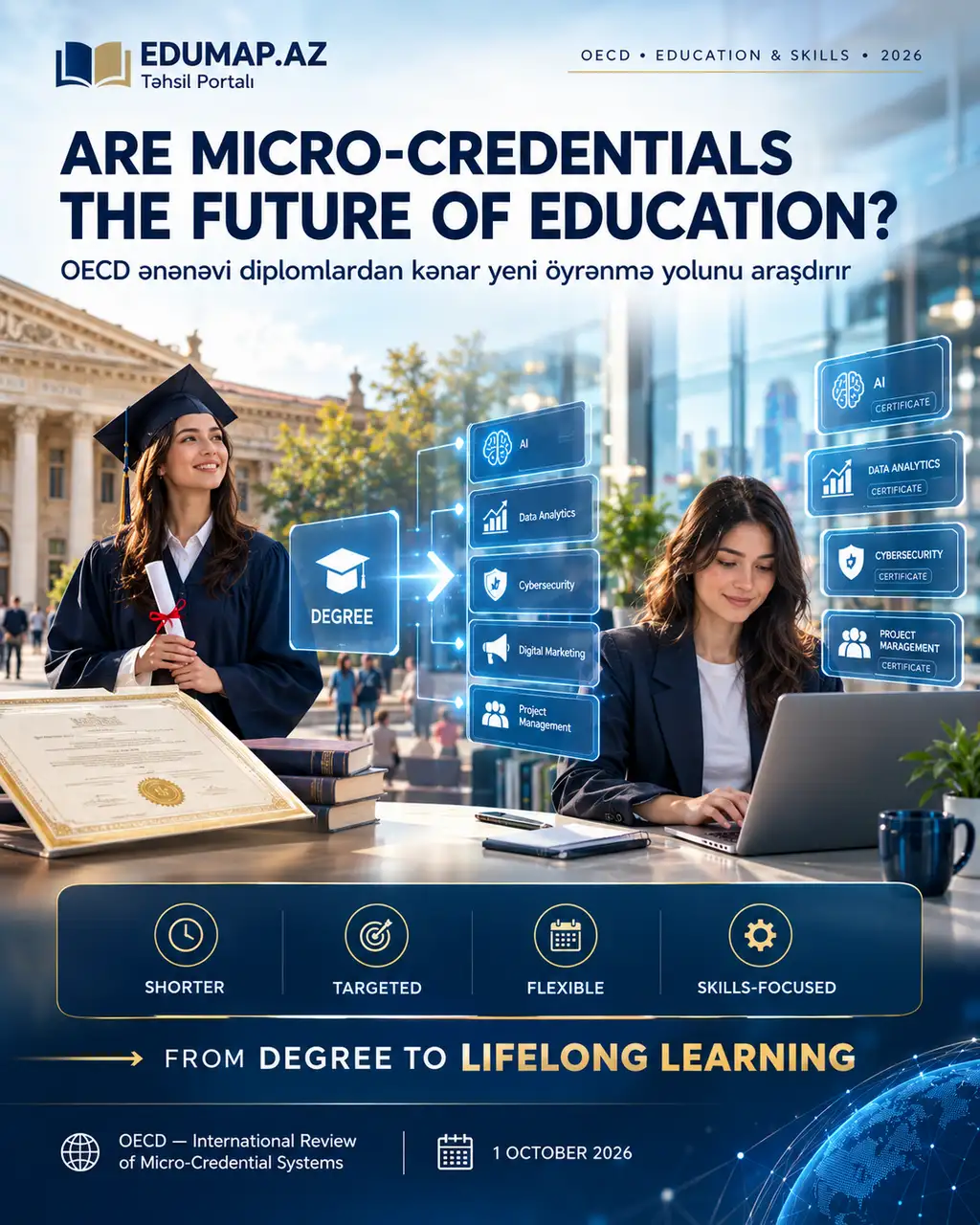
Are Micro-Credentials the Future of Education? OECD Examines a New Path Beyond Traditional Degrees
A new OECD review examines how short, flexible learning opportunities could reshape lifelong learning — while warning that micro-credentials need quality standards, recognition and stronger links to labour-market needs.
By Rasim Abdurahman
Education Editor, Edunews.az
October 6, 2026
For decades, a university degree has been one of the strongest signals of professional preparation.
But the labour market is changing faster than ever.
Artificial intelligence, digitalisation, automation and emerging technologies are creating new skills while making some existing skills less relevant. For many workers, completing a degree at the beginning of their career may no longer be enough to remain competitive throughout their working lives.
This is where micro-credentials are gaining attention.
These shorter, targeted learning opportunities are designed to help people acquire or demonstrate specific knowledge, skills and competencies without necessarily completing a full degree programme.
OECD: Micro-credentials are expanding
On October 1, 2026, the OECD published its International Review of Micro-Credential Systems: From Fragmentation to Alignment.
The report examines how countries are attempting to build more coherent micro-credential systems and argues that these programmes can support upskilling, reskilling and lifelong learning.
A micro-credential can focus on a specific skill rather than an entire academic discipline.
For example, someone with a degree in economics could take a short, assessed programme in data analytics, artificial intelligence, project management or digital marketing rather than returning to university for another multi-year degree.
This flexibility could become increasingly important as skill requirements change.
Are micro-credentials replacing university degrees?
Not necessarily.
One of the most important points in the OECD's work is that micro-credentials should not automatically be viewed as substitutes for traditional qualifications.
Instead, they can complement degrees and other formal qualifications.
A bachelor's or master's degree can provide broad academic and professional preparation, while a micro-credential can demonstrate a more specific and recently acquired skill.
This distinction is particularly important in regulated professions such as medicine, law and teaching, where formal qualifications remain essential.
However, in rapidly changing sectors, employers may increasingly want evidence of specific technical or professional competencies in addition to a degree.
The problem: too many certificates, too little trust
The rapid expansion of micro-credentials also creates a challenge.
Not every short course or online certificate has the same value.
If different institutions and countries use different definitions, standards and assessment methods, employers may struggle to understand what a particular credential actually represents.
The OECD warns that fragmented systems, weak quality assurance and limited links to labour-market needs can make micro-credentials difficult to recognise and navigate.
The future question may therefore not simply be:
“Which certificate does this person have?”
Instead, employers may increasingly ask:
“What skill does this credential actually prove?”
OECD calls for more coherent systems
The OECD review argues that micro-credentials need to become part of a more structured lifelong-learning ecosystem.
Countries need clearer answers to fundamental questions:
What exactly qualifies as a micro-credential?
What level does it represent?
What learning outcomes should it demonstrate?
How should learning be assessed?
Who is allowed to issue the credential?
How is quality assured?
Will employers recognise it?
Can it contribute towards a larger qualification?
The OECD's comparative analysis focuses particularly on Australia, Estonia, Finland and Ireland, while drawing on international examples from other countries.
Universities could become lifelong learning partners
Micro-credentials could also change the role of universities.
Higher education institutions can offer micro-credentials as standalone learning opportunities or integrate them into larger programmes.
This creates a potential shift from the traditional model of:
“Study for several years, graduate and leave.”
towards:
“Study, graduate, return, update your skills and continue learning throughout your career.”
A graduate could, for example, return to a university several years after completing a degree to obtain a focused credential in AI, cybersecurity, data analytics or another emerging field.
The university therefore becomes not only a place for initial education, but also a potential lifelong learning partner.
Employers will play a critical role
Micro-credentials cannot succeed through education providers alone.
Employers need to understand and trust them.
If companies do not know what a credential represents, its value in the labour market remains limited.
That is why the OECD emphasises stronger links between micro-credential provision and actual labour-market needs.
The issue is particularly important in fast-changing sectors such as technology, where employers may need workers to acquire new skills much faster than traditional education systems can update entire degree programmes. OECD research has previously highlighted the potential of micro-credentials for rapid upskilling and reskilling, particularly in technology-related fields.
Edunews Analysis: Will skills matter more than degrees?
The rise of micro-credentials raises a much bigger question about the future of education:
Will employers care more about a degree or about what a person can actually do?
The answer is likely to be both.
A university degree can demonstrate broad academic preparation and a foundation in a field. A micro-credential can provide more specific evidence of a skill acquired later.
Imagine a candidate with:
Bachelor's degree + Data Analytics micro-credential + AI certification + Work experience
This profile may provide employers with a more detailed picture of what the candidate can actually contribute.
In this sense, the future CV may gradually move beyond:
Education → University → Degree
towards:
Degree + Skills + Micro-credentials + Experience + Continuous Learning
But micro-credentials also carry risks
More certificates do not automatically mean better education.
If thousands of low-quality, poorly assessed or poorly recognised credentials enter the market, learners may find it even harder to identify valuable programmes.
The OECD therefore highlights the importance of clear definitions, quality assurance, transparency, recognition and strong connections to labour-market needs.
There is also a broader question of equity.
If valuable micro-credentials become concentrated among people who can afford private training, access to continuous learning could become more unequal.
A successful micro-credential ecosystem therefore needs not only good programmes, but also accessible pathways for learners who need new skills most.
Conclusion
Micro-credentials do not necessarily signal the end of the university degree.
They may instead represent the next layer of an increasingly flexible education system.
As technology and labour markets change faster, people may need to update their skills repeatedly throughout their careers rather than relying on a single qualification earned decades earlier.
The future of education may therefore be less about learning once and graduating and more about learning continuously and demonstrating new skills when they matter.
The real promise of micro-credentials is not simply producing more certificates.
It is creating a trusted way for people to learn a specific skill, prove it and use it in the real world.
Sources
OECD — International Review of Micro-Credential Systems: From Fragmentation to Alignment, 2026
OECD — Public Policies for Effective Micro-Credential Learning
OECD — Building the Future of Skills Development through Micro-Credentials
OECD — Quality and Value of Micro-Credentials in Higher Education
Editorial Note: This article was prepared for Edumap.az based on OECD research and official publications.