Is AI Making Students Smarter — or Weakening Their Ability to Learn?
OECD findings suggest that artificial intelligence can improve students’ performance on schoolwork without necessarily improving what they learn. As AI becomes more common in education, experts are calling for a stronger focus on critical thinking, independent learning and digital literacy.
By Rasim Abdurahman
Education Editor, Edunews.az
October 11, 2026
Artificial intelligence is rapidly changing how students study, complete assignments and search for information. With just a few prompts, students can generate essays, solve mathematics problems, summarise textbooks and receive explanations of complex subjects.
But an important question is emerging: Are students actually learning more, or are AI tools simply helping them produce better answers?
Research published by the Organisation for Economic Co-operation and Development (OECD) suggests that the answer depends largely on how artificial intelligence is used.
In its OECD Digital Education Outlook 2026, published in January, the organisation examined emerging evidence on generative AI in education. Its central finding is that using AI to complete a task does not automatically translate into lasting learning gains.
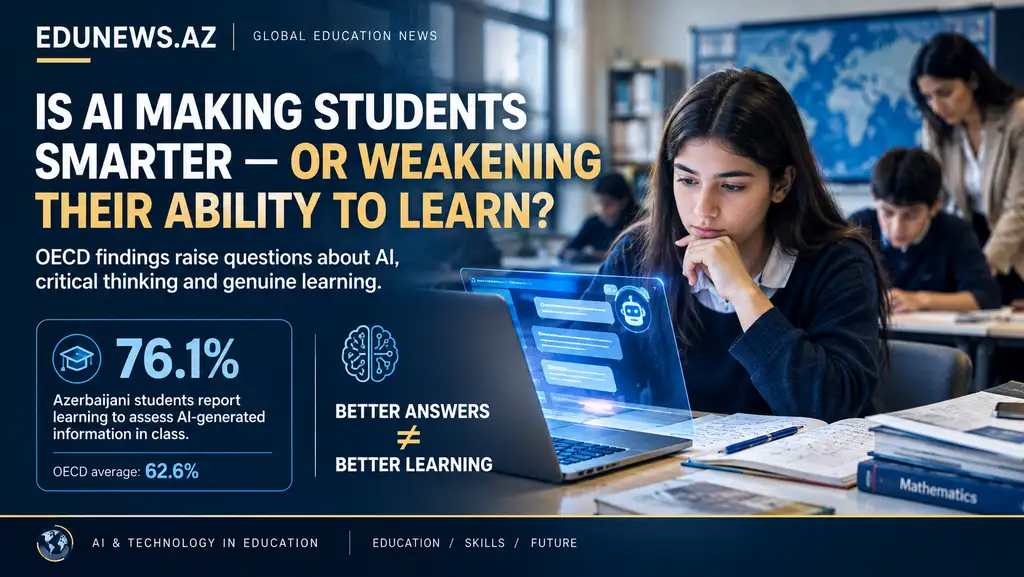
Better Answers Do Not Always Mean Better Learning
Generative AI can help students produce higher-quality work, particularly when they use it to explain difficult concepts, explore ideas or receive feedback.
However, the OECD warns that general-purpose AI tools can also allow students to outsource the thinking that learning is supposed to develop.
A student who asks an AI chatbot to write an essay may receive a polished result without learning how to construct an argument, organise evidence or express ideas independently.
Similarly, a student who copies an AI-generated solution to a mathematics problem may complete the assignment successfully without understanding the method.
The difference becomes particularly important when students later sit examinations without access to AI.
The OECD notes that some studies have found that performance advantages associated with general-purpose AI tools disappear — and sometimes reverse — when access to those tools is removed.
The implication is significant: successful task completion should not be confused with genuine learning.
What Does the OECD Say About AI in Classrooms?
The OECD's 2026 report identifies both opportunities and risks in the use of generative AI.
AI can support learning when it is used with a clear educational purpose. Purpose-built educational tools can ask questions, provide targeted feedback, adapt explanations and encourage students to work through problems rather than simply receive answers.
The report also highlights the potential of AI to help teachers prepare lessons, develop educational materials and improve some administrative tasks.
But these benefits are not automatic. AI tools need to be designed and used around sound teaching principles, with teachers remaining central to the learning process.
The OECD therefore recommends that education systems prioritise human learning, independent thinking and foundational skills rather than adopting technology simply because it is available.
What Do Recent PISA Findings Reveal?
The OECD's September 2026 discussion of PISA findings added another dimension to the debate.
Andreas Schleicher, the OECD's Director for Education and Skills and head of the PISA programme, discussed the relationship between students' AI use, reading performance and critical thinking.
The findings suggest that students who perform better academically tend, in some comparisons, to use AI less. However, the relationship is complex: outcomes depend on how students use the technology and whether they are taught to evaluate AI-generated information.
Reading skills are particularly important in this context.
Students need to distinguish facts from opinions, evaluate evidence, recognise ambiguity and question information that appears convincing but may be inaccurate.
These skills become even more essential when AI can generate fluent answers that contain errors or unsupported claims.
The challenge for schools is therefore not simply to teach students how to use AI, but also to teach them how to assess its output.
Azerbaijan: Students Are Learning to Evaluate AI-Generated Information
The OECD's Education GPS profile for Azerbaijan includes several notable indicators on students' use of AI for schoolwork.
According to the profile's PISA 2025 data:
76.1% of students in Azerbaijan reported learning to assess AI-generated information in class, compared with an OECD average of 62.6%.
8.5% reported that they did not use AI for schoolwork, compared with an OECD average of 13.7%.
12.9% said they did not use AI to help them learn, compared with an OECD average of 20.7%.
These figures suggest that AI is already part of the educational experience for many students in Azerbaijan, while reported classroom instruction on evaluating AI-generated information is relatively widespread.
However, these indicators do not establish that AI use itself improves academic performance. Nor do they show that every student has the same level of access, guidance or digital literacy.
The key question for Azerbaijan's education system is how to turn widespread exposure to AI into meaningful learning outcomes.
The Role of Teachers Is Becoming More Important
As AI tools become more capable, teachers may need to place greater emphasis on the process of learning rather than only the final product.
For example, instead of asking students to submit an essay alone, a teacher could ask them to explain how they developed their argument, identify which sources they used and defend their conclusions in class.
In mathematics, students could be asked to compare an AI-generated solution with their own method and identify any errors.
In science, they could evaluate an AI-generated explanation against reliable evidence.
These approaches do not require schools to reject AI. Instead, they make students responsible for understanding, checking and explaining the work they produce.
AI can also assist teachers with lesson planning and feedback, potentially freeing up time for individual support and classroom interaction.
The OECD stresses, however, that educational AI should complement teachers' expertise rather than replace the human relationships at the heart of education.
Should Schools Ban AI?
A blanket ban may appear to be a straightforward solution, but it does not address the broader challenge of preparing students for a world in which AI is widely available.
At the same time, allowing unrestricted AI use can undermine independent thinking if students rely on it to complete every task.
A more balanced approach would distinguish between different uses.
Students might use AI to explore a topic, receive feedback or compare alternative explanations. But they should also practise writing, calculating, researching and solving problems independently.
Schools should establish clear rules about acceptable AI use, academic honesty, privacy and the disclosure of AI assistance.
Assessment methods may also need to evolve. Oral examinations, in-class writing, practical tasks and project discussions can help teachers determine whether students understand what they submit.
The objective should be to ensure that AI supports learning rather than conceals gaps in understanding.
Edunews Analysis: The Real Challenge Is Not AI — It Is How We Learn
For students, parents and teachers, the debate over AI is often framed as a choice between embracing technology and protecting traditional education.
That is a false choice.
The more important distinction is between using AI as a tool for thinking and using it as a substitute for thinking.
A student who asks AI to explain a difficult concept, then checks the explanation, solves a problem independently and discusses the result may benefit from the technology.
A student who copies the answer without understanding it may finish the assignment faster but gain little lasting knowledge.
This distinction has implications for homework, examinations, university admissions and future employment. If AI can produce many routine assignments, education systems will need better ways to assess understanding, reasoning, creativity and practical competence.
For Azerbaijan, the OECD indicators on classroom instruction in evaluating AI-generated information provide an encouraging starting point. The next step is to ensure that students can apply those skills consistently across subjects and beyond the classroom.
Conclusion
Artificial intelligence is unlikely to disappear from education. Its influence will probably grow as tools become more accessible and increasingly integrated into everyday learning.
But technology alone cannot guarantee better education.
The OECD's research points to a clear principle: AI can support learning when it is guided by educational goals, but it can also weaken the learning process when students outsource too much of their thinking.
The future of education will depend not simply on how well students use AI, but on whether they can think independently, evaluate information and explain what they know.
The most important question is no longer whether students use AI. It is whether AI helps them become better learners.
Sources
OECD, OECD Digital Education Outlook 2026: Exploring Effective Uses of Generative AI in Education.
OECD, PISA Findings on Artificial Intelligence Use, Reading Skills and Learning, September 2026.
OECD Education GPS, Azerbaijan — Student Performance (PISA 2025).
Editorial Note: This article was prepared by Edumap.az based on OECD publications and education indicators. Figures are attributed to the OECD sources cited above.