
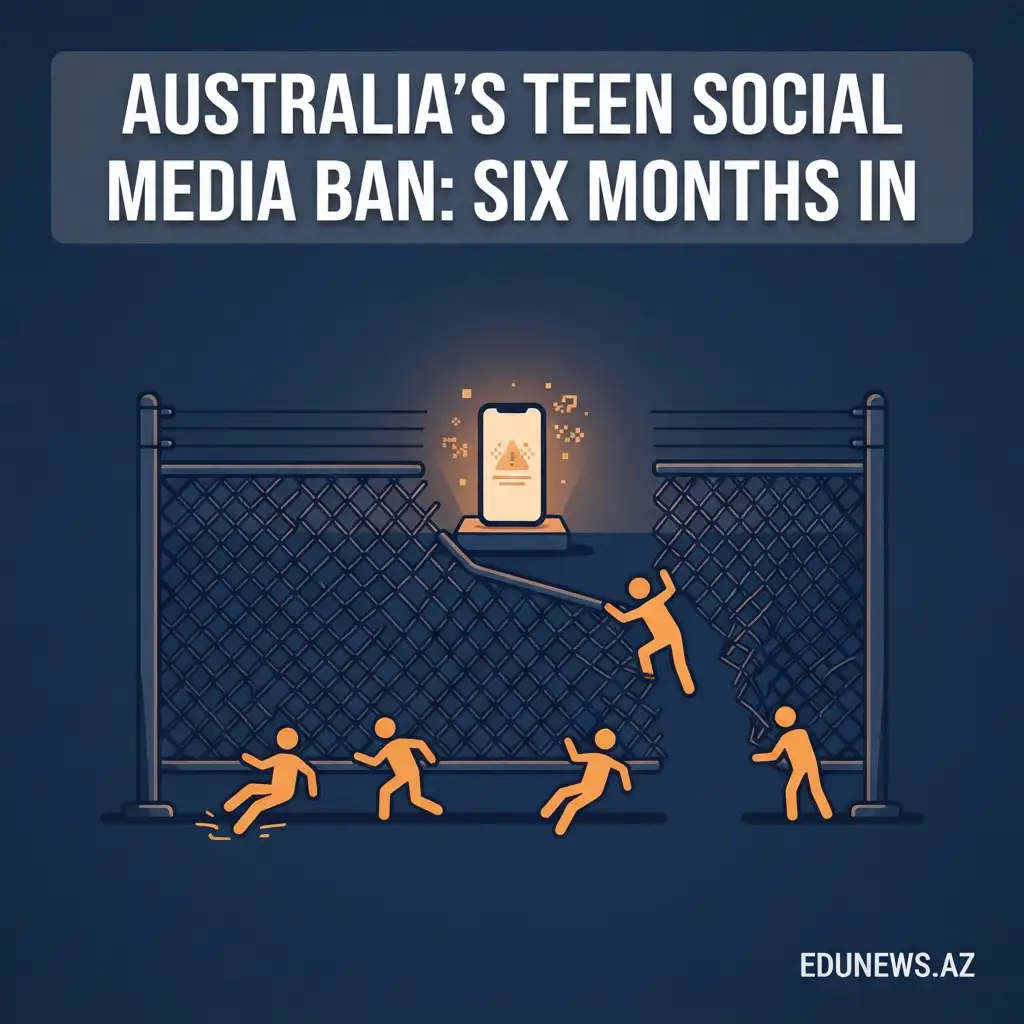
Australia Banned Kids From Social Media. Six Months Later, the Data Says It Mostly Didn't Work.
CANBERRA — Australia became the first country in the world to enforce a full under-16 social media ban, effective December 10, 2025 — a policy other governments, including Azerbaijan with its own social-media registration rules for children introduced this August, are watching closely as a live test case for whether legal restrictions can actually change how children use the internet. Six months of real data now in hand, the answer is uncomfortable for anyone hoping for a clean success story: the ban has removed nearly five million accounts, and it has barely dented how much social media content teenagers actually consume.
Australia's own eSafety Commissioner — the regulator responsible for the ban's enforcement — issued a compliance update finding that seven in ten children who held accounts on the restricted platforms simply remained on Facebook, Instagram, Snapchat, and TikTok. Most teens circumvented the checks entirely, and the platforms themselves, according to multiple independent reviews of the policy's first months, failed to build the kind of consistent, reliable restriction systems the law assumed would exist. Perhaps the most striking finding, one that should worry policymakers more than the circumvention numbers themselves: teenagers who did lose their accounts didn't stop consuming social media content. They kept watching videos, scrolling posts, and clicking recommendations while logged out — meaning platforms continued ranking and recommending content to them based on device data, location, and browsing signals, just without an account attached to track it. Regulators can count the deleted accounts. They have no reliable way to measure what teenagers are still watching without them, which means the policy may have made the underlying problem harder to see rather than smaller.
Here's the detail that should reframe how any government approaches this issue going forward, including ones currently drafting their own rules: a 2026 review published in Frontiers in Developmental Psychology found that the entire body of experimental research most commonly cited to justify these bans has a fundamental gap — not one study actually tested participants younger than 16, the exact population the bans target. "We do not know how social media bans will affect youth because we have never studied that question," the lead researcher put it bluntly. The researchers aren't arguing bans are wrong. They're making a narrower, sharper point: governments are spending enormous political capital and public trust on an intervention that has never been measured on the population it's being imposed on, and doing so with real children as the test subjects rather than the research subjects.
The mechanics of why enforcement keeps failing are worth understanding in detail, because they apply well beyond Australia's specific law. Age verification comes in three basic flavors — self-attestation (simply checking a box), age estimation (analyzing facial images or activity patterns), and hard verification (uploading government ID) — and each carries a different failure mode. Self-attestation is trivially easy to lie about. Facial-estimation technology, according to National Institute of Standards and Technology testing, makes measurably more errors on younger faces and on people of color, meaning the "objective" technical solution isn't actually neutral in practice. Hard ID verification solves the accuracy problem but creates a new one: it forces families to hand sensitive identity documents to tech companies, building exactly the kind of large, centralized data honeypot that privacy advocates warn becomes its own security risk — a concern that isn't hypothetical, since age-verification systems have already produced real data leaks elsewhere.
There's a market-structure problem hiding underneath the privacy problem, too. Building reliable age-verification infrastructure — compliance teams, verification vendors, appeals processes for wrongly-flagged accounts — is expensive enough that only large, well-resourced platforms can realistically absorb the cost. Smaller and newer platforms either can't compete or become de facto unregulated safe havens where teenagers migrate specifically because enforcement is weaker there — meaning a policy designed to protect children from major platforms may end up pushing them toward smaller ones with less safety infrastructure of any kind, a genuinely perverse outcome relative to the ban's stated goal.
None of this means the underlying concern driving these policies is wrong — the mental-health and wellbeing questions around heavy adolescent social media use remain real and actively debated in the research literature, including ongoing disagreement among psychologists about whether social media use drives poor mental health or whether the causation actually runs the other way, with existing mood or mental-health struggles predicting heavier social media use rather than the reverse. What the Australian case demonstrates isn't that the problem is imaginary. It's that "ban the accounts" turns out to be a much blunter, more circumventable, and less measurable tool than it sounds like on paper — and that governments moving forward with similar restrictions, including the EU's ongoing deliberations and the UK's under-16 ban set to take effect in spring 2027, are largely repeating the same enforcement design Australia already showed doesn't hold up, rather than learning from what specifically broke.
For Azerbaijan's own recently introduced social-media rules for children — registration requirements backed by fines up to 50,000 manat for violating platforms — the Australian experience is directly relevant homework, not a distant cautionary tale. The core enforcement questions Australia is still struggling with six months in — how do you verify age without creating a privacy risk larger than the problem you're solving, and how do you prevent kids from simply migrating to unmonitored corners of the internet once the major platforms tighten up — are the exact questions any country's child-safety framework eventually has to answer in practice, not just in the text of the law. Whether Azerbaijan's approach, still in its early implementation phase, ends up solving those questions more successfully than Australia has so far is a story worth revisiting once the policy has had time to actually run.