Azerbaijan Introduces New Per-Student Funding Model for State Schools
Azerbaijan is gradually moving state general education institutions toward a new funding model based on the number of students, with detailed funding amounts and implementation rules expected to be approved within one month.
By Rasim Abdurahman
Education Editor, Edunews.az
Published: September 29, 2026
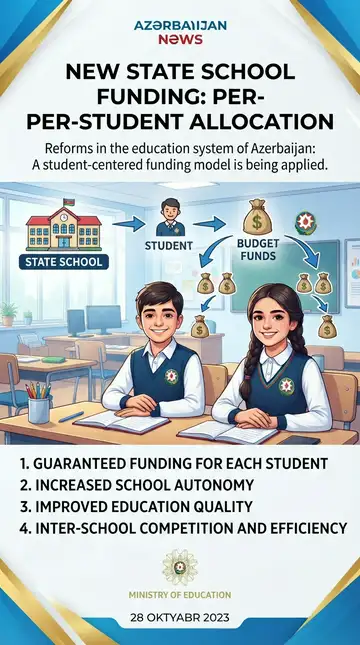
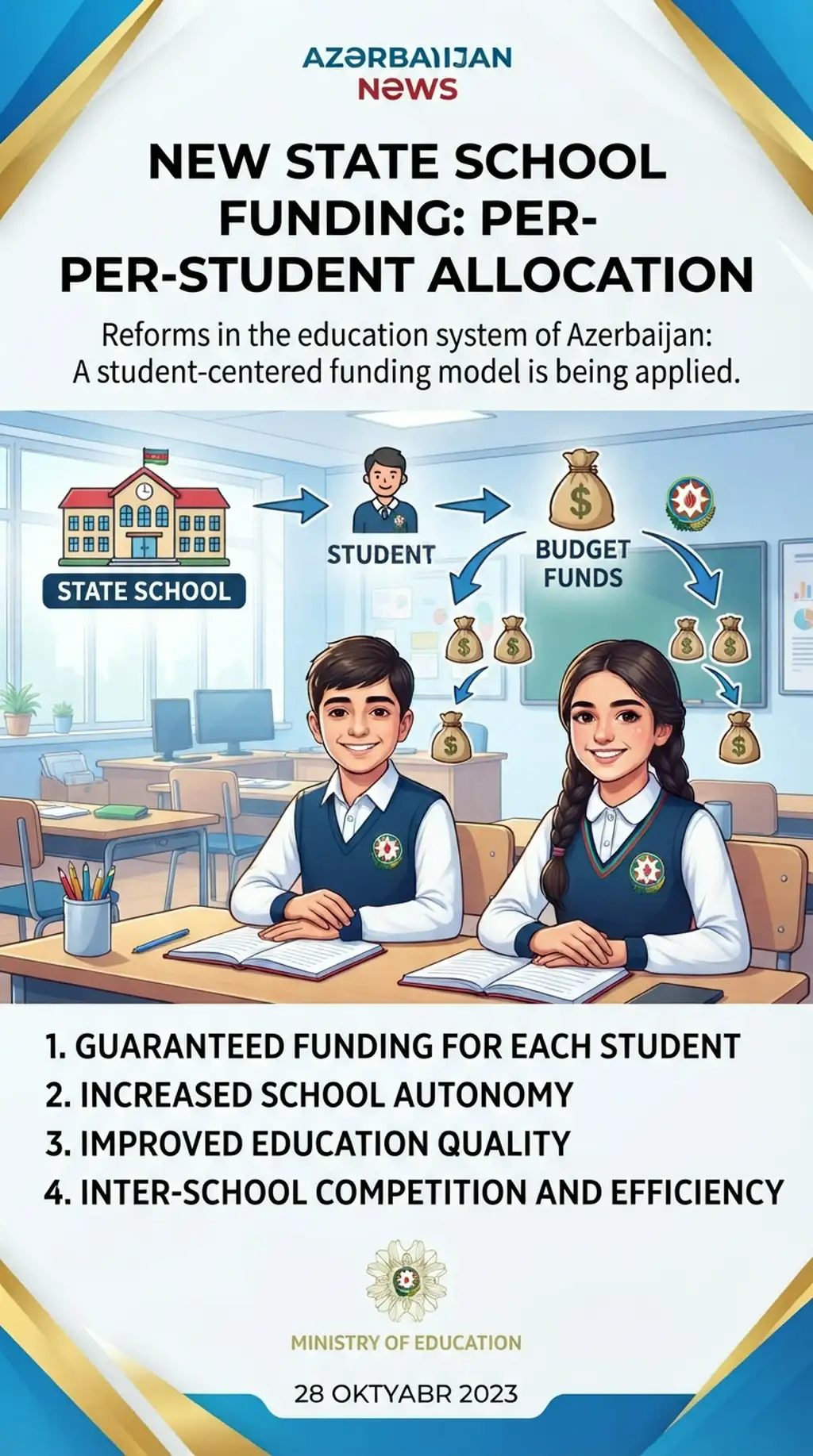
Azerbaijan is introducing a new financing mechanism for state general education institutions, shifting gradually toward a per-student funding model beginning with the 2026–2027 academic year.
The change was established by a decree signed by President Ilham Aliyev on September 24, 2026. Under the decree, state general education institutions will gradually be financed from the state budget according to the number of learners, with adjustment coefficients applied depending on the type of school and level of general education.
The reform represents a significant change in how public-school resources are planned and allocated. Instead of relying solely on broader institutional budgeting, the new approach is designed to establish a closer relationship between the number of students and the funding allocated to participating schools.
What is per-student funding?
Under a per-student or per-capita financing model, funding is calculated with reference to the number of learners enrolled in an education institution.
In simple terms, the number of students becomes an important factor in determining the amount of public funding allocated to a school.
However, Azerbaijan's new system will not use a single identical amount for every student.
The presidential decree states that adjustment coefficients will be applied to annual education expenditure per learner according to different types of general education institutions and levels of general education.
This means that the eventual funding formula can take differences between types and levels of education into account.
How will the new system be introduced?
The reform will be implemented gradually, rather than across every state school at once.
The Ministry of Science and Education, in coordination with the Ministry of Finance, will determine the list of state general education institutions to be financed under the per-student principle for each subsequent calendar year. The number of learners at those institutions will also be determined as part of this process.
The gradual approach is important because it allows the authorities to monitor the implementation of the model before expanding it further.
A government analysis of the reform also notes that the phased approach can help identify technical and institutional issues and allow adjustments to be made during subsequent stages.
How much money will each student receive?
The exact amount has not yet been announced.
The presidential decree instructs the Cabinet of Ministers to approve, within one month, the annual education expenditure per learner for the relevant types of general education institutions, as well as the rules for financing schools under the new model and applying the adjustment coefficients.
Therefore, it would be premature to state that every student will generate a specific amount of funding for their school.
The next government decision will be particularly important because it should establish the financial parameters of the new mechanism.
Which schools will be included?
The decree does not state that every state general education institution will immediately move to the new model.
Instead, the Ministry of Science and Education will determine the schools to be financed according to the per-student principle for each calendar year, in coordination with the Ministry of Finance.
This confirms that the reform will be introduced in stages.
The exact list of participating schools and the corresponding number of learners will therefore become clearer through subsequent implementation decisions.
Why does the reform matter?
One of the main potential changes is the way resources are connected to the number of learners.
The Center for Analysis of Economic Reforms and Communication described the reform as a change in the approach to allocating financial resources, rather than simply a change in the amount of money allocated to schools.
A per-student approach can provide a clearer formula for allocating public resources because funding becomes more directly connected to the number of learners served by a school.
At the same time, student numbers alone cannot describe all of a school's financial needs.
Schools can differ significantly in their location, infrastructure, student population, educational level and maintenance requirements. The government analysis specifically highlights these factors as considerations that can affect financial needs.
This is one reason why the adjustment coefficients included in the presidential decree will be important.
What could change for schools?
The exact effects will depend on the rules that are still to be approved.
However, the new model could affect several areas of school financial planning, including:
- how annual school funding is calculated;
- how differences between school types are reflected in funding;
- how student numbers are incorporated into budget planning;
- how resources are monitored;
- how funding requirements are assessed from year to year.
The reform may also create a more transparent connection between the number of students served by a school and the resources allocated to it.
But the effectiveness of the system will ultimately depend on the details of the formula and how successfully it accounts for schools with different circumstances.
This is not Azerbaijan's first move toward per-student financing
The new school-financing reform is part of a broader evolution of education financing in Azerbaijan.
The country's Education Development Strategy has previously identified the transition toward per-student financing of education institutions as one of the directions for improving the sustainability and efficiency of education financing.
Similar financing principles have also been used in other parts of Azerbaijan's education system.
For example, the Cabinet of Ministers has previously regulated per-student financing for state-ordered training in higher education, while a separate mechanism has been established for vocational education.
In 2026, Azerbaijan also introduced a new financing model based on cooperation between parents, the state and private providers in preschool education, with the stated goals of expanding access and increasing parental choice.
The new general-education mechanism therefore fits into a wider movement toward more differentiated and formula-based education financing.
Edunews Analysis
The most important part of Azerbaijan's new funding reform is not the phrase “per-student financing” itself, but what the final formula will look like.
A system based on student numbers can make education funding more systematic and predictable. But a simple calculation based only on enrolment would not necessarily reflect the real cost of operating different schools.
For example, a small school in a remote area may have very different infrastructure and staffing costs from a large urban school. Specialised schools and different education levels may also require different levels of expenditure.
The government's decision to introduce adjustment coefficients is therefore significant. The coefficients can potentially allow the funding formula to reflect some of these differences.
The next stage of the reform will be especially important: the Cabinet of Ministers must define the annual expenditure per learner and the detailed financing rules.
Only after those parameters are published will it be possible to assess how the new system will affect individual schools and whether the funding model provides sufficient resources for different educational environments.
For now, the reform should be understood as the beginning of a transition rather than the final form of Azerbaijan's school-financing system.
What happens next?
The Cabinet of Ministers has been instructed to approve the annual expenditure per learner, financing procedures and adjustment-coefficient rules within one month.
The Ministry of Science and Education will then determine, together with the Ministry of Finance, which state general education institutions will be financed under the new model and how many learners they have.
As these details become available, schools, teachers, parents and education researchers will be able to better understand the practical consequences of the reform.
For Azerbaijan's education system, the coming months will therefore be important not only for implementing the new financing model, but also for determining how effectively funding can be connected to the actual needs of schools and students.
Sources
- President of the Republic of Azerbaijan — Decree on the introduction of a new financing mechanism for state general education institutions.
- Azerbaijan Ministry of Science and Education — official publication of the presidential decree.
- Center for Analysis of Economic Reforms and Communication — analysis of the new financial model for general education.
- Cabinet of Ministers of Azerbaijan — higher education financing mechanisms.
- Azerbaijan Ministry of Science and Education — Education Development Strategy.
Editorial Note: This article was independently prepared by Edunews based on official Azerbaijani government sources and institutional analysis. Interpretive comments are presented in the “Edunews Analysis” section and are intended to provide educational context for readers.