PISA 2025: Reading and Mathematics Scores Fall to Their Lowest OECD Levels on Record
The latest global assessment of 15-year-olds reveals a continued decline in reading and mathematics performance, while AI use creates a new challenge for education systems.
By Rasim Abdurahman
Education Editor, Edunews.az
Published: September 27, 2026
The latest results from the OECD’s Programme for International Student Assessment (PISA) have revealed a major challenge facing education systems around the world.
The PISA 2025 assessment, released on September 8, shows that average performance across OECD countries has fallen to the lowest levels ever recorded in the assessment in both reading and mathematics.
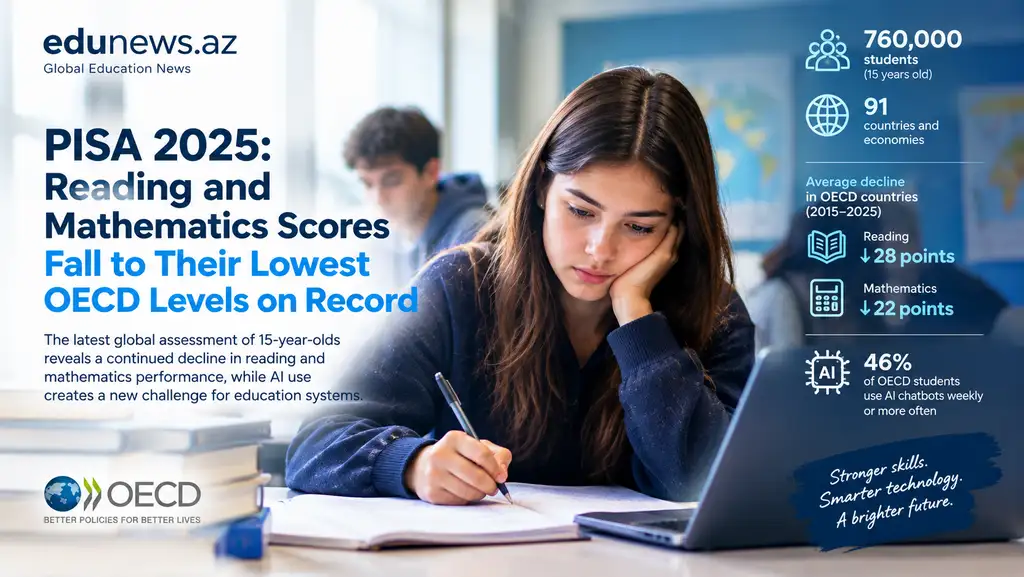
The assessment involved approximately 760,000 15-year-old students across 91 countries and economies, representing around 33 million students of the same age worldwide.
The results also provide a new perspective on one of the biggest questions facing education today: how technology and artificial intelligence should be used in learning.
Reading and mathematics reach record-low OECD averages
The decline in student performance has been particularly significant in reading.
Between 2015 and 2025, average reading performance across OECD countries fell by 28 points, while mathematics performance declined by 22 points.
The OECD describes the reading decline as equivalent to roughly one and a half years of learning, while the mathematics decline represents slightly more than one year of learning.
Science, the main subject assessed in the 2025 cycle, showed a different pattern. Average science performance across OECD countries was broadly stable between 2022 and 2025, although the longer-term trend since 2009 remains a concern.
Across the OECD, one in five 15-year-olds is now a low performer in science, mathematics and reading, compared with 16% in 2022.
Reading skills are changing in the AI era
The PISA 2025 findings raise concerns that go beyond traditional reading scores.
The OECD reports particularly steep declines in reading skills that are increasingly important in an environment filled with digital information.
These include:
evaluating information;
distinguishing fact from opinion;
connecting information from multiple sources;
navigating ambiguity;
and thinking critically about what is being read.
The OECD also reports that the share of students displaying what it calls “hasty reading” — reading quickly but inaccurately — nearly doubled between 2018 and 2025, reaching 9%.
These skills are particularly important at a time when students can receive instant answers from search engines, social media and AI systems.
AI is now part of the learning environment
PISA 2025 also provides new data on students’ use of artificial intelligence.
According to the OECD, 46% of students in OECD countries use AI chatbots weekly or more often to help them learn.
But the relationship between AI use and educational performance is not straightforward.
The OECD says higher-performing students tend to be those who use AI less, while the findings suggest that AI can be associated with better learning outcomes when students are explicitly taught how to interpret and assess AI-generated information.
In other words, the issue is not simply whether students use AI.
The way they use it matters.
Students using AI for answers may not necessarily learn more
One of the most important findings concerns AI-generated writing.
Students who reported that they did not use AI to draft text for writing assignments generally performed better than students who said they did.
At the same time, among frequent AI users, students who used AI to support learning and were taught how to assess the quality of AI-generated information tended to perform better than students who received no such guidance.
This distinction is becoming increasingly important for schools.
An AI system can produce an answer in seconds. But education is not simply about obtaining an answer.
Students also need to understand why an answer is correct, whether the information is reliable and how they can solve a similar problem independently.
Digital distraction is also affecting classrooms
The PISA findings highlight another challenge associated with technology.
More than one in four students reported that classmates were distracted by digital devices during most or every science lesson.
Students who reported being surrounded by distracted classmates tended to perform less well, showed lower engagement with learning and reported feeling less connected to their schools.
This suggests that the digitalisation of education involves more than providing students with devices.
Schools also need to establish clear expectations about when technology supports learning and when it becomes a distraction.
The digital divide remains an education challenge
Technology does not affect all students equally.
Socioeconomic background remains strongly associated with educational performance. Across OECD countries, students from advantaged backgrounds scored 85 points higher in science than students from disadvantaged backgrounds.
The challenge for education systems is therefore twofold.
Students need access to digital technologies, but they also need the knowledge and skills required to use those technologies effectively.
Simply giving a student access to an AI chatbot does not guarantee that the student has the critical-thinking skills necessary to evaluate its response.
Some education systems are moving against the broader trend
Although the overall OECD picture is negative, PISA 2025 does not show decline everywhere.
The OECD reports that some education systems improved their performance over the longer 2015–2025 period.
In science, improvements were recorded in several systems, including Lithuania, the Slovak Republic, Türkiye, the Dominican Republic, Georgia, Macao (China), Montenegro, Qatar, Thailand, the United Arab Emirates and Uruguay.
The highest-performing education systems across the three core domains included the Chinese jurisdictions of Beijing, Shanghai, Jiangsu and Zhejiang, together with Singapore. Estonia, Japan, Korea, Macao (China), Chinese Taipei and the United Kingdom were also among the top-performing systems.
These differences show that the global decline does not affect every education system in the same way.
Edunews Analysis: Education is facing a different kind of technology problem
For years, the central question in digital education was whether schools had enough technology.
The PISA 2025 results suggest that the next question may be more complicated:
Do students know how to use technology without allowing technology to replace the learning process?
AI can summarise a text, generate an essay, solve a mathematical problem or provide an explanation almost instantly.
But if students stop doing the cognitive work themselves, the technology can make completing a task easier without necessarily making the student more capable.
This is why reading, mathematics and science remain fundamental even in an increasingly AI-driven education system.
Students need strong subject knowledge to use AI effectively.
They also need to know how to question information, identify errors, compare sources and recognise when an AI-generated answer is unreliable.
The future of education may therefore require both stronger foundational skills and stronger AI literacy.
What should schools focus on next?
The PISA findings suggest several areas that education systems may need to prioritise:
1. Strengthen reading and mathematics foundations.
Digital tools cannot compensate for weak core skills.
2. Teach students to evaluate AI-generated information.
Students need to question AI responses rather than automatically accept them.
3. Use technology for clearly defined educational purposes.
The OECD recommends careful and moderate use of AI and digital tools rather than unrestricted use.
4. Reduce digital distraction.
Technology should support classroom learning rather than compete with students’ attention.
5. Invest in teachers.
Teachers remain central to helping students understand information, develop critical thinking and use new technologies responsibly.
The bigger lesson from PISA 2025
PISA 2025 is not simply a report about test scores.
It provides a snapshot of how young people are learning in a rapidly changing digital environment.
The results show that many education systems are struggling to maintain performance in core subjects while simultaneously adapting to AI, smartphones and increasingly digital classrooms.
The challenge for schools is therefore not to choose between traditional education and technology.
It is to determine how technology can strengthen learning without replacing the thinking that learning requires.
As AI becomes more capable, the ability to read carefully, evaluate evidence, solve problems and think independently may become even more important.
The future-ready student may not be the student who uses the most technology — but the student who knows when, why and how to use it.
Sources
OECD, PISA 2025: Students’ reading and mathematics performance declined sharply across the OECD, September 8, 2026.
OECD, PISA 2025 Results (Volume I): Future-Ready Students, September 8, 2026.
OECD, PISA findings on artificial intelligence use, reading skills and learning, September 8, 2026.
Editorial note: This article was independently written by Edunews.az based on OECD data and publications. Interpretive commentary is identified as “Edunews Analysis.”