Europe Launches New Literacy Coalition as One in Three 15-Year-Olds Struggles With Reading
A new European initiative will bring schools, universities, libraries, teachers, parents and policymakers together to strengthen literacy across Europe.
By Rasim Abdurahman
Education Editor, Edunews.az
Published: September 28, 2026
Europe is launching a new continent-wide effort to address declining literacy skills among children, young people and adults.
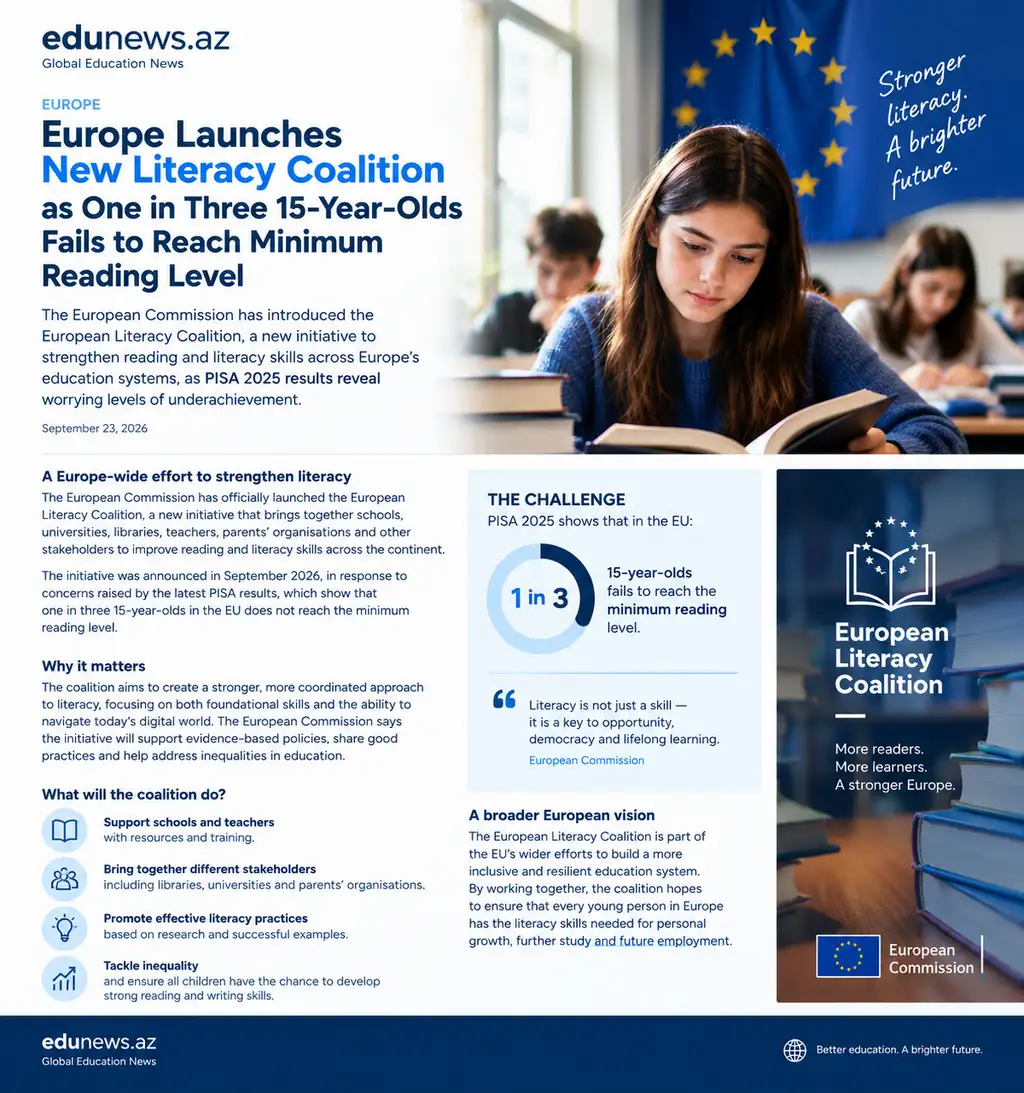
The European Commission has officially launched the European Literacy Coalition, a new multi-stakeholder network designed to strengthen reading, writing and broader literacy skills across Europe.
The initiative comes at a critical moment. According to the European Commission, one in three 15-year-olds in the European Union does not reach the minimum proficiency level in reading, based on the latest PISA 2025 findings.
The Coalition was officially launched in Brussels on September 22–23, bringing together organisations from education, culture, employment, health, digital media and other sectors that influence literacy throughout people's lives.
A Europe-wide response to a growing literacy challenge
The European Literacy Coalition is not intended to be a new school curriculum or a single educational programme.
Instead, it is designed as a European network for cooperation, knowledge sharing and evidence-based action.
The Coalition brings together:
Schools and education providers
Libraries and cultural organisations
Universities and research institutions
Teachers', learners' and parents' organisations
Literacy and civil society organisations
Public authorities and policymakers
Employers and social partners
Media and digital organisations
The European Commission says the initiative will help organisations work together more effectively and share successful approaches to literacy education.
Why is reading becoming such a major concern?
The launch follows growing concern about basic skills across Europe.
The latest PISA assessment found that reading performance has deteriorated significantly. Across OECD countries, average reading scores fell by 28 points between 2015 and 2025, equivalent to roughly one and a half years of learning.
The European Commission's concern goes beyond the ability to read words.
Modern literacy increasingly requires students to understand, evaluate and interpret information, including information encountered online and through digital technologies.
This is particularly important in an environment where students are exposed to social media, short-form content, artificial intelligence and large amounts of information every day.
The OECD's PISA 2025 report found particularly steep declines in reading skills related to evaluating information, connecting information across multiple sources and thinking critically about what students read.
Literacy is no longer only about books
The European Commission is taking a broader definition of literacy.
Its current framework includes the ability to understand, use, evaluate and reflect on information presented through written, visual, audio and digital materials.
That means the literacy challenge facing European education systems is not simply about encouraging children to read more books.
It is also about helping young people determine whether information is reliable, understand different sources, interpret data and communicate effectively.
This becomes even more important as artificial intelligence becomes part of everyday learning.
The Commission's latest research on AI in education has warned that students can benefit from generative AI when it supports their own thinking, but excessive reliance on AI may interfere with the development of critical-thinking and cognitive skills.
What will the European Literacy Coalition do?
The Coalition's mission includes several areas.
First, it aims to strengthen cooperation with schools through a whole-school approach to literacy.
Second, it will promote evidence-based recommendations that can support national literacy policies.
Third, it will connect existing literacy initiatives and encourage organisations to share effective practices.
The initiative will also focus on strengthening the literacy skills of both learners and educators.
Another important priority is addressing literacy challenges in the digital era, while increasing public awareness of the importance of reading and literacy.
The problem starts before secondary school
The European Commission's strategy does not focus exclusively on teenagers.
The Coalition's work covers the entire learning journey, from early childhood education through adulthood.
This reflects growing evidence that foundational skills are developed long before students take international assessments such as PISA.
The EU's broader Action Plan on Basic Skills includes measures aimed at improving reading, mathematics, science, digital and citizenship skills from the early years through school education and adult learning.
The European Commission has also highlighted the role of families and communities in supporting children's learning.
Adults are part of the literacy challenge too
The issue does not end when students leave school.
According to the European Commission, the 2023 Survey of Adult Skills found that one in four working-age adults struggles with reading and writing.
This means literacy is increasingly being treated as a lifelong skill rather than something that schools are solely responsible for developing.
Weak literacy can affect education, employment, access to information and participation in society.
The Commission also links low literacy with increased vulnerability to misinformation and difficulties participating fully in civic and democratic life.
The European Literacy Coalition has a broader goal
The Coalition is part of the European Commission's wider Union of Skills strategy.
Its founding document, the Warsaw Memorandum, sets out shared principles and priorities for cooperation.
The Coalition itself was developed through cooperation between the European Commission and literacy organisations from across Europe. A co-creation workshop in Warsaw in May 2026 helped shape the memorandum before the official launch in Brussels in September.
The initiative therefore represents an attempt to move from individual literacy projects toward greater coordination at European level.
Edunews Analysis: The next literacy crisis may be digital
Europe's literacy challenge is becoming more complicated.
For previous generations, literacy largely meant being able to read, write and understand a text.
For today's students, that is only the starting point.
A student may be able to read a paragraph but still struggle to determine whether an online claim is reliable. They may be able to use an AI chatbot but have difficulty checking whether its answer is accurate. They may consume thousands of pieces of digital content without developing deeper reading habits.
This is why the European Literacy Coalition is significant.
Its challenge is not simply to persuade young people to read more.
It is to help create a generation capable of reading deeply, evaluating information, thinking critically and using digital tools responsibly.
The timing is particularly important because the European Commission's latest research shows that AI is already being used widely by young people. Four in ten EU residents aged 16–24 used generative AI for formal education in 2025, while only 29.7% of EU teachers surveyed in TALIS 2024 had participated in professional development related to AI for teaching and learning.
That creates a new connection between two major education challenges: literacy and artificial intelligence.
Students need strong foundational reading skills to use AI effectively. At the same time, they need digital and AI literacy to evaluate the information they encounter.
What happens next?
The European Literacy Coalition is expected to develop cooperation between education and cultural organisations, share evidence and successful practices, and support stronger literacy policies across Europe.
Its effectiveness, however, will ultimately depend on what happens beyond the European level — in classrooms, schools, libraries, families and communities.
The European Commission has created the framework.
The next question is whether national education systems can turn that framework into measurable improvements in students' reading and literacy skills.
For Europe, the issue is no longer simply how many children attend school.
It is increasingly about what they are able to understand, evaluate and use when they leave the classroom.
Sources
European Commission — European Literacy Coalition, European Education Area.
OECD — PISA 2025 Results (Volume I): Future-Ready Students.
OECD — PISA 2025 official press release, September 8, 2026.
European Commission — Basic Skills / Action Plan on Basic Skills.
European Commission — Reports on AI and digital technologies in education, September 2026.
Editorial note: This article was independently written by Edunews.az based on information published by the European Commission and OECD. Interpretive observations are presented separately as Edunews Analysis.