US Opens 2027–28 FAFSA Earlier Than Ever: What Students Need to Know
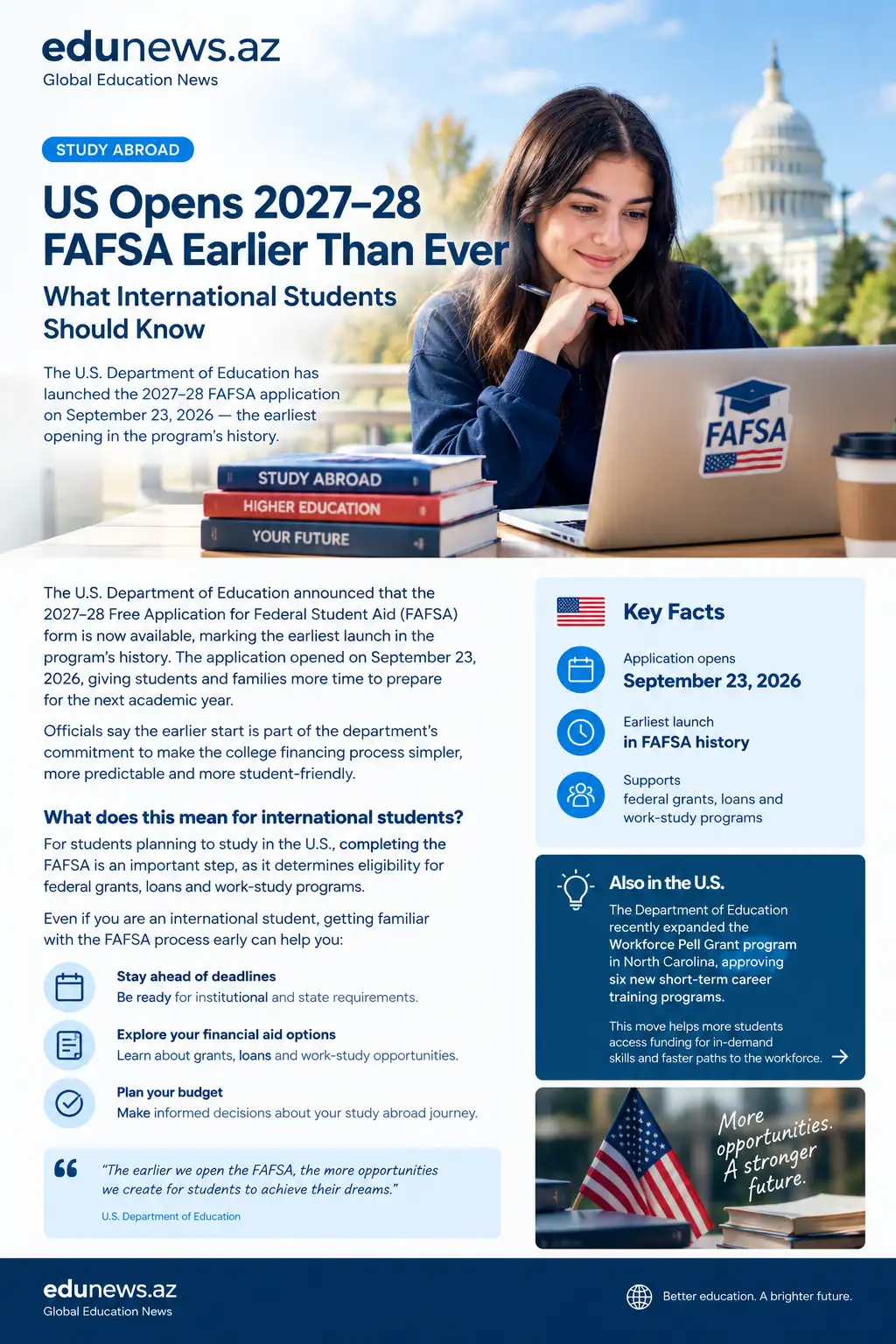
The U.S. Department of Education has opened the 2027–28 FAFSA, giving students and families an earlier start on the federal financial aid process.
By Rasim Abdurahman
Education Editor, Edunews.az
Published: September 29, 2026
The United States has opened the 2027–28 Free Application for Federal Student Aid (FAFSA) earlier than ever before, marking the second consecutive year in which the application has launched at the earliest point in its history.
The U.S. Department of Education announced on September 23 that the FAFSA form for students seeking financial aid for the 2027–28 academic year is now available online. The department said the early launch is intended to give students, families, colleges and states more time to prepare for the financial-aid process.
For students planning to attend college, career school or other eligible postsecondary education programs in the United States from July 1, 2027, through June 30, 2028, the 2027–28 FAFSA is the relevant application.
What is FAFSA?
FAFSA stands for the Free Application for Federal Student Aid. It is the main application used to determine eligibility for U.S. federal student aid.
Completing the FAFSA can provide access to federal financial aid such as Pell Grants, federal work-study and federal student loans. Information submitted through FAFSA may also be used by states and educational institutions when determining eligibility for their own financial aid programs.
The form is therefore an important part of the college-financing process for eligible students in the United States.
What has changed for 2027–28?
The U.S. Department of Education says the latest FAFSA includes several changes designed to make the process easier to complete.
Among the updates are clearer language and instructions, intended to reduce confusing terminology and make questions easier for students and families to understand.
Students can also invite a contributor — such as a parent — by text message as well as email, according to the department.
Another planned improvement is the ability to pre-populate information from a previous FAFSA later in the fall, which is expected to make renewal faster for returning applicants.
The FAFSA system also includes features that allow students to receive information about potential Pell Grant or federal-aid eligibility in real time, while parents with multiple children applying for aid can reuse certain information rather than entering it repeatedly.
Why does the early opening matter?
FAFSA has traditionally been associated with the beginning of the U.S. college financial-aid cycle. Opening the form earlier gives students more time to complete the application and address problems before institutional and state deadlines.
The Department of Education says the 2027–28 form was required by law to launch no later than October 1, but it became available on September 23.
For students and families comparing universities, an early financial-aid application can also become part of the broader planning process alongside admissions applications, scholarship searches and budgeting.
However, students should not assume that submitting FAFSA automatically guarantees financial aid. Eligibility depends on the applicant's circumstances, the type of aid and the relevant federal, state and institutional requirements.
What about international students?
This is particularly important for students from Azerbaijan and other countries considering study in the United States.
FAFSA is not a general scholarship application for all international students. Federal Student Aid states that a student generally must be a U.S. citizen or an eligible noncitizen to receive federal student aid.
Most foreign citizens are not eligible for U.S. federal student aid, although certain categories of noncitizens can qualify. Federal Student Aid specifically lists certain permanent residents and other eligible noncitizen categories among those who may qualify.
Students who are planning to study in the United States on a typical student visa should therefore distinguish between:
Federal financial aid
University-based scholarships
Institutional financial aid
State-based financial assistance
Private scholarships
For international applicants, university scholarships and other funding opportunities may be more relevant than federal FAFSA-based aid.
A wider shift in U.S. education funding
The FAFSA launch comes as the U.S. is also expanding access to financial support for shorter career-training programs.
On September 25, the U.S. Department of Education approved six new Workforce Pell Grant programs at Forsyth Technical Community College in North Carolina.
The approved programs include training for firefighters, electrical power-line installers and repairers, welders, paramedics and nursing assistants. The department says Workforce Pell expands access to postsecondary education beyond traditional four-year degree pathways.
The development is part of a broader change in how postsecondary education can be financed, with federal Pell funding becoming available for qualifying short-term workforce programs.
According to the Department of Education, eligible Workforce Pell programs must meet requirements related to earnings, job placement and completion, among other criteria.
What should students do now?
Students preparing for the 2027–28 academic year can begin by determining whether they are eligible for federal student aid and creating or accessing their StudentAid.gov account.
The official Federal Student Aid guidance recommends preparing the information required for the FAFSA, including relevant tax and financial information. The 2027–28 form uses 2025 income and tax information.
Students should also check the financial-aid deadlines of each university they are considering. Institutional and state deadlines can differ from the federal FAFSA timeline.
For international students, the process should begin with checking each university's scholarship and financial-aid policies rather than assuming that FAFSA applies to them.
Edunews Analysis
The early FAFSA launch is more than a change to a calendar date. It reflects a broader effort to move financial planning closer to the beginning of the university application process.
For students, the practical lesson is straightforward: admission planning and financial planning increasingly need to happen together.
Students considering U.S. universities should not wait until receiving an admission offer to investigate the cost of attendance, scholarships, financial aid and possible funding sources.
At the same time, international applicants need to understand the difference between U.S. federal financial aid and university-specific funding. A student can be interested in studying in America without being eligible for FAFSA-based federal aid.
The expansion of Workforce Pell also highlights another important trend: higher education policy is increasingly connecting financial assistance with shorter, employment-oriented training routes alongside traditional university degrees.
For Edunews readers, this makes the latest U.S. developments relevant not only to prospective university students, but also to young people considering professional education and career-focused training.
What happens next?
The 2027–28 FAFSA is now available, and students planning to enter U.S. postsecondary education in the 2027–28 academic year can begin the financial-aid process.
The next step for each student will depend on citizenship or eligible-noncitizen status, the institution they plan to attend, their financial circumstances and applicable state or university deadlines.
For students from Azerbaijan interested in studying in the United States, the FAFSA opening is therefore best viewed as one part of a larger study-abroad planning process that should also include university scholarships, admissions requirements, English-language requirements and the total cost of education.
Sources
U.S. Department of Education — 2027–28 FAFSA announcement.
Federal Student Aid — Filling Out the FAFSA.
Federal Student Aid — Steps for Students.
U.S. Department of Education — Workforce Pell programs in North Carolina.
Federal Student Aid — Information for International Students.
Editorial Note: This article was independently prepared by Edunews based on information published by the U.S. Department of Education and Federal Student Aid. Interpretive comments are presented in the “Edunews Analysis” section and are intended to provide educational context for readers.