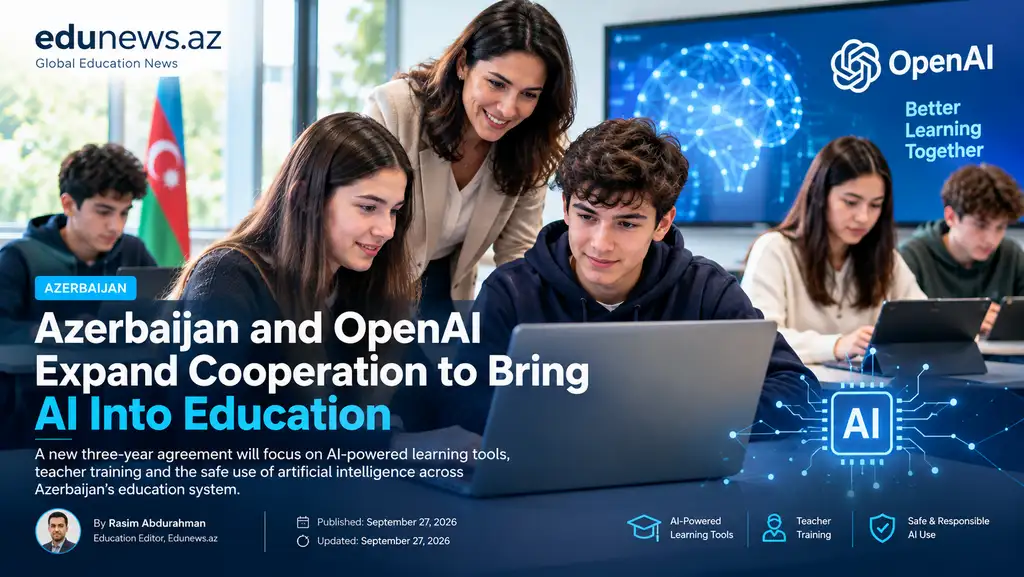
Azerbaijan and OpenAI Expand Cooperation to Bring AI Into Education
A new three-year agreement will focus on AI-powered learning tools, teacher training and the safe use of artificial intelligence across Azerbaijan’s education system.
By Rasim Abdurahman
Education Editor, Edunews.az
Published: September 27, 2026
Azerbaijan is expanding its cooperation with OpenAI to integrate artificial intelligence more deeply into the country’s education system.
The Ministry of Science and Education of the Republic of Azerbaijan and OpenAI have signed a three-year Memorandum of Understanding aimed at expanding the responsible use of AI in education.
The agreement was signed in New York by Azerbaijan’s Minister of Science and Education Emin Amrullayev and Leah Belsky, OpenAI’s Vice President of Education. According to the ministry, the cooperation will focus on AI-powered educational tools, teacher training and the development of approaches for the safe and responsible use of AI in schools.
What will the new Azerbaijan–OpenAI partnership focus on?
The new cooperation covers several areas of Azerbaijan’s education system.
One of the central projects will be the development of a learning management system for mathematics, science and reading using OpenAI technologies.
The system is expected to provide teachers with AI-powered assistance in:
lesson planning;
preparing educational materials;
assessing students;
and managing teaching-related tasks.
The Ministry of Science and Education says the goal is to help optimise the time teachers spend on preparation and administrative work, allowing them to devote more time to direct interaction with students.
The agreement also includes plans to develop AI-powered educational tools for both teachers and students.
Teachers will receive AI training
Teacher training is another major component of the agreement.
OpenAI will support training programmes for teachers, students and education professionals, while a “train-the-trainer” programme is expected to help build local expertise in artificial intelligence.
This could become an important part of Azerbaijan’s AI-in-education strategy.
Introducing AI tools into schools requires more than providing access to technology. Teachers also need to understand when AI should be used, how its output should be evaluated and how it can support learning without replacing students’ own thinking.
The new cooperation therefore includes work on methodologies, recommendations and frameworks for the safe, ethical and responsible use of AI in education.
This is the second memorandum between Azerbaijan and OpenAI
The latest agreement is not the beginning of the partnership.
The Ministry of Science and Education says it is the second Memorandum of Understanding signed between Azerbaijan and OpenAI.
Earlier in 2026, Azerbaijan began cooperation with OpenAI on an AI-powered adaptive learning platform under the country’s “Digital School” initiative.
That earlier project was designed to create personalised learning opportunities for more than 500,000 students.
According to the ministry, the planned platform can analyse students’ knowledge and skills, provide personalised tasks and offer AI-based learning support according to individual learning needs. It is also designed to provide performance information to teachers, school administrators and the ministry.
The earlier project is planned to begin with a pilot phase before being expanded more broadly, with teacher oversight, alignment with the national curriculum, continuous evaluation and data protection included in the implementation approach.
What could AI change in Azerbaijan’s classrooms?
The new partnership could affect several parts of everyday education.
For teachers, AI tools could reduce the time required to prepare lesson materials and organise certain assessment tasks.
For students, adaptive learning systems could potentially provide additional practice based on individual learning needs.
For education administrators, AI-based systems could provide more detailed information about learning progress and help identify areas where additional support may be required.
However, these potential benefits depend on how the technology is implemented.
AI-generated information can contain errors, and automated tools cannot replace the professional judgement of teachers. The ministry’s emphasis on safe, ethical and responsible use therefore represents an important part of the agreement rather than simply an additional feature.
Azerbaijan’s AI-in-education strategy is expanding
The cooperation with OpenAI is part of a broader digital transformation of Azerbaijan’s education system.
The Ministry of Science and Education has also been expanding the use of digital tools in higher education. In 2026, the ministry reported that licensed Microsoft tools, including AI-powered solutions such as Copilot, were being introduced at higher education institutions across the country.
The ministry has said that these tools can support academic activities including lesson planning, instructional materials and assessment.
This suggests that AI adoption is no longer limited to experimental projects. It is increasingly becoming part of discussions about how schools, universities and education professionals operate.
Edunews Analysis: The next challenge is not access to AI — it is how AI is used
Azerbaijan’s agreement with OpenAI comes at a time when education systems around the world are facing the same question: How can AI improve learning without replacing learning itself?
Giving students access to an AI tool is relatively easy.
The more difficult task is designing a system in which students still need to read, think, solve problems, evaluate information and develop their own skills.
The same applies to teachers.
AI may help a teacher prepare a lesson plan in less time, but the teacher still needs to determine whether the material is appropriate for a particular class and whether it meets the national curriculum.
This means that AI literacy may become as important as digital literacy for both teachers and students.
A successful AI-in-education strategy will therefore depend not only on technology, but also on teacher training, curriculum design, data protection, assessment methods and clear rules for responsible use.
What happens next?
The three-year memorandum creates a framework for further cooperation between Azerbaijan’s education authorities and OpenAI.
The immediate areas of focus include AI-powered educational tools, teacher and education-professional training, the development of learning systems for mathematics, science and reading, and methodologies for safe and responsible AI use.
The earlier adaptive learning project also provides a foundation for testing how AI can be integrated into Azerbaijan’s national education infrastructure, beginning with a pilot approach and potentially expanding over time.
The results of these projects will be important not only for Azerbaijan but also for the wider discussion about how national education systems can integrate generative and adaptive AI technologies.
For Azerbaijan’s schools, the central question is no longer whether artificial intelligence will enter the classroom.
It is how effectively the education system can use AI while keeping teachers, students and learning outcomes at the centre of the process.
Sources
Azerbaijan Ministry of Science and Education — Azerbaijan’s Ministry of Science and Education and OpenAI Expand Cooperation on the Use of AI in Education, September 23, 2026.
Azerbaijan Ministry of Science and Education — Azərbaycan “OpenAI” ilə regionda ilk adaptiv öyrənmə platformasının hazırlanmasına başlayır, 2026.
Azerbaijan Ministry of Science and Education — Azerbaijan and OpenAI Collaborate to Deploy AI-Powered Tutoring Across the Nation’s Schools, 2026.
Editorial note: This article was independently written by Edunews.az based on official institutional sources. Interpretive commentary is identified as “Edunews Analysis.”