Europe’s Schools Are Adopting AI — But Teachers Still Need More Support
New European Commission reports show that artificial intelligence is becoming part of education across Europe, while teacher training, digital access and responsible use remain major challenges.
By Rasim Abdurahman
Education Editor, Edunews.az
Published: September 27, 2026
Artificial intelligence is rapidly moving from experimental technology into everyday education.
New reports from the European Commission show that generative AI is already being used by a significant share of young people across Europe, while governments and schools are developing new policies to respond to the technology.
But the reports also highlight an important challenge: having access to AI does not automatically mean students are learning more.
The impact of AI depends heavily on how students use it, how teachers guide that use and whether education systems provide the necessary digital infrastructure and training.
Four in 10 young Europeans used generative AI for education
According to Eurostat data cited by the European Commission, four in 10 young people aged 16 to 24 in the European Union used generative AI tools for formal education in 2025.
The figure demonstrates how quickly AI has entered the learning environment.
Students are using generative AI for a wide range of activities, including understanding difficult concepts, preparing assignments, researching topics and generating or improving written content.
However, the European Commission stresses that better performance on a task should not automatically be interpreted as better learning.
Students are more likely to benefit when AI supports their own thinking and when they remain actively involved in the learning process. Educational AI tools designed for specific learning purposes can also produce better outcomes than general-purpose AI tools.
AI use can improve performance — but may not improve learning
One of the most important findings is the distinction between completing a task and actually learning from it.
A student may use an AI chatbot to produce a polished essay, solve a mathematical problem or summarize a complex text. The final result may look better, but the student may not have developed the underlying knowledge or skills required to reproduce the task independently.
The OECD has highlighted a similar concern in its Digital Education Outlook 2026. Its analysis says generative AI can support learning when it is used with clear pedagogical objectives, but outsourcing cognitive tasks to general-purpose AI can improve task performance without necessarily producing genuine learning gains.
This makes the role of teachers increasingly important rather than less important.
Teacher training is becoming a critical issue
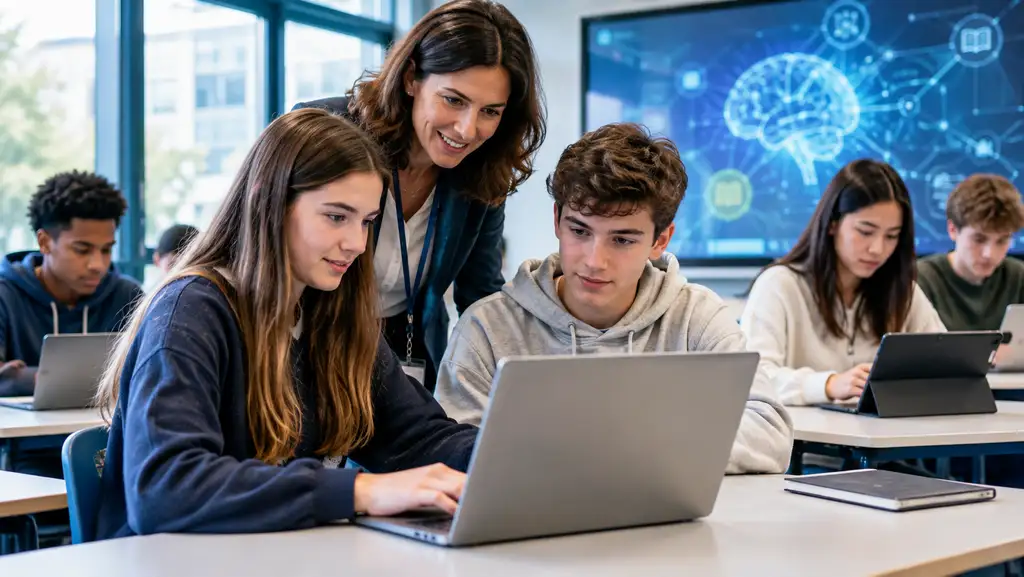
As students gain easier access to AI tools, teachers are increasingly expected to understand how these technologies work and how they should be incorporated into learning.
The European Commission's reports identify continuing gaps in teacher support, particularly around areas such as personalised learning, evaluating online information and using AI effectively.
The European Commission also notes that teachers need substantial initial and continuous professional development to make effective use of generative AI while maintaining responsible practices.
The OECD's 2026 Digital Education Outlook reports that 37% of lower-secondary teachers used AI for their work in 2024, while 57% said AI could help write or improve lesson plans. At the same time, 72% believed AI could create academic-integrity risks by allowing students to present AI-generated work as their own.
Nearly two-thirds of European education systems now address AI
AI is also becoming a policy issue.
According to the European Commission, nearly two-thirds of European education systems now address artificial intelligence through national strategies, guidance or other policy frameworks.
At the same time, implementation remains at an early stage and access to advanced AI technologies differs between schools and education systems.
Digital inequality remains another concern. Students from disadvantaged socioeconomic backgrounds may have fewer opportunities to develop digital skills because of differences in access to devices, reliable internet connections and learning resources.
This means the AI divide could become another form of educational inequality if access and digital skills are not addressed together.
Edunews Analysis: The real AI challenge may be how schools teach students to use it
The most important question for education systems may no longer be whether students should use AI.
Students are already using it.
The more difficult question is what students should be expected to do themselves — and what AI should be allowed to do for them.
If AI simply replaces reading, writing, problem-solving and independent thinking, students may become more efficient at producing answers without necessarily developing the skills behind those answers.
But if teachers use AI as a tool for questioning, feedback, personalised support, research and discussion, the technology can become part of a broader learning process.
This suggests that schools may need to move beyond simple “AI allowed” or “AI banned” policies.
A more useful approach could be to define when AI is appropriate, when students should work independently and how students must evaluate AI-generated information.
The OECD's recent findings point in a similar direction: students can benefit from AI when they are taught to interpret and assess the information it produces rather than simply accepting its answers.
What happens next?
The European Commission says the findings will contribute to its ongoing work on digital education and skills under the Union of Skills, as well as the preparation of a forthcoming Education Package covering basic skills, teachers and trainers, and digital education infrastructure.
For schools, the next phase of AI adoption is therefore unlikely to be only about purchasing new technology.
It will also involve:
- training teachers to use AI effectively;
- teaching students how to evaluate AI-generated information;
- protecting academic integrity;
- addressing privacy and safety concerns;
- reducing inequalities in digital access;
- and designing learning activities where students continue to think, create and solve problems independently.
AI is already changing education. The bigger question is whether education systems can change fast enough to make that technology genuinely useful for learning.
Sources
- European Commission, New reports examine how AI and digital technologies are shaping education in Europe, September 22, 2026.
- European Commission, Two Commission reports show impact of artificial intelligence and digital technologies on teaching and learning in Europe, September 22, 2026.
- OECD, OECD Digital Education Outlook 2026: Exploring Effective Uses of Generative AI in Education, January 19, 2026.
Editorial note: This article was independently written by Edunews.az based on the cited institutional sources. Interpretive commentary is identified as “Edunews Analysis.”