The World Is Running Out of Teachers: New OECD Report Warns of a Growing Education Crisis
A new OECD report reveals that teacher shortages are putting pressure on education systems, particularly in mathematics, science and disadvantaged communities, while a new generation of teachers is becoming harder to recruit and retain.
By Rasim Abdurahman
Education Editor, Edunews.az
Published: October 1, 2026
The global education system is facing a challenge that may be just as important as artificial intelligence, digital transformation and declining student performance: there may not be enough qualified teachers to teach the next generation.
A new report from the Organisation for Economic Co-operation and Development (OECD) shows that teacher shortages are affecting most OECD education systems, with particularly serious recruitment difficulties in mathematics and science and in rural, remote and disadvantaged communities.
The findings were published on September 29 in Education at a Glance 2026, the OECD's annual report comparing education systems across countries. This year's edition places teacher shortages at the centre of its analysis.
9.1% of teachers are not fully qualified
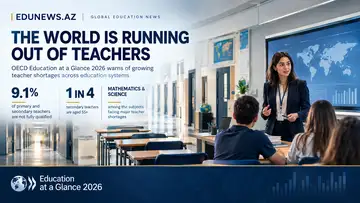
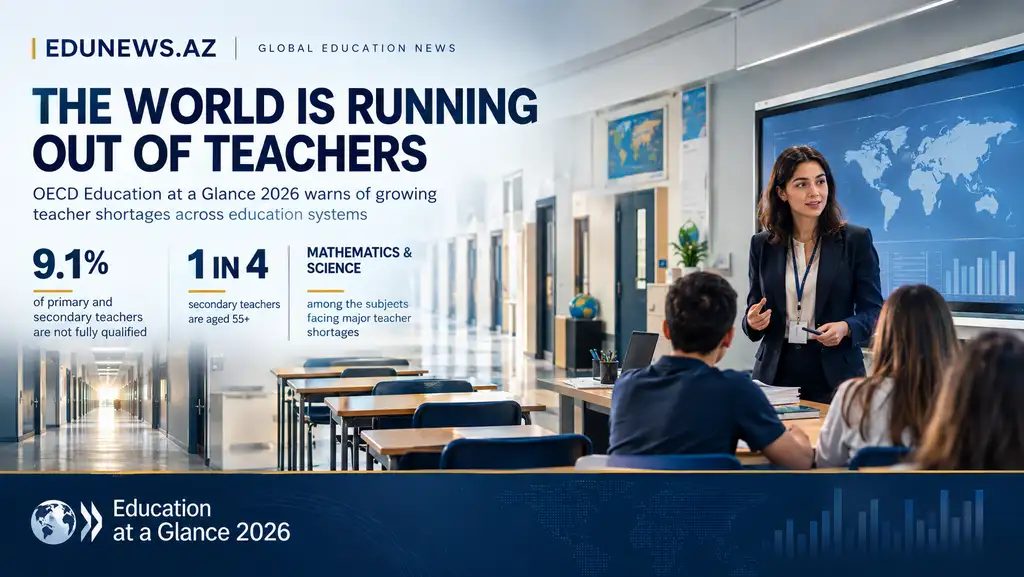
One of the report's most striking findings is that 9.1% of primary and secondary teachers across OECD countries were not fully qualified during the 2024/25 school year.
In some countries, the figure was considerably higher, exceeding 18% in Chile, Denmark, Estonia and Germany.
The OECD says this does not necessarily mean that schools are unable to recruit teachers at all. Instead, education systems are increasingly filling vacancies by recruiting people who do not hold the standard teaching qualifications.
This can be one way of responding to immediate staffing shortages, but it also raises questions about maintaining teaching quality and professional standards.
Mathematics and science are under particular pressure
Teacher shortages are not evenly distributed across subjects.
The OECD found that 11 of the 16 countries and economies with available data reported shortages of fully qualified mathematics and science teachers at secondary level.
The problem can become even more serious in rural and remote communities, where attracting qualified professionals can be more difficult.
This creates a potentially important challenge for education systems because mathematics and science are among the subjects increasingly connected to technology, engineering, artificial intelligence and the future labour market.
If schools cannot consistently provide qualified teachers in these areas, the consequences can extend beyond the classroom and affect students' preparation for further education and employment.
One in four secondary teachers is 55 or older
Another issue identified by the OECD is the age profile of the teaching workforce.
Around one in four secondary teachers across OECD countries is aged 55 or older.
This means that many education systems are approaching a period in which large numbers of experienced teachers could leave the profession through retirement.
The challenge is therefore not limited to today's vacancies.
Education systems need to prepare for the possibility that teacher shortages could become more difficult in the coming years if retirement rates rise while insufficient numbers of younger professionals enter the profession.
Why don't more people want to become teachers?
The answer is more complicated than salary alone.
According to the OECD, 85% of teachers report being satisfied with their jobs, a level broadly similar to workers in other professions.
However, only 22% of teachers believe that teaching is valued by society.
The OECD says that salaries, working hours and working conditions matter, but other factors also influence whether teachers enter and remain in the profession.
These include:
relationships with students;
relationships with parents;
support from school leaders;
school climate;
professional autonomy;
public recognition;
opportunities for professional development.
This suggests that addressing teacher shortages may require more than simply increasing recruitment numbers.
Teacher salaries are part of the problem — but not the whole problem
Across OECD countries, teachers generally earn less than other workers with comparable tertiary education.
On average, teachers earn between 87% and 95% of the earnings of other tertiary-educated workers, depending on the level of education they teach.
The gap can be particularly significant at the beginning of a teaching career: starting salaries for lower-secondary teachers average around 61% of the earnings of similarly educated workers.
This creates a difficult recruitment environment.
A university graduate with strong mathematics, science or technology skills may have multiple career options. Schools therefore compete with other sectors for the same pool of highly educated workers.
The OECD describes teacher shortages as part of a wider shortage of skilled workers across labour markets.
Could technology help?
The report points to technology and new ways of organising teaching as potential parts of the response.
However, technology is not presented as a replacement for teachers.
Instead, the OECD notes that technology, specialised support staff and new organisational approaches could help teachers spend more time on tasks where their expertise has the greatest value.
This is particularly relevant as schools around the world adopt artificial intelligence.
AI can help teachers prepare materials, analyse information and automate some administrative tasks. But the teacher shortage identified by the OECD also demonstrates why education systems need to think carefully about the human role in education.
The central question may not be whether AI can perform some teaching-related tasks.
It may be how technology can support teachers without weakening the human relationships that make education effective.
More young people are entering higher education — but a degree is not an automatic guarantee of employment
The OECD report also highlights another important development.
Across OECD countries, the share of 25–34-year-olds with tertiary education increased from 40% in 2015 to 47% in 2025.
At the same time, however, unemployment among tertiary-educated young adults increased by 0.4 percentage points between 2023 and 2025, while unemployment among young adults whose highest qualification was upper secondary education decreased by 0.2 percentage points.
The OECD stresses that it is too early to know whether this represents a temporary change or a longer-term shift.
The report also notes that some commentators have linked the changing pattern to artificial intelligence and changing demand for skills, but says evidence of a lasting AI-driven shift remains limited.
This creates another important message for students: having a university degree remains valuable, but education systems also need to ensure that graduates develop skills that remain relevant to changing labour markets.
What does this mean for the future of education?
The OECD findings point to a challenge that education systems cannot solve overnight.
Training a qualified teacher takes time.
Replacing experienced teachers who retire requires a new generation of professionals.
And attracting talented graduates into teaching means competing with other sectors that may offer different salaries, working conditions and career opportunities.
The problem is therefore both immediate and long-term.
Countries need to recruit teachers today while simultaneously building a sustainable pipeline of educators for the future.
Edunews Analysis: The next education crisis may be a shortage of people, not technology
Much of the global education conversation currently focuses on artificial intelligence.
How should students use ChatGPT?
Should schools allow AI?
How will AI change university education?
Which jobs will AI transform?
These are important questions.
But the OECD's latest findings highlight another fundamental issue: technology cannot solve a teacher shortage by itself.
A school can have computers, high-speed internet and AI tools, but students still need qualified adults who can explain difficult concepts, identify misunderstandings, motivate learners, manage classrooms and provide human support.
The teacher shortage also has a direct connection to the future of AI education.
If mathematics and science teachers are already difficult to recruit, education systems may struggle to prepare enough students for the fields that will drive future technological development.
For this reason, teacher policy should be viewed not only as an education issue, but also as a long-term economic and workforce strategy.
The next decade may therefore require countries to rethink how they recruit, train, support and retain teachers.
What happens next?
The OECD report does not offer one universal solution because teacher shortages differ significantly between countries.
However, its findings point toward several areas that education systems can examine:
Recruitment: creating stronger pathways into teaching, including routes for mid-career professionals.
Retention: improving working conditions and reducing unnecessary administrative pressure.
Recognition: increasing the professional and social recognition of teachers.
Targeted support: directing additional resources toward subjects and communities where shortages are most severe.
Professional development: ensuring teachers can adapt to new technologies and changing student needs.
Long-term planning: preparing for the retirement of older teachers before shortages become more severe.
The OECD also highlights countries such as Australia and the Netherlands, where more than 15% of lower-secondary teachers are second-career teachers, as examples of systems using alternative pathways to diversify the teaching workforce.
The message from the new report is clear: the future of education depends not only on what technology can do, but also on whether education systems can attract and retain the people who use that technology to help students learn.
Sources
OECD — Education at a Glance 2026.
OECD — Executive Summary: Education at a Glance 2026.
OECD — Teacher shortages are putting pressure on education systems across the OECD, September 29, 2026.
Editorial Note: This article was independently prepared by Edunews based on OECD data and official publications. Interpretive comments are presented in the “Edunews Analysis” section and are intended to provide additional context for readers.