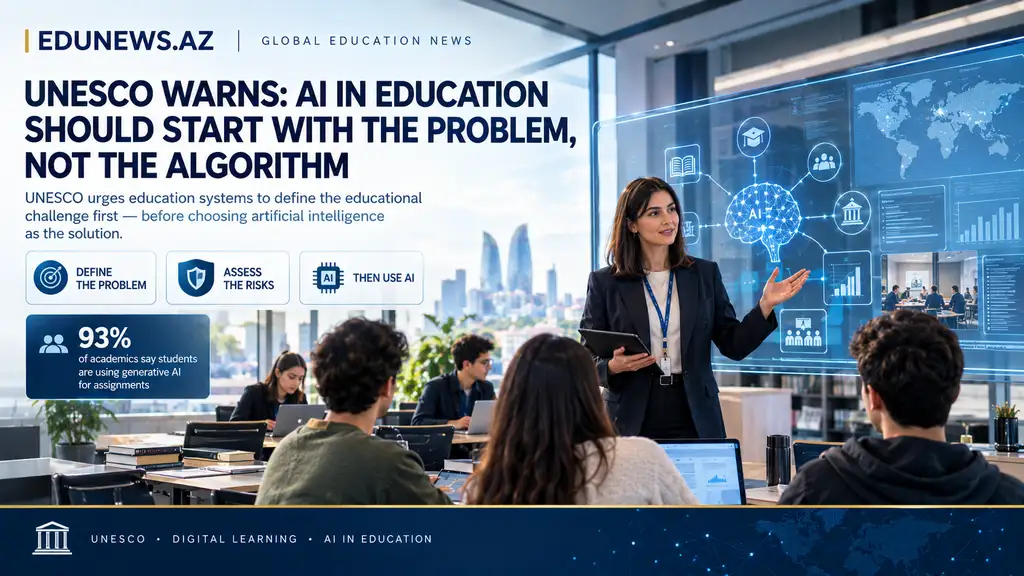
UNESCO Warns: AI in Education Should Start With the Problem, Not the Algorithm
As artificial intelligence rapidly enters classrooms and universities, UNESCO is urging education systems to rethink how they adopt AI — starting with the educational problem, not the technology itself.
By Rasim Abdurahman
Education Editor, Edunews.az
Published: October 3, 2026
Artificial intelligence is becoming one of the most important technologies shaping education. AI tutors, generative AI tools and automated learning systems are increasingly being discussed as ways to personalise education, support teachers and improve learning outcomes.
But UNESCO is raising a fundamental question: Are education systems asking the right question before adopting AI?
In a new article published on October 2, UNESCO argues that the starting point for AI in education should not be the algorithm. Instead, policymakers, educators and technology developers should first identify the problem they are trying to solve.
The message is simple but significant:
Do not start with AI. Start with education.
The problem should come before the technology
During UNESCO's Digital Learning Week 2026, participants from more than 20 countries took part in practical training on designing AI-based products and services for education.
Instead of beginning by choosing an AI technology, participants first mapped the problems facing different groups within education.
Among the issues identified were poor learning outcomes in elementary schools, a growing mismatch between skills and jobs, questions about the purpose of higher education in the 21st century and concerns that AI could weaken the authority and expertise of teachers.
This approach changes the order of decision-making.
Rather than asking:
“How can we use AI?”
education systems are encouraged to ask:
“What problem are we trying to solve, and is AI actually the right solution?”
That distinction could become increasingly important as schools and universities face growing pressure to adopt new technologies.
AI is not automatically the answer
Technology can be powerful, but UNESCO's latest approach highlights an important limitation: not every education problem is a technology problem.
For example, if students are struggling with reading comprehension, an AI tutor may potentially provide additional practice or personalised support.
But the underlying problem could also involve teacher shortages, curriculum design, inadequate learning materials, limited parental support or inequalities in access to education.
In such cases, introducing an AI system alone would not necessarily solve the problem.
UNESCO therefore argues that defining the problem first can help policymakers determine where AI can complement other interventions — and where it may not be the appropriate solution at all.
Ethics should be considered before AI is deployed
Another major point in UNESCO's latest work is the timing of ethical assessment.
The organisation argues that ethical considerations should not be treated as a final compliance check after an AI system has already been built.
Instead, ethical risks should be examined during the design process.
During the UNESCO training, participants used the organisation's Ethical Impact Assessment methodology to examine proposed AI systems and identify potential risks before deployment.
This approach considers questions such as:
- What data will the system collect?
- Who controls that data?
- Could certain groups of students be disadvantaged?
- Can teachers and learners understand how the system operates?
- What happens if the AI produces incorrect information?
- Could the technology reduce rather than strengthen human learning?
- Who is responsible if the system causes harm?
For education systems, these questions are becoming increasingly important as AI moves from experimentation into everyday use.
What happens to the teacher?
One of the most sensitive questions surrounding AI in education is the future role of teachers.
UNESCO's latest discussion highlights concerns that poorly designed AI systems could undermine teacher authority and professional judgement.
The organisation's position is that AI should support teachers rather than replace their professional contribution.
This issue is particularly relevant at a time when education systems are already facing teacher shortages.
The OECD's Education at a Glance 2026 report, published in September, found that 9.1% of primary and secondary teachers across OECD countries were not fully qualified in 2024/25. The report also identified mathematics and natural sciences as areas where teacher shortages are particularly common.
This creates an interesting challenge for education systems.
AI may provide additional support to teachers, but technology cannot automatically replace the human relationships, classroom judgement and professional expertise involved in teaching.
Students also need new AI skills
AI adoption is not only about giving students access to new tools.
Students increasingly need to understand how AI works, what its limitations are and how to evaluate information generated by AI systems.
UNESCO has developed AI competency frameworks for both students and teachers as part of its broader work on responsible AI in education.
The organisation says its work since 2024 has included support for 58 countries in developing frameworks, curricula and quality-assured training programmes for digital or AI competencies.
The objective is not simply to create better AI users.
It is to help learners and educators become capable of making informed decisions about when, why and how AI should be used.
Universities are facing the same transformation
The debate is particularly significant in higher education.
Universities are already dealing with generative AI in assignments, research and assessment.
At UNESCO's Digital Learning Week, the organisation released findings from its second annual survey on AI in higher education.
According to the survey, 93% of academics believe students are using generative AI to produce assignments, while 63% perceive a decline in students' cognitive capacities.
The survey also found that most respondents favoured controlled or disclosed AI use for specific assignments rather than either completely banning the technology or allowing unrestricted use.
This suggests that the debate is gradually moving beyond a simple question of whether students should use AI.
The bigger question is becoming:
How should education change when AI is already part of the learning environment?
A new model for AI adoption
UNESCO's latest approach can be summarised in two principles:
1. Define the educational problem before choosing the technology.
2. Evaluate ethical risks before deploying the AI system.
These principles could influence how governments, universities, schools and technology companies approach AI projects in the coming years.
Instead of launching an AI pilot simply because the technology is available, education leaders could begin by identifying a measurable educational challenge and then determine whether AI provides a meaningful solution.
This could also make AI investments more transparent.
If an education system spends millions on an AI platform, policymakers should be able to explain what educational problem the platform is intended to address and how its impact will be measured.
Edunews Analysis: The real question is not whether education will use AI
The global education debate is increasingly moving beyond the question of whether AI belongs in classrooms.
It is already entering them.
The more important question is what role AI should play.
The risk is not necessarily that schools will use too much technology. The larger risk may be that institutions adopt technology without first defining what successful learning looks like.
A sophisticated AI tutor cannot compensate for a poorly designed curriculum.
An automated assessment system cannot automatically create meaningful learning.
And a chatbot cannot replace every interaction between a teacher and a student.
At the same time, rejecting AI completely may prevent education systems from benefiting from tools that can provide additional support, accessibility and personalised learning opportunities.
The challenge, therefore, is not simply AI versus traditional education.
It is about finding the right balance between technology, teachers, students, evidence and human judgement.
UNESCO's latest message offers a useful framework for that debate:
First define the problem. Then decide whether AI belongs in the solution.
What happens next?
AI adoption in education is likely to continue expanding. UNESCO's Digital Learning Week 2026 and its latest work indicate that the international discussion is increasingly focused on governance, ethics, teacher agency, student rights and the educational value of AI.
For schools and universities, the next stage may therefore be less about asking whether they should adopt AI and more about developing clear rules for when, why and how AI should be used.
The future classroom may contain more AI than today's classroom.
But according to UNESCO's emerging approach, the technology should remain a tool in service of education — not the starting point for defining what education should become.
Sources
- UNESCO — Start with defining the problem, not the algorithm: Designing AI for education
- UNESCO — Education Ministers call for education to remain a common good in the age of AI
- UNESCO — Digital Learning Week 2026
- OECD — Education at a Glance 2026
Editorial Note
This article was independently written by Edunews.az based on information published by UNESCO and OECD. Interpretive commentary is presented separately under the Edunews Analysis section.