Five Years, 1,094 Rejections: Inside Azerbaijan's Quiet War on Academic Plagiarism
BAKU — Azerbaijan's Higher Attestation Commission (AAK) revealed this week that between 2019 and 2024, it refused to award a scientific degree or academic title in 1,094 separate cases — more than 30% of all applications the commission reviewed during that period. AAK Chairman Famil Mustafayev, describing the figures in an interview, said the rejections were driven mainly by plagiarism, weak scientific quality, and failure to meet documentation requirements — with plagiarism sitting at the center of the commission's enforcement priorities.
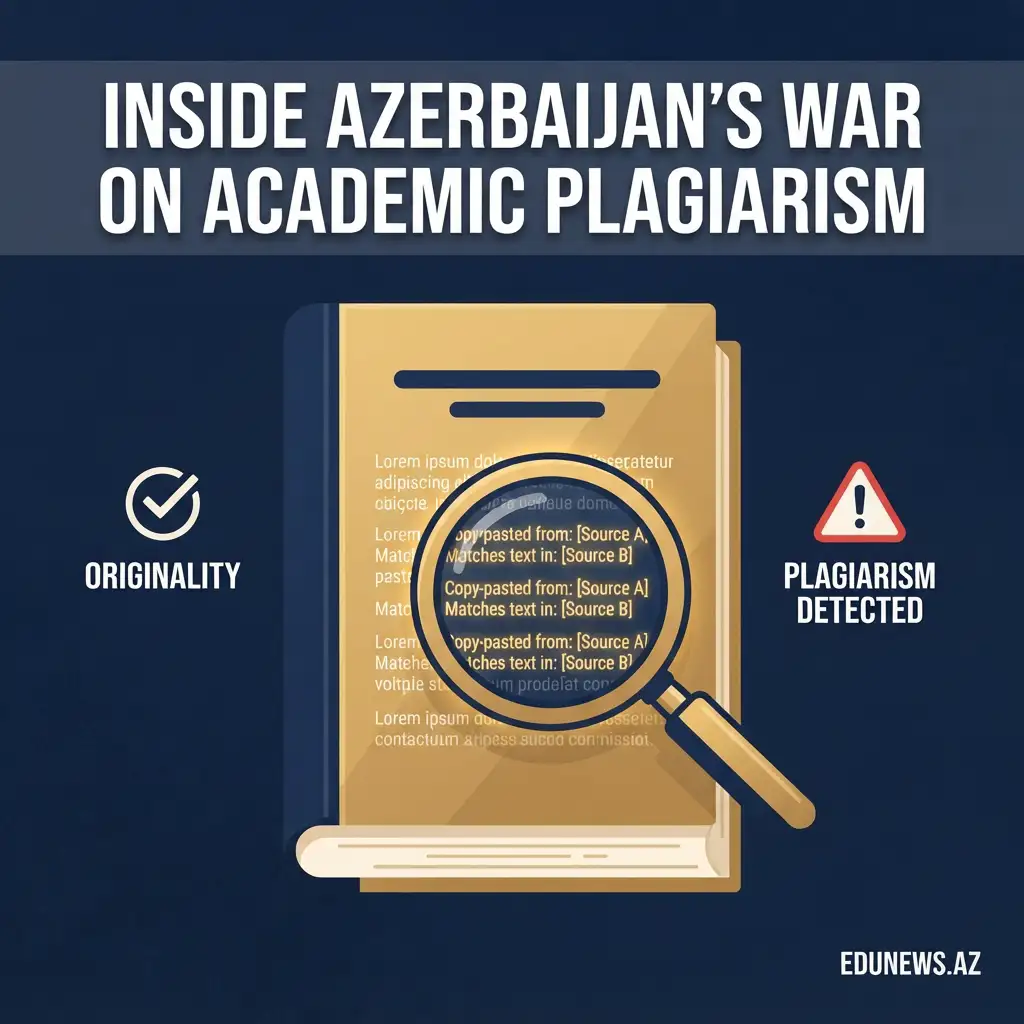
What makes this week's disclosure more than a routine statistics release is the detail Mustafayev gave about how AAK actually catches plagiarism, and what happens once it does. Every dissertation submitted for a degree or title is run through internationally licensed plagiarism-detection software — StrikePlagiarism, Antiplagiat.ru, and Turnitin, the same tool at the center of ongoing debates in Western universities over false-positive rates and AI-generated text detection. But AAK doesn't stop at the software's similarity score. Expert panels conduct a parallel content analysis and contextual keyword search specifically designed to catch what Mustafayev described as cases where a dissertation registers a technical plagiarism score of zero yet still contains clear evidence of plagiarism — meaning candidates attempting to game the detection software by paraphrasing closely enough to avoid triggering an automated match are still being caught through human review layered on top of the algorithmic check.
The commission's enforcement extends well beyond the person submitting the dissertation. Under Azerbaijan's Regulation on the Procedure for Awarding Scientific Degrees, if AAK determines that a defended dissertation used another author's material without proper attribution, the commission doesn't just reject the individual work — it imposes a three-year restriction on the academic supervisor, scientific advisor, and official opponents who gave the dissertation a positive review, barring them from serving in those same roles again during that period. That's a structurally significant enforcement design choice: it makes the entire chain of academic sign-off accountable for a plagiarism finding, not just the original author, which changes the incentive calculus for supervisors and opponents who might otherwise be tempted to wave through a weak or borrowed dissertation as a professional favor.
Mustafayev also flagged categories of misconduct that go beyond straightforward copy-paste plagiarism and are harder for any automated system to catch: the presentation of pseudo-scientific conclusions, previously published research repackaged as new findings, dissertations built around repeatedly recycled topics, and — in the most serious cases — dissertations effectively written by other individuals or commercial ghostwriting operations on the actual candidate's behalf. Each of these categories represents a more sophisticated form of academic fraud than simple textual copying, and each requires the kind of expert human judgment that similarity-detection software, by design, cannot provide on its own.
This matters for a country actively trying to expand its research capacity and international scientific standing at the same time it's confronting exactly this kind of internal quality problem. As covered previously on this site, Canada spent this summer publicly recruiting scientists directly away from Harvard, MIT, and Yale, backed by half a billion dollars in government funding — part of a broader global competition for research talent that rewards countries with credible, trusted academic credentialing systems. A national degree-granting body that visibly polices plagiarism, restructures accountability across the entire dissertation approval chain, and is willing to reject roughly a third of applications rather than rubber-stamp them, is making a specific bet: that credibility in the international research community depends on being known for rigor, not just research output volume. A commission that quietly waved through weak or borrowed dissertations might produce more nominal PhDs per year, but it would produce degrees carrying steadily less international credibility — precisely the opposite of what a country hoping to build research partnerships, attract international faculty, or see its own scientists taken seriously abroad actually needs.
There's an open question AAK's disclosure doesn't fully answer: whether a 30%-plus rejection rate reflects a genuinely serious integrity problem within Azerbaijan's research pipeline, or whether it reflects a commission that has simply gotten far more rigorous at catching problems that already existed at similar rates before better detection tools were in place. Mustafayev's own framing leans toward the second interpretation — a commission actively strengthening its technological and procedural tools over this specific five-year window — but distinguishing between "more misconduct" and "better detection of existing misconduct" is a genuinely difficult empirical question that the raw rejection-rate number, on its own, can't resolve. Either way, for anyone currently pursuing a graduate degree, an advisor role, or an opponent position within Azerbaijan's dissertation system, this week's disclosure is a clear, concrete signal: AAK's plagiarism enforcement isn't a formality standing between a finished dissertation and a rubber stamp — it's an active, multi-layered screening process that assigns real professional consequences up and down the entire chain of academic sign-off, not just to the person whose name is on the cover page.