
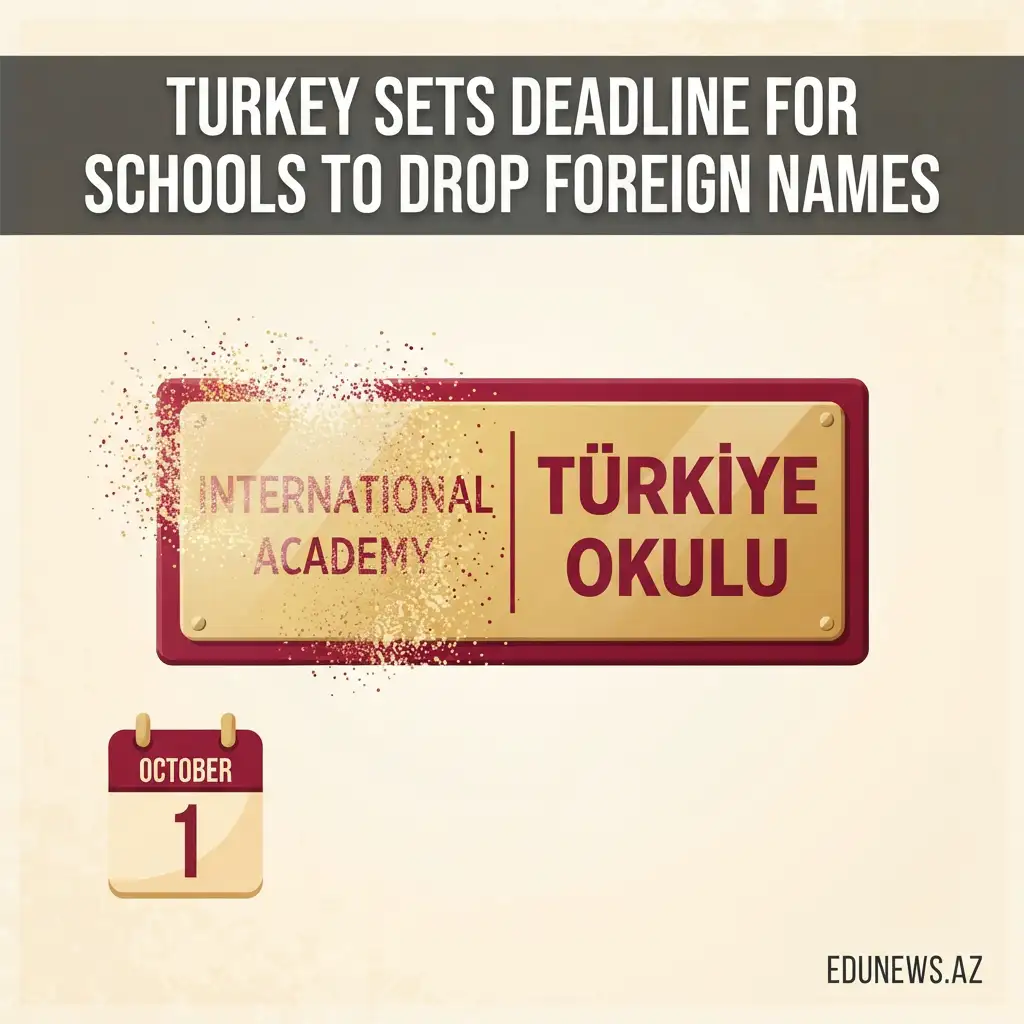
Turkey Gives Private Schools Until October 1 to Drop Foreign Names
ANKARA — Turkey's Education Ministry has set an October 1, 2026 deadline for domestic private schools operating under foreign-language names to switch to Turkish ones, enforcing a naming requirement that has technically existed in regulation since 2020 but is now being applied with new urgency and a hard compliance date. The directive covers previously licensed institutions currently operating under non-Turkish designations, requiring them to submit new names for ministry approval.
The rule itself is narrower than it might first appear, and the exemptions matter as much as the mandate. Minority schools, genuinely international institutions, and courses devoted exclusively to foreign-language instruction remain explicitly outside the requirement — meaning a school like Robert College, the well-known American-founded private school in Istanbul operating as a recognized foreign institution, is unaffected. What the ministry is targeting specifically is domestic private schools — Turkish-owned, Turkish-licensed institutions serving primarily Turkish students — that have adopted English, French, or other foreign-language branding without qualifying for the international-school exemption category. An earlier, narrower version of this enforcement effort surfaced in August 2024, when the ministry sent letters to governorates in six provinces requesting that 30 specific schools with non-Turkish names be renamed; this week's directive appears to be a broader, nationwide continuation of that same enforcement push, now backed by a firm deadline rather than case-by-case requests.
The ministry's stated rationale leans heavily on cultural and linguistic preservation language: proposed replacement names must carry genuine Turkish meaning, align with the goals of Turkish national education, and respect what the ministry describes as the nation's "national, moral, human, spiritual and cultural values." The government's own framing describes the policy as guarding against "cultural degeneration, identity erosion, linguistic alienation" and potential negative effects on students' psychosocial development — language that positions the rule as child-protective and identity-preserving rather than simply administrative housekeeping.
That framing puts the policy squarely inside a debate playing out in multiple countries this year over the relationship between globalized, English-dominant education branding and national cultural identity — though the specific arguments and stakes differ meaningfully by context. Supporters of naming requirements like Turkey's typically argue that allowing private education to brand itself primarily in a foreign language, particularly when done for prestige or marketing purposes rather than genuine bilingual instruction, can subtly signal that foreign-language, foreign-styled education carries more status than an equivalent Turkish-named institution — an association critics say is worth actively discouraging through regulation rather than leaving unaddressed. Critics of naming mandates, in Turkey and in comparable debates elsewhere, generally counter that a school's name is a poor proxy for its actual educational quality or cultural content, and that this kind of naming enforcement risks functioning more as a symbolic nationalist gesture than a substantive intervention in what students are actually taught — a criticism made more pointed by the fact that the rule targets branding specifically, not curriculum, language of instruction, or any other more substantive marker of a school's character.
For context, Turkey's genuinely international education sector — schools serving expatriate and diplomatic families, offering International Baccalaureate or other foreign curricula, concentrated heavily in Istanbul and Ankara — sits entirely outside this week's directive and continues operating under its established foreign names without any change required. That distinction is likely to matter significantly for how the policy is actually perceived and enforced in practice: a genuinely international school with a foreign curriculum, foreign accreditation, and a substantially non-Turkish student body has a straightforward case for exemption, while a domestically-oriented private school that adopted an English name primarily for marketing appeal, without corresponding foreign curriculum or accreditation, sits squarely in the category the ministry is targeting.
The ministry has not published a list of which specific institutions must comply or estimated how many schools nationwide will be affected by the October 1 deadline, leaving the practical scope of enforcement somewhat unclear until compliance activity becomes visible closer to the deadline itself. For Azerbaijani families and institutions with ties to the Turkish education sector — a meaningful population given the volume of academic exchange, joint universities, and shared educational partnerships between the two countries — the directive is worth watching primarily as a signal of how Turkey's government currently balances private-sector educational branding against broader national-identity policy, a balance that could plausibly extend to other areas of cross-border educational cooperation and naming conventions if the enforcement approach proves durable.