
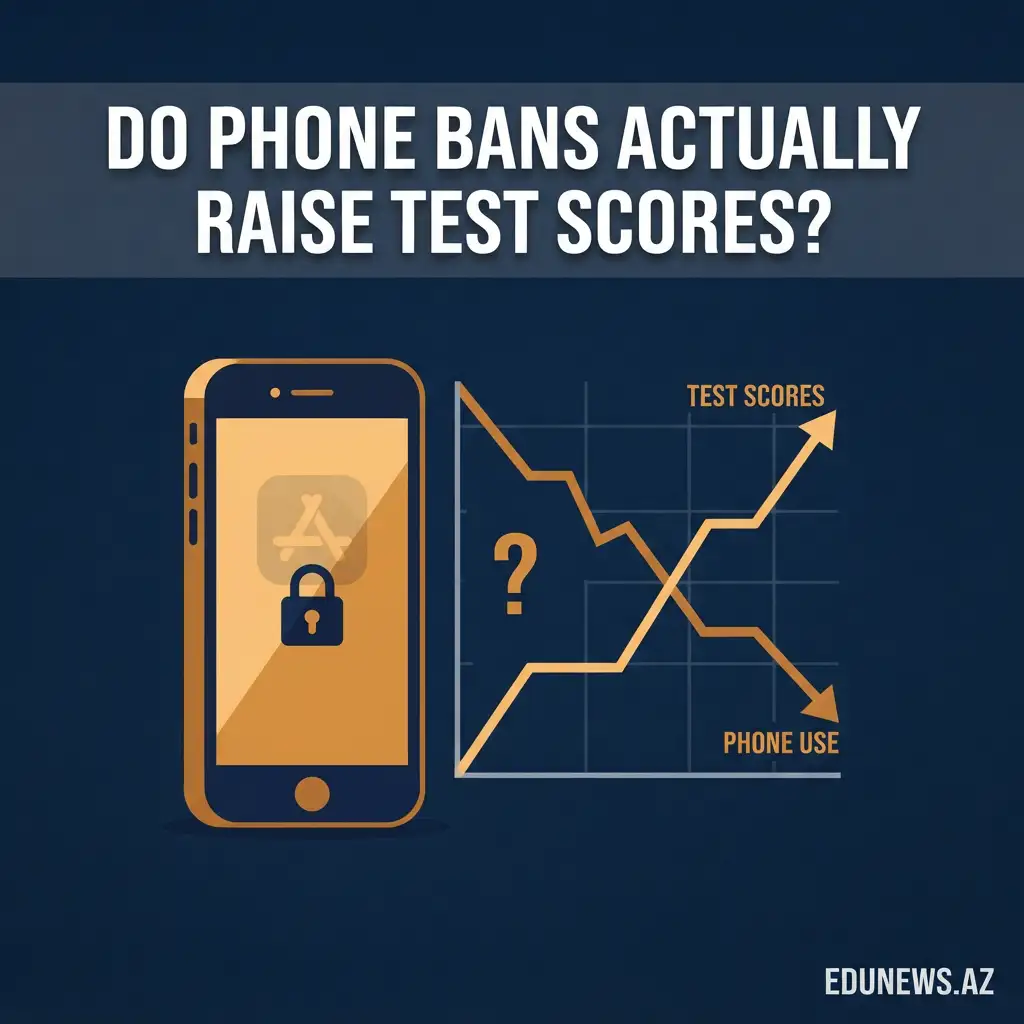
Do Phone Bans Actually Raise PISA Scores? The New Data Says: It's Complicated — and Not in the Direction You'd Expect
PARIS — With PISA 2025 results now fully public, one of the most-asked questions in education circles this week has a genuinely uncomfortable answer: countries and economies with more widespread school phone bans tended to have lower average science performance this cycle, not higher — the opposite of what the global rush toward phone restrictions has been implicitly betting on. The OECD's own report is careful to note that PISA data can't establish causation, and offers a specific alternative explanation: it may be that lower-performing systems are more likely to have adopted bans as a corrective measure in the first place, rather than bans causing the lower performance.
That finding lines up with earlier research on the same question. A 2024 analysis by the British Educational Research Association, examining PISA 2022 data across 81 countries, found an almost identical pattern: for every 10 percentage-point increase in the share of schools banning phones within a country, mean PISA scores fell by roughly 9.4 points — a relationship that held even after controlling for gender, school behavior, and socioeconomic status. Two consecutive PISA cycles, using different data, arriving at the same counterintuitive correlation, is enough to take seriously as a real pattern rather than statistical noise, even without being able to say why it's happening.
But — and this is the part that makes the story genuinely more interesting than a simple "phone bans don't work" headline — PISA 2025 also contains data that cuts in the opposite direction on a more specific, narrower question. Students in schools that prohibit phone use are roughly 13% less likely to report digital distraction during class, and OECD-wide, students who reported digital distraction during science lessons scored 11 points lower than those who didn't, after accounting for socioeconomic background. In France specifically, that distraction penalty was more than double the OECD average — 24 points. So phone bans do appear to measurably reduce reported classroom distraction. They just don't appear, at the system level, to translate into the higher aggregate test scores that would be the obvious next logical step.
The UAE offers a striking individual case study of exactly this tension. PISA 2025 found 90.1% of UAE students now attend phone-free schools, nearly double the 49.5% OECD average — one of the most aggressive national phone-restriction rates in the assessment. Education officials there have pointed to reduced digital distraction as a genuine, tangible classroom benefit. Whether that translates into a proportionally higher UAE PISA score, given the broader pattern this cycle showing high-ban systems tending toward lower average performance, is exactly the kind of individual-country exception versus global-pattern tension that makes this data resist a single clean headline.
Denmark's case adds yet another layer. Danish officials proposed extending the country's phone restrictions to a total ban — covering breaks and schoolyard time, not just lessons — specifically in response to PISA 2025 showing Denmark's lowest performance since it began participating in the assessment in 2000. Danish students reported spending 3.2 hours per school day using digital devices for learning, nearly double the OECD average of 1.7 hours, alongside above-average reported classroom distraction. Denmark's own Ministry of Education acknowledged directly what the OECD's global data shows: the relationship between phone bans and academic performance "remains unclear," even as the country moves toward a stricter ban anyway — a policy response based on plausible reasoning and reduced distraction rather than proven score gains, which is a genuinely honest way to justify a policy, even if it complicates any simple "the evidence shows bans work" narrative.
Context matters enormously here too, since the global movement itself is moving fast regardless of how settled the underlying evidence is: at least 114 education systems worldwide now have some form of national phone ban, according to PISA 2025 data, up sharply from just a handful of years ago, with South Korea passing a nationwide classroom ban in 2025 and France extending its existing ban to all high schools starting this academic year. A separate UK study from Birmingham University found no proof that phone bans alone improve academic performance or wellbeing, and argued bans need to be paired with broader strategies addressing phone use outside school hours too — a finding that would help explain why a policy that clearly reduces in-class distraction doesn't automatically show up as a national score gain, if students are simply making up screen time before or after school instead.
For Azerbaijan — currently absorbing its own strong PISA 2025 improvement while Minister Amrullayev warns publicly that unregulated AI use risks creating new learning problems — this data is worth reading carefully rather than reflexively. The honest lesson from two consecutive PISA cycles isn't "phone bans don't matter." It's that reducing classroom distraction and raising national test scores are two different policy goals that don't automatically move together, and that any country weighing its own phone-restriction policy should be explicit about which of those two outcomes it's actually trying to achieve — because the evidence for one is real and measurable, while the evidence for the other remains, in the OECD's own careful phrasing, simply unclear.