
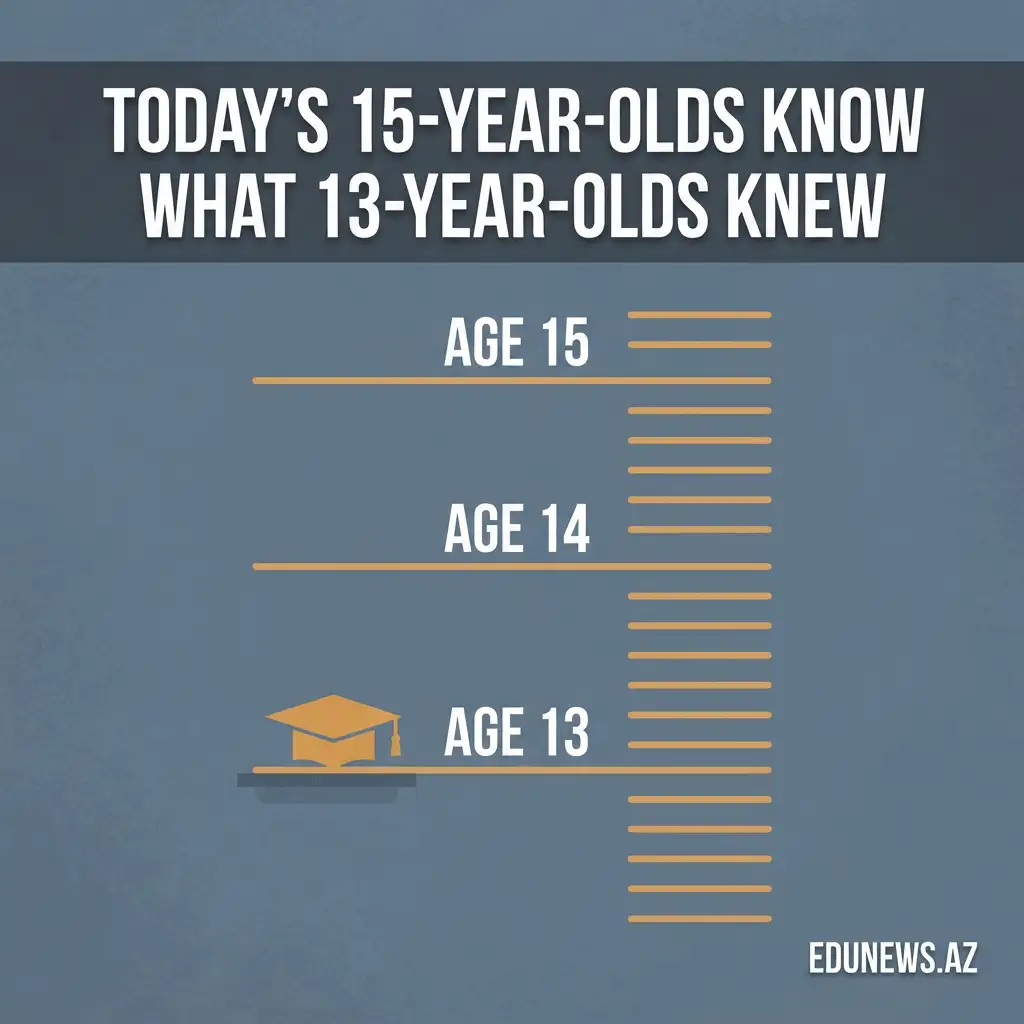
PISA 2025's Real Headline: Today's 15-Year-Olds Know What 13-Year-Olds Knew a Decade Ago
Buried beneath the country-by-country PISA 2025 rankings dominating this week's coverage is a single comparison stark enough to cut through all the methodological nuance: average OECD reading scores fell 28 points between 2015 and 2025 — roughly a year and a half of learning, gone. Mathematics fell 22 points, just over a year of learning. Higher education analyst Alex Usher, summarizing the results for his widely-read industry newsletter, put it in the bluntest terms anyone has managed yet: "fifteen year-olds can now do what thirteen year-olds could do ten years ago."
That framing matters more than another ranking table because it sidesteps the country-versus-country comparison entirely and asks a different, harder question: regardless of which nation sits where on this year's list, has the assessment itself been quietly measuring a two-year developmental regression across the entire OECD bloc simultaneously? If Usher's comparison holds up under closer scrutiny, PISA 2025 isn't really a story about winners and losers — it's a story about the water level dropping under every boat in the harbor at once, which makes country rankings almost beside the point next to the more urgent question of why the whole system is producing less capable 15-year-olds than it was producing a decade ago.
This lines up directly with research this site examined last month in coverage of post-pandemic "learning loss": Stanford economist Eric Hanushek's analysis found American student achievement specifically peaked around 2012-2013 and has been declining steadily ever since, with COVID accelerating an already-underway slide rather than causing it outright. PISA's 2015-to-2025 window captures almost exactly that same pre-existing decline, now confirmed at the international level rather than just within a single country's domestic testing data — two entirely separate assessment systems, using different methodologies and covering different populations, converging on the same underlying finding: something changed for the worse in how 15-year-olds learn, well before any classroom ever closed for a pandemic.
The "what caused it" question remains genuinely contested, and this week's PISA release adds one more specific culprit to the debate without resolving it: PISA 2025 data shows students in most education systems now use AI chatbots for schoolwork, described in the OECD's own report language as "creating new challenges and opportunities for their learning" — a carefully neutral phrasing for a technology this site has covered extensively this year through research on cognitive offloading, AI's tendency to grade essays more generously than human teachers, and the American Psychological Association's recent warning that engagement with educational technology is not the same thing as learning. Andreas Schleicher, the OECD's own director overseeing PISA, offered a different but complementary explanation specific to Canada's results: a measurable decline in parental interest in their children's education — a finding that, if it generalizes beyond Canada, would suggest family engagement, not just classroom technology or curriculum design, deserves more attention in the decline story than it currently receives.
There's a sobering coda to this week's PISA coverage worth including for perspective, even though it comes from outside the OECD's wealthy-country core: a separate report this week noted that in one lower-income education system, only 12.8% of students passed national university entrance exams this year — an improvement over the previous year's 8.9%, but still catastrophically low by any standard, alongside a finding that only about half of graduating students in some developing education systems pass university exit examinations at all, a quality-control measure used in countries from Brazil to Ethiopia. The analyst covering that data posed the same unresolved question education researchers keep returning to across completely different contexts: is the problem the education itself, or the exam measuring it? PISA's OECD-wide decline and this lower-income system's near-total exam failure rate are different scales of crisis, but they share the same diagnostic uncertainty at their core.
For Azerbaijan, riding a genuinely strong PISA 2025 improvement this same week, the broader OECD-wide decline is worth reading as context rather than comfort: improving against a falling global baseline is a real, creditable achievement, but it's a different accomplishment than improving against a stable or rising one, and Minister Amrullayev's own repeated caution — that today's results will only be fully understood in 10 to 15 years — looks increasingly well-calibrated against a backdrop where even the world's wealthiest, most stable education systems are still trying to figure out why their 15-year-olds have quietly lost two years of measurable capability over the past decade.