
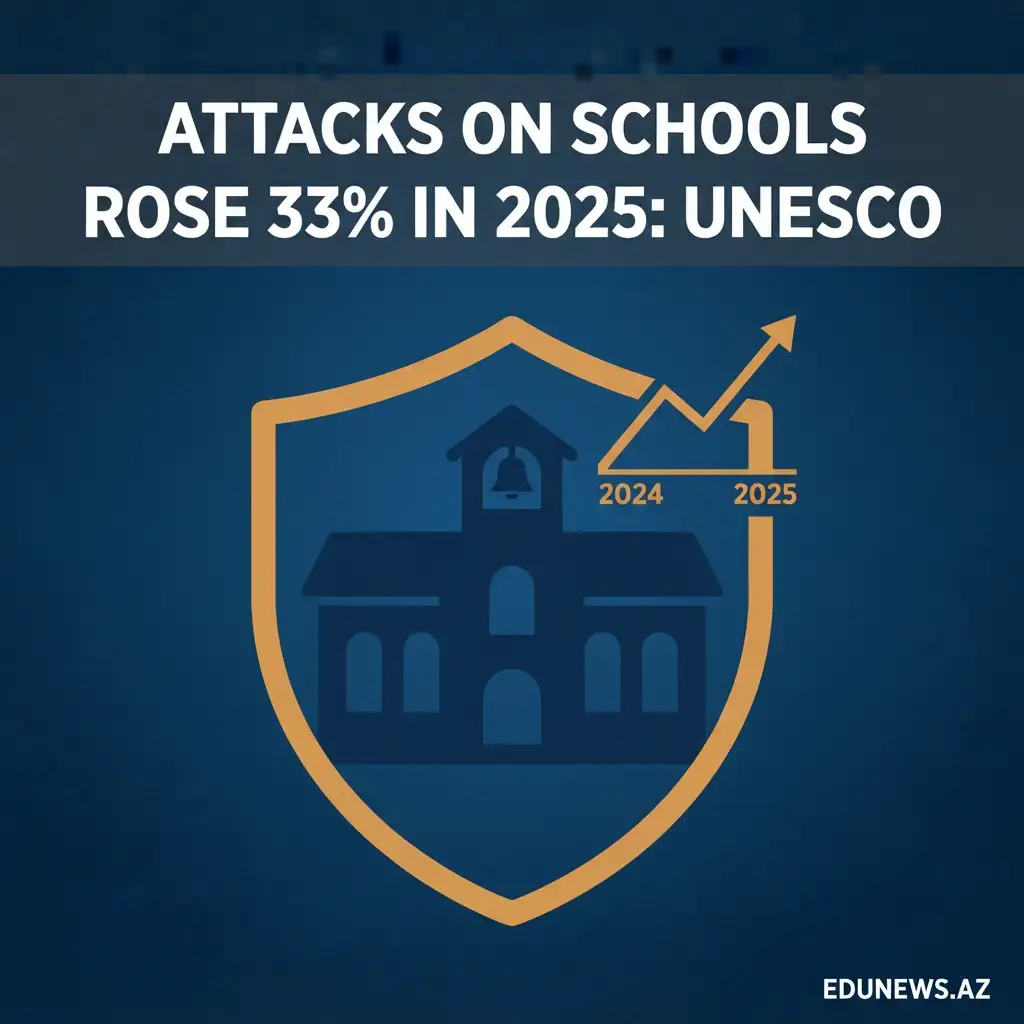
On the Day Meant to Protect Schools From Attack, UNESCO's Own Numbers Show the Opposite Is Happening
PARIS — September 9 is the International Day to Protect Education from Attack, established by unanimous UN General Assembly decision in 2020. This year's observance arrived with data that undercuts its own purpose: UNESCO confirmed 1,680 verified attacks on schools in 2025, a 33% increase over the 1,265 recorded in 2024 — the numbers moving in exactly the wrong direction on the one day each year set aside to draw attention to them.
The school-attack figure sits inside a larger, harder-to-absorb picture. UNESCO estimates 258 million children and adolescents worldwide currently have their education disrupted by crises of one kind or another, with 93 million entirely out of school — a figure this site covered last month when it was first released, now folded into today's broader observance. The disruption isn't distributed evenly: nearly 80% of all crisis-affected out-of-school children, roughly 74 million, live in just 20 countries facing the world's most severe emergencies. Within those settings, the barriers compound for the most vulnerable groups specifically — 74% of refugee children, 52% of internally displaced children, and 45% of children with disabilities in these crisis zones are out of school entirely, well above the rates for children in the same countries who aren't refugees, displaced, or disabled.
UNESCO Director-General Khaled El-Enany used the occasion to restate a principle that shouldn't need restating but evidently does: schools and universities must always be protected, with all parties to conflicts expected to respect international law so education can continue "in safety and dignity, even in the midst of crisis." A separate, independently compiled count from the Global Coalition to Protect Education from Attack — covering a slightly different two-year window, 2024 through 2025 — recorded at least 8,566 attacks on education and incidents of schools or universities being used for military purposes, a more than 40% increase over the prior reporting period, with at least 10,600 students, teachers, professors, and education staff harmed.
The regional concentration of this crisis is stark and specific, not diffuse. A UNESCO rapid assessment of the Arab states region alone, published earlier this year, found more than 100 million children living in conditions defined by violence and instability across 15 affected countries, with 52 million experiencing direct disruption to their schooling. Within that assessment, the State of Palestine's education system was described as devastated "to an unprecedented degree" — an estimated 97.5% of schools damaged or destroyed, cutting off more than 637,000 children from education entirely, with over a million young people now needing mental health and psychosocial support as a direct consequence. In Lebanon, more than 1,150 educational facilities have been repurposed as emergency shelters for displaced families, while 570 schools remain closed or sit inside active conflict zones, cutting off close to 242,000 students from learning through no fault of their own.
This site's coverage this year has already documented one of the starkest individual examples behind these aggregate numbers: Ukraine's schoolchildren beginning their fifth consecutive wartime school year, with a third of the country's students learning entirely online because in-person classes remain too dangerous in frontline regions. Today's UNESCO data confirms that story isn't an isolated case — it's one instance of a pattern repeating, and by UNESCO's own measurement, worsening, across multiple regions simultaneously. A Newsweek opinion piece marking today's observance argued the global response has for too long been reactive — condemning attacks after they happen, assessing damage, appealing for humanitarian access, rebuilding where possible — and called for the next phase of international action to focus on designing education systems that actively deter the strategic value of attacking them in the first place, rather than simply responding once the damage is done.
For education systems far from active conflict — Azerbaijan among them, currently absorbing genuinely good news of its own this week with a strong PISA 2025 result — today's UNESCO figures are a useful, sobering corrective to how narrowly "education policy" tends to get defined in stable countries. Curriculum design, testing methodology, AI integration, and tuition financing are the questions dominating this site's coverage of Azerbaijan's own education system this year. For 258 million children elsewhere, the more basic question — will the school building still be standing, and safe enough to enter, tomorrow — remains entirely unresolved, and by today's data, is getting worse rather than better.