
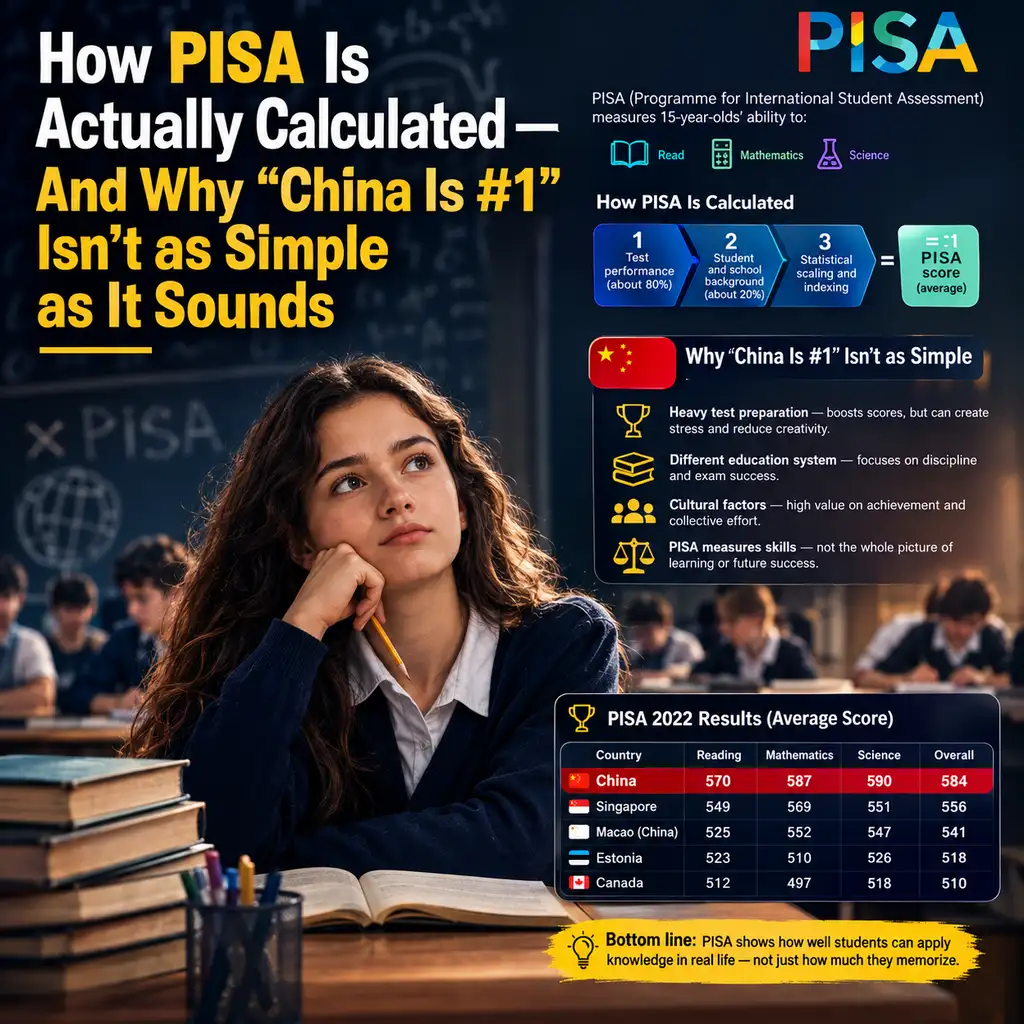
How PISA Is Actually Calculated — And Why "China Is #1" Isn't as Simple as It Sounds
Every three years, headlines announce the same kind of story: "Singapore tops world in math," or "Western countries fall behind Asia in reading." The source is almost always the same test — PISA, the OECD's Programme for International Student Assessment. It's treated as the gold standard of global education comparison. It's also more statistically complicated, and more politically contested, than the two-line news summary ever lets on.
Here's how it actually works — and where the numbers deserve a second look.
What PISA Actually Tests
PISA doesn't test what students memorized from their national curriculum. It tests whether 15-year-olds can apply knowledge in reading, math, and science to realistic, unfamiliar problems — closer to reasoning ability than rote recall. It runs every three years, coordinated by the OECD, and now covers more than 80 countries and education systems, testing over 600,000 students who stand in for tens of millions of real 15-year-olds worldwide.
The assessment itself takes around two hours per student, delivered by computer, alongside a background questionnaire covering things like home environment, school resources, and study habits — data researchers later use to explain why scores differ, not just that they differ.
The Sampling: More Complicated Than It Looks
Here's the part almost nobody outside education-statistics circles understands: no student takes the whole test. PISA uses a technique called matrix sampling — each student answers only a rotated subset of the full item pool, and statisticians use item response theory (a scaling method that estimates ability from partial responses, the same family of statistics behind adaptive tests like the GRE) to reconstruct a comparable score across students who never even saw the same questions.
On top of that, PISA doesn't test a random sample of the whole country directly — it uses a two-stage design. First, schools are sampled with a probability proportional to their size. Then, roughly 35 students are randomly sampled within each selected school. Because this design is statistically more complex than a simple random sample, PISA doesn't calculate standard errors the normal way — it uses a resampling technique (essentially running the calculation thousands of times on slightly different simulated samples) just to get a trustworthy margin of error.
The result: a PISA "score" isn't a raw average. It's a heavily modeled statistical estimate, built from partial answers, complex weighting, and repeated resampling — genuinely sophisticated, but also genuinely a step removed from "how well did this country's kids do on this test," which is how it usually gets reported.
Where It Gets Politically Messy: Who Counts as "The Country"?
This is PISA's most persistent controversy, and it's not a minor technical footnote.
PISA's rule is that a "region" can represent an entire country if it meets sampling standards — which sounds reasonable until you look at who has actually used that rule. China does not test nationally. Its results have been built from a small handful of its wealthiest, best-resourced provinces — Beijing, Shanghai, Jiangsu, and Zhejiang, commonly abbreviated B-S-J-Z — while the other 28 provincial-level regions, home to the vast majority of China's population, aren't included at all.
The controversy runs deeper than "China only tested rich cities." Critics — including Brookings Institution researchers and education statisticians — have pointed out that Shanghai's own sample appears to systematically undercount migrant children, who make up a huge share of the city's actual 15-year-old population but are restricted from full access to urban schooling under China's hukou household-registration system. When independent researchers tried to estimate how many 15-year-olds should have shown up in Shanghai's sample based on standard population ratios, the numbers came in dramatically short — suggesting a meaningful chunk of the city's least-advantaged teenagers simply weren't part of the test pool that produced China's chart-topping scores.
The OECD has defended its methodology and disputes the exclusion claims. But the pattern is clear enough that it's not just internet skepticism: Hong Kong, Macao, and Singapore also report as standalone city-states rather than as part of larger, more diverse national populations, meaning several of PISA's very top performers are, structurally, wealthy urban enclaves being compared against entire nations — rural regions, poorer provinces, and all.
Other Reasons to Read Rankings Carefully
Test-taking culture varies enormously. In some education systems, PISA is treated as a genuinely high-stakes national event, with local officials actively involved in preparation. In others, it's just another Tuesday for a randomly selected classroom. That difference in how seriously students take an assessment that doesn't affect their own grades can move scores independently of actual ability.
Small rank differences are mostly noise. Because PISA scores come with real statistical margins of error, the gap between, say, the 5th- and 12th-ranked country is often not statistically meaningful — even though news coverage treats every position on the list as a precise, meaningful step down.
PISA measures one narrow slice of "good education." Applied reasoning in three subjects says nothing about creativity, physical education, arts, civic engagement, or dozens of other things a healthy school system might value — a limitation the OECD itself acknowledges even as headlines routinely treat PISA rank as a full verdict on a country's schools.
So What Should You Actually Trust?
PISA is still one of the most rigorous, carefully designed comparative measurements in education — the statistical machinery behind it is genuinely impressive, and for most participating countries, the sampling is legitimate and nationally representative. The caution isn't "ignore PISA." It's narrower than that: treat any result built from a sub-national or city-state sample with real skepticism when it's being compared against full-country results, and treat small rank differences between similarly-scoring countries as statistical noise rather than meaningful gaps.
For Azerbaijan and countries considering PISA participation or already comparing themselves against it, the practical lesson is this: the number is only as trustworthy as the sample behind it. A country that tests its entire population honestly and scores modestly is giving you more useful information than one that tests only its richest city and tops the chart.