
How QS and THE Rankings Are Actually Calculated — And When You Shouldn't Trust Them
Every year, millions of students and parents make one of the biggest decisions of their lives partly based on a number they never really question: a university's rank. #47. #212. Top 10. But almost nobody stops to ask what that number is actually built from — and once you look inside the formula, you start to understand why two rankings can disagree wildly about the exact same university.
Here's what's actually inside the two most-cited global rankings, and where the cracks are.
How QS Calculates Its Number
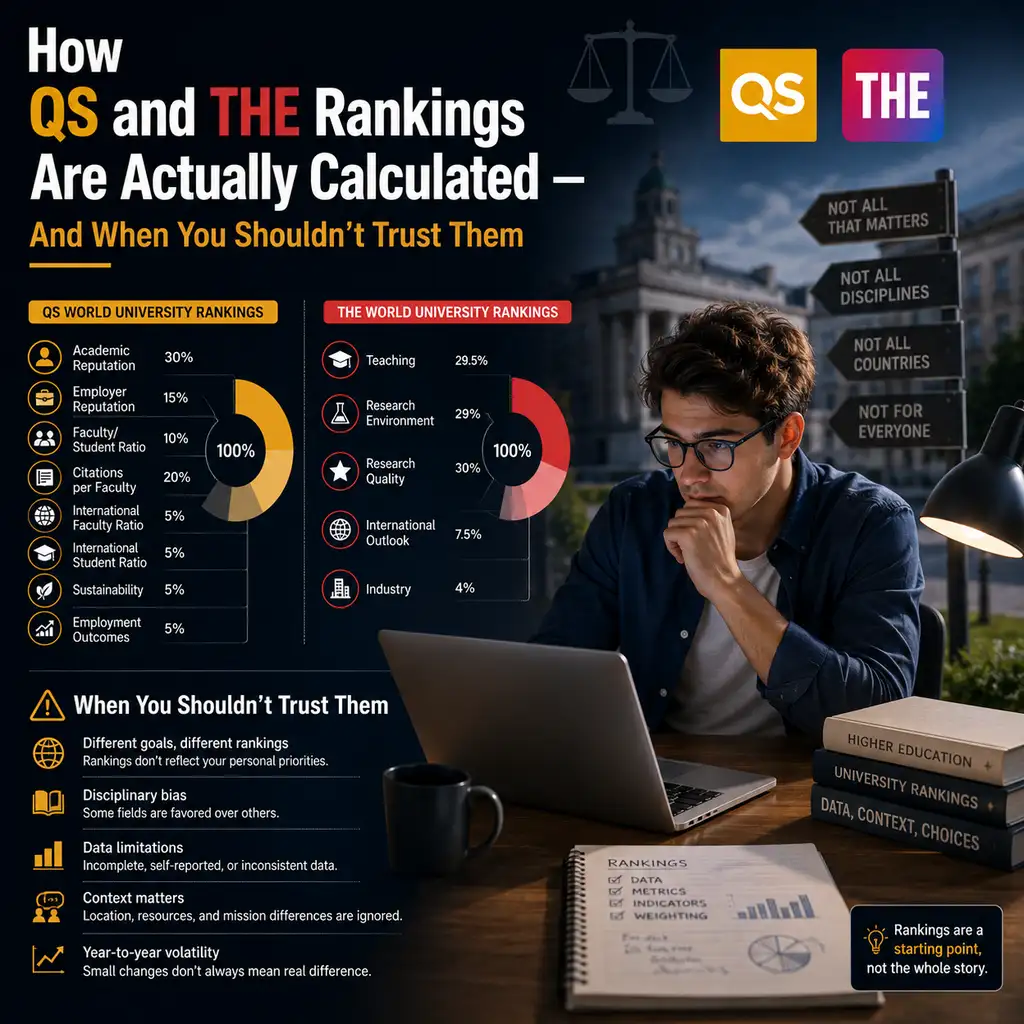
The QS World University Rankings blend several "lenses" into one overall score, weighted like this in the current methodology:
- Academic Reputation — 30%. A massive global survey of academics asking them to name the best universities in their field.
- Citations per Faculty — 20%. How often an institution's research gets cited, divided by the size of its faculty.
- Employer Reputation — 15%. A separate survey, this time of employers, asking which universities produce the best graduates.
- Faculty/Student Ratio — 10%. A rough proxy for teaching resources and class sizes.
- International Faculty Ratio and International Student Ratio — 5% each.
- The remaining share covers newer additions like sustainability and employment outcomes, which QS has been folding in over recent editions.
Notice what that adds up to: reputation surveys alone — Academic Reputation plus Employer Reputation — make up 45% of a university's entire QS score. Almost half the ranking comes down to what other people think of a university, not what it directly measures about teaching quality, student outcomes, or value for money.
How THE Calculates Its Number
Times Higher Education spreads its scoring across five broader "pillars," built from 18 individual indicators:
- Teaching (including a reputation survey component)
- Research environment (volume, income, and reputation)
- Research quality (largely citation impact)
- International outlook (staff, students, and co-authorship)
- Industry and Innovation (income from industry, patents)
THE's reputation survey carries real weight too, but it's spread more thinly across categories than QS's, rather than concentrated into two dominant reputation-only indicators. THE also caps how much any single university's own staff can vote for it in the reputation survey — no more than 10% of a university's total votes can come from people who work there, a rule added specifically to stop the most obvious form of self-promotion.
Where the Cracks Show Up
1. Reputation surveys measure fame, not quality. Academics are asked to name the best universities in their field — and unsurprisingly, they tend to name the universities they've already heard of. Older, wealthier, English-language, and Western institutions have a structural head start simply because more people have heard of them, regardless of how good the actual teaching is on the ground. Researchers analyzing the QS methodology have pointed out that response rates skew heavily toward certain regions, and that the identities of employer-survey respondents have never been published — meaning nobody outside QS can verify who's actually doing the voting.
2. Small movements can swing rankings wildly. Because so many universities cluster closely together in score, a tiny shift in one indicator — a handful of extra citations, a slightly better survey response rate — can move an institution up or down dozens of places in the published table, even though almost nothing meaningfully changed about the education students receive there.
3. Research gets rewarded more than teaching. Between citations, research income, and research-focused reputation questions, a huge share of both rankings is really measuring how much high-impact research a university produces — which correlates only loosely with whether undergraduates get a good classroom experience. A university can be a research powerhouse and a mediocre place to actually be taught.
4. English-language and STEM bias. Citation-counting tools favor English-language journals and fields that publish frequently and cite heavily — hard sciences and medicine, mainly. Humanities departments, and universities in non-English-speaking countries, are structurally disadvantaged by the same formula regardless of actual academic quality.
5. It can be gamed — and sometimes is. Researchers studying university strategy in several countries have documented institutions deliberately encouraging faculty to cite each other's work more, pushing staff to fill out reputation surveys favorably, or restructuring how research output gets reported — not to become better universities, but to become better-ranked ones. QS has introduced anti-gaming measures over the years, but the underlying incentive to optimize for the metric rather than the mission hasn't gone away.
So When Should You Actually Trust Them?
Rankings aren't worthless — they're just answering a narrower question than most people assume. They're reasonably good at telling you:
- Which universities have strong global research reputations
- Which institutions publish influential, highly-cited work
- Broad tiers — a top-20 university is almost certainly stronger, by most reasonable measures, than one ranked 800th
They're much less reliable for:
- Comparing two universities close together in rank (say, #85 vs. #110) — that gap is often statistical noise, not a meaningful quality difference
- Judging undergraduate teaching quality specifically
- Comparing universities across very different countries and languages, where reputation-survey bias runs deepest
- Any single subject or department — a university's overall rank tells you almost nothing about how good one specific program is; always check subject-specific rankings instead
The Practical Takeaway
Use rankings the way you'd use a single online review: informative, worth glancing at, never the whole decision. For anyone actually choosing where to study — including Azerbaijani students weighing offers abroad — the more useful questions are the ones no ranking captures well: What's the actual graduation rate in your specific program? What do recent graduates in your field say about their job outcomes? What does the cost of living actually look like once you're there? A university ranked #150 with a strong program in your exact field and a manageable cost of living may serve you far better than a #40 school in a subject it's not actually known for.
The number on the page was never designed to make that decision for you. It was designed to measure reputation and research output — and reputation, as every ranking's own methodology quietly admits, is largely a measure of who's already famous.