
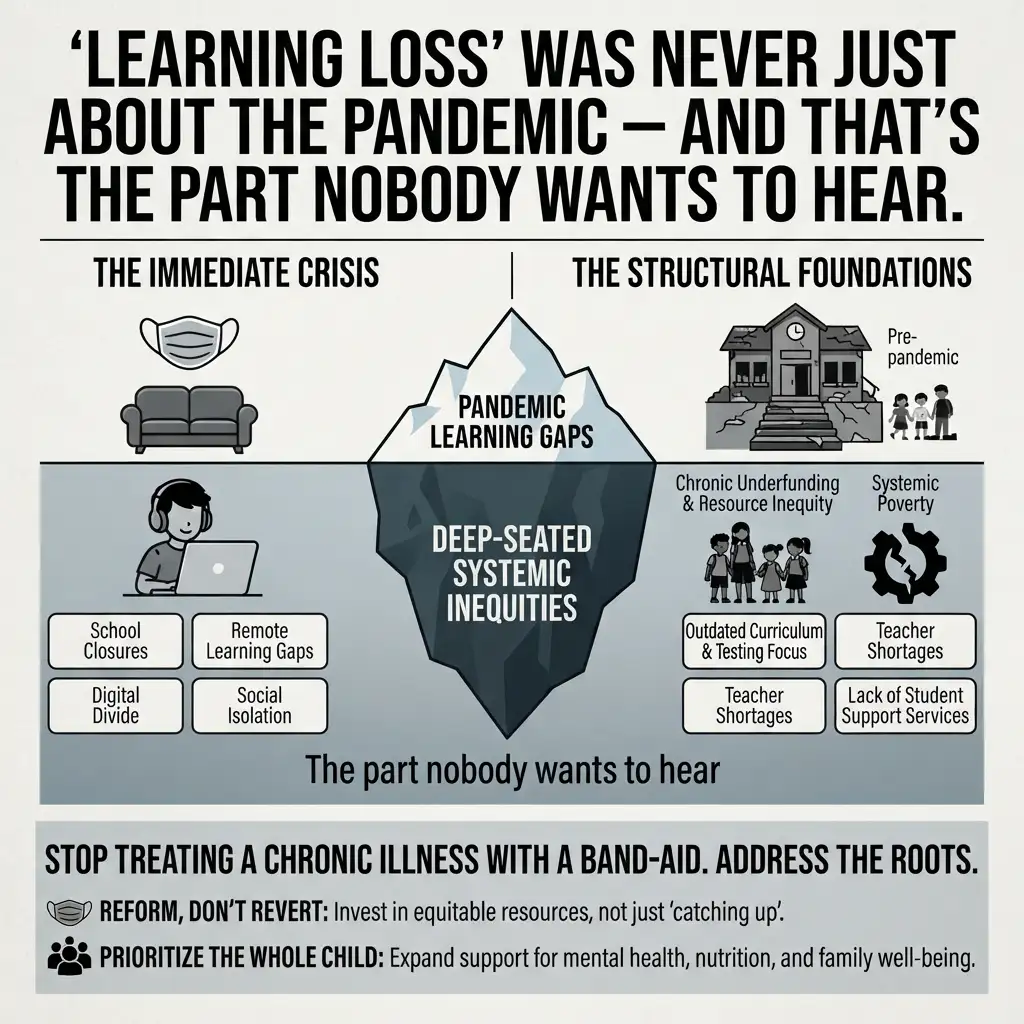
"Learning Loss" Was Never Just About the Pandemic — And That's the Part Nobody Wants to Hear
For five years now, "learning loss" has been shorthand for one specific story: schools closed in 2020, kids fell behind, and eventually they'd catch back up. That story is comforting. It's also, according to the data now sitting in front of researchers, largely wrong.
The Numbers Nobody Wanted
Here's where things actually stand. As of the most recent Education Recovery Scorecard — a joint project between Harvard, Stanford, and Dartmouth researchers tracking roughly 35 million American students — the average US student remains close to half a grade level behind pre-pandemic achievement in both math and reading. Not one single state scored above its 2019 levels in both subjects. Eighth-grade reading scores on the National Assessment of Educational Progress (NAEP) — the test everyone calls "the Nation's Report Card" — are now at their lowest point since 1990. That's not a pandemic-era low. That's a 35-year low.
And here's the detail that should worry anyone still telling the "we'll catch up eventually" story: reading scores didn't just fail to recover after 2022 — they kept falling for two more years. Math rebounded almost immediately once schools reopened. Reading didn't. The federal government poured $190 billion into K-12 recovery efforts. It wasn't nearly enough to close the gap, and in reading specifically, it barely slowed the decline.
The Twist: This Started Before COVID Ever Existed
This is the part that upends the whole "pandemic learning loss" framing. Stanford economist Eric Hanushek's 2026 analysis, drawing on NAEP data going back to the 1970s, found something uncomfortable: American student achievement peaked around 2012-2013 — and has been declining ever since, well before any school ever closed for COVID.
Run the numbers, and the pandemic-era drop (2019-2022) turns out to be roughly the same size as the decline that had already happened in the seven years before it. The pandemic didn't create the crisis. It accelerated a slide that was already underway — one researchers now increasingly link to a specific decade-old policy shift: the point when states largely switched off test-based accountability systems, right around the same years smartphones and social media fully took over teenage life.
In other words: "learning loss" was never really a two-year story. It's a decade-long one, and COVID just made it impossible to ignore.
Who Actually Fell Behind — and Who Didn't
The recovery data reveals something else that complicates the tidy national narrative: it was never one crisis. It was several, layered on top of each other unevenly.
The achievement gap between high- and low-scoring students has widened sharply — districts in the highest-income decile were nearly four times more likely to recover fully in both subjects than districts in the lowest-income decile. Federal relief dollars did help — they reduced losses in higher-poverty districts by about 10% of a grade-equivalent in math and reading — but only in districts that actually spent the money on things proven to help. Many didn't.
And there's a factor hiding in plain sight that explains a meaningful chunk of the stalled recovery: chronic absenteeism. Kids simply aren't showing up to school as consistently as they used to. Rates have come down from their post-pandemic peak, but they're still well above pre-pandemic levels — and researchers estimate that if attendance had simply returned to normal, the recovery so far would have been meaningfully larger. You can't relearn what you missed if you're still missing school.
So Is There Any Good News?
A little, and it's worth taking seriously rather than dismissing. The 2025 NAEP data showed the first real signs of a reading turnaround in over a decade — tentatively linked to a wave of state-level "science of reading" reforms that changed how early literacy is actually taught. More than 100 US school districts are now performing above their pre-pandemic levels in both math and reading simultaneously, proving recovery isn't structurally impossible — just uneven, and dependent on choices individual districts and states made rather than something that was going to happen automatically with time.
Why This Matters Beyond the US
None of this data is Azerbaijani, and Azerbaijan's own pandemic-era school closures and recovery trajectory looked different in important ways. But the underlying lesson generalizes past any one country's test scores: "kids will catch up eventually" was always a hope, not a plan. The systems that are actually closing gaps right now are the ones that changed something specific — how reading is taught, how absenteeism is addressed, how recovery funding gets spent — rather than the ones that waited for a return to normal that, on the data available so far, simply hasn't arrived on its own.
The pandemic didn't invent this problem. It just made the decade-long one impossible to keep ignoring.