
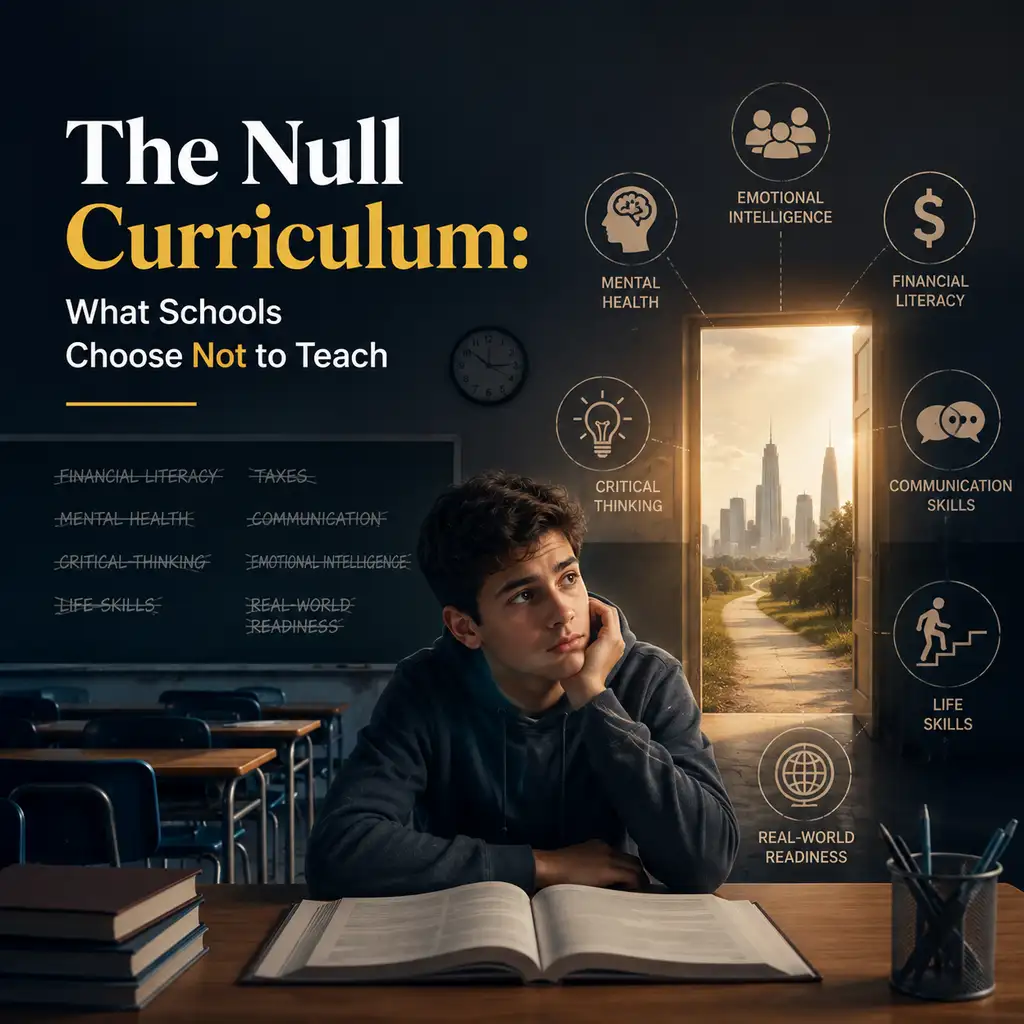
The Null Curriculum: What Schools Choose Not to Teach
Most conversations about education focus on what's being taught. Fewer people ask the more uncomfortable question: what isn't?
Education researcher Elliot Eisner gave this idea a name — the null curriculum — to describe everything a school system quietly leaves out. Not by accident, necessarily, but as the inevitable result of every curriculum being a series of choices. Every hour spent teaching one subject is an hour not spent teaching another. Every topic included is a topic that pushed something else out. The null curriculum is that "something else" — and Eisner's point was that these omissions teach students something too: that whatever got left out apparently wasn't important enough to include.
The Subjects Everyone Notices Are Missing
Ask almost any adult what they wish school had taught them, and a familiar list comes up fast: how to file taxes, how credit works, how to negotiate a salary, how to manage stress, how relationships actually function once you're an adult navigating them without a teacher supervising. Financial literacy and emotional intelligence are probably the two most commonly cited gaps in education systems worldwide — not because nobody has thought to include them, but because curriculum time is finite, and something always has to give.
This is where the null curriculum becomes genuinely useful as a concept rather than just a complaint: it reframes "why didn't school teach me this?" from a personal grievance into a structural question. Someone, somewhere, decided that quadratic equations were worth a semester and personal budgeting wasn't. That decision might have been reasonable. It might not have been. But it was a decision — made by a curriculum committee, a ministry, a textbook publisher — not a law of nature.
It's Not Just About Practical Skills
The null curriculum goes deeper than "life skills" that got left out. It also describes entire perspectives, histories, and ways of thinking that a curriculum simply never engages with. A history curriculum that covers wars and treaties in detail but says almost nothing about the everyday lives of ordinary people during those periods is teaching something by omission — that political and military events matter more than lived experience. A science curriculum that never discusses the ethical dilemmas scientists actually grapple with is quietly teaching that science is a purely technical enterprise, free of moral complexity, which working scientists would tell you is far from true.
None of this is necessarily malicious. Curriculum designers work under real constraints: limited hours, standardized testing requirements, teacher training capacity, and political sensitivities that make certain topics harder to include than others. But the null curriculum reminds us that "we didn't have time" and "we didn't think it mattered" often produce the exact same result for the student sitting in the classroom.
A Useful Question for Parents and Educators Alike
The null curriculum isn't really an argument for cramming more into an already packed school day — that's rarely realistic. It's an invitation to ask a sharper question: given that we can't teach everything, what did we choose not to teach, and why?
For parents, that might mean actively filling gaps at home — having the conversation about money, emotional regulation, or critical thinking that the school day simply doesn't have room for. For educators and policymakers, it means treating curriculum design as an ongoing act of prioritization, not a fixed, neutral list of "the important stuff" that somehow assembled itself.
Azerbaijan's own education system, like every system worldwide, has its own null curriculum — its own list of things every student walks away without, simply because something else took the time slot instead. Naming that list, even informally, is often the first step toward deciding whether it should stay that way.
What's missing from a curriculum is never neutral. It's a choice — even when nobody remembers making it.