
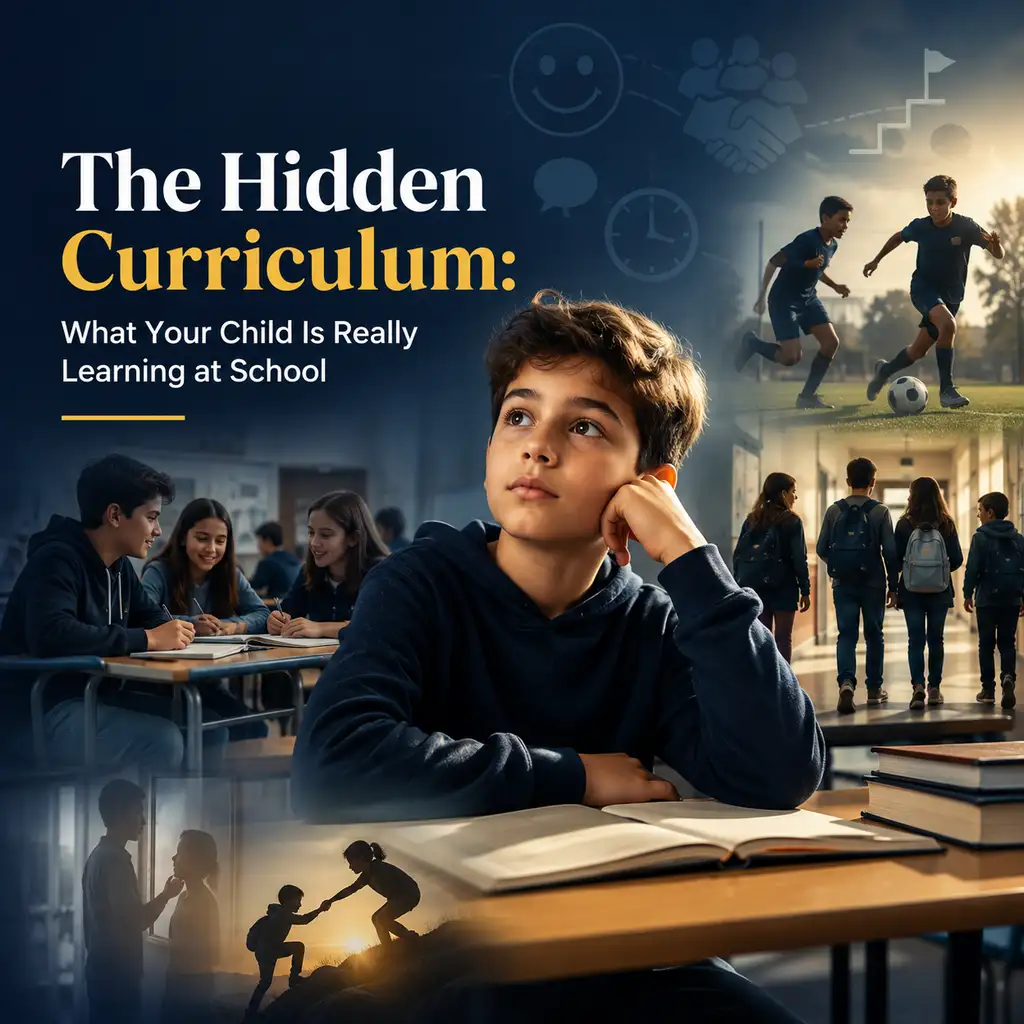
The Hidden Curriculum: What Your Child Is Really Learning at School
Ask any parent what their child learned at school today, and you'll usually get an answer about math, reading, or science. But sit in on a single school day — really watch it — and you'll notice something else being taught constantly, to every student, by no one in particular: how to wait your turn. How to read a teacher's mood. Who gets praised for raising their hand and who gets told to sit down. None of it is written in any syllabus. All of it is being learned anyway.
This is what education researchers call the hidden curriculum — and once you know the term, you start seeing it everywhere.
A Concept That's Older Than You Think
The phrase was coined back in 1968 by sociologist Philip Jackson, who noticed something schools have always done but rarely talked about openly: alongside the official subjects, every classroom quietly teaches students how to behave, how to interact with authority, and what kind of person is considered "successful" within that particular building's culture. Jackson wasn't describing a flaw exactly — he was naming something schools do simply by existing as social institutions, whether they mean to or not.
The formal curriculum is what shows up in a lesson plan. The hidden curriculum is everything else: the unspoken rule that speaking out of turn gets you corrected but staying silent never does; the subtle signal that certain accents, clothing styles, or ways of speaking are treated as more "serious" than others; the quiet lesson, repeated daily, about whose questions get taken seriously and whose get brushed aside.
Why It Matters More Than It Sounds Like It Should
Here's the uncomfortable part: the hidden curriculum doesn't affect every student equally. Research going back decades has found that it can reinforce exactly the kind of social hierarchies schools claim to be dismantling. A well-known 2005 study by education researcher Edward Morris found that dress-code enforcement in some American schools disproportionately targeted clothing styles associated with Black students, while styles associated with the dominant culture went unremarked — teaching students, without a single word of it appearing in any handbook, whose self-expression was "appropriate" and whose wasn't.
Sexuality education offers another well-documented example: when a curriculum discusses only heterosexual relationships as the default, LGBTQ+ students absorb something that was never written down anywhere — that their experience is the exception, not the norm. Nobody planned that lesson. It got taught anyway.
None of this means teachers are doing something wrong on purpose. Most of the time, the hidden curriculum runs on autopilot, shaped by habits, cultural assumptions, and institutional norms nobody actively chose — which is exactly what makes it worth paying attention to. You can't fix what you don't notice.
What It Looks Like Where You Are
The hidden curriculum isn't a uniquely American or Western phenomenon — it exists in every school system, including here in Azerbaijan, just shaped by local culture and expectations instead. Ask yourself: does your child's school quietly reward conformity over curiosity? Does it treat questioning a teacher as disrespect, regardless of how the question was asked? Do certain students get more patience, more benefit of the doubt, more encouragement to speak up — and if so, is there a pattern to who they are?
These aren't accusations. They're the kind of questions the hidden curriculum concept exists to help you ask.
Can It Be Changed?
The good news, according to researchers who study early-years and school settings, is that once adults become aware of the hidden curriculum, they can start shaping it on purpose rather than leaving it on autopilot. A few starting points that show up consistently in the research:
- Notice who gets praised, and for what. Effort and curiosity, or just quiet compliance?
- Look at what's represented. Do the books, materials, and examples in a classroom reflect a range of backgrounds, or just one?
- Ask what "good behavior" actually means in practice — and whether it's being applied the same way to every student.
- Treat mistakes as part of learning, not just something to be corrected quickly and moved past.
None of this requires rewriting a syllabus. It requires noticing the parts of school that were never written down in the first place — and asking, deliberately, what they're actually teaching.
The hidden curriculum isn't something you can opt your child out of. But once you can name it, you can start asking better questions about it — of your child's school, and of the choices happening in your own home, too.