Turkey Offers a Record 805,000 University Places for 2026 — With AI and Cybersecurity Quotas Expanding Fast
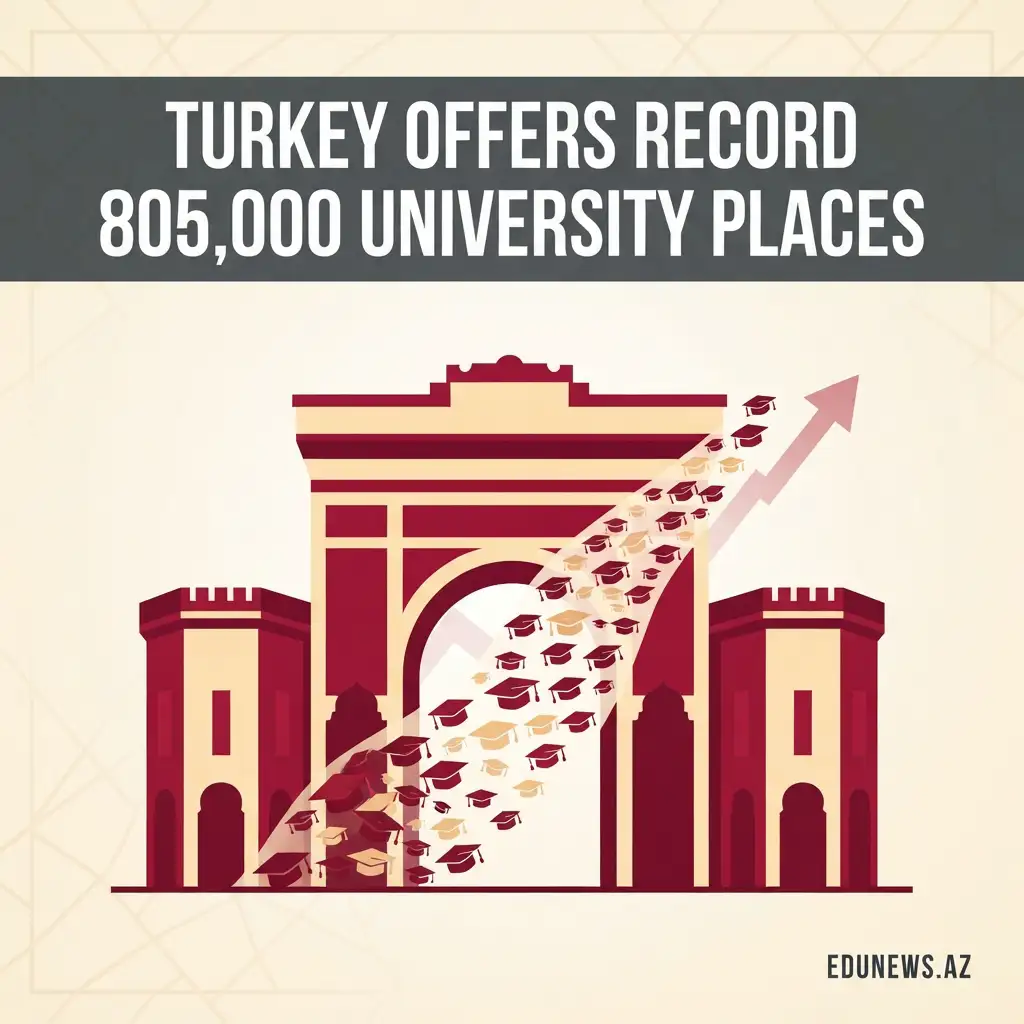
ANKARA — Turkey's Council of Higher Education (YÖK) confirmed this week that the country is offering 805,747 university places for the 2026 admissions cycle, split across 371,476 associate degree places, 407,080 undergraduate places, and 27,191 special talent program places spanning universities in Turkey and the Turkish Republic of Northern Cyprus. It's one of the largest single-year quota offerings in the country's history, and it arrives with a deliberate tilt toward the fields Turkey's government considers strategically important: expanded quotas in artificial intelligence, cybersecurity, and other future-oriented specialties, alongside sixteen entirely new academic programs admitting students for the first time this year.
The scale of the applicant pool behind those numbers is itself notable. More than 2.2 million candidates sat Turkey's Basic Proficiency Test (TYT) this cycle, 1.47 million took the Field Proficiency Test (AYT), and 143,270 sat the Foreign Language Test. Preference submission ran from July 29 through August 10, following the July 21 release of exam results — meaning Turkey's entire admissions cycle, from testing through final placement, moved through in under a month, a pace that stands in sharp contrast to the multi-stage, multi-week specialty-selection and registration process Azerbaijani applicants have been navigating this same admissions season.
YÖK didn't just expand access — it tightened it in specific, competitive corners. The minimum ranking required for admission to law faculties was raised from 125,000 to 100,000 nationally, a meaningful jump that pushes law further into elite-only territory, while medicine, dentistry, pharmacy, architecture, and teacher education programs continue to face their own existing national ranking thresholds. Read together, the pattern is coherent even if it looks contradictory at first glance: Turkey is simultaneously making higher education more accessible in aggregate — more total seats than ever — while making its most prestige-heavy, employment-guaranteed fields harder to break into, funneling growth toward technology and future-oriented sectors instead of spreading it evenly across every discipline.
That's not incidental. YÖK explicitly tied this year's quota planning to "Türkiye's labor market needs, employment policies and the country's long-term human capital strategy" — language that echoes almost exactly what Azerbaijan's own Ministry of Science and Education has said about its 2022-2028 state scholarship program, and what education ministries from the US to Singapore have been saying all year as they redesign programs around AI-era job markets rather than traditional academic prestige alone. Turkey isn't an outlier in this instinct. It's simply moving at a scale — 805,000 places in a single cycle — that makes the pattern impossible to miss.
For Azerbaijani families, Turkey's admissions numbers carry direct, practical weight beyond general regional interest. Turkey remains one of the most popular international study destinations for Azerbaijani students, helped by shared language, geographic proximity, deep institutional ties — including the newly opened Turkey-Azerbaijan University and Istanbul Technical University's new branch presence within Karabakh University — and a Turkish higher education system that has grown dramatically more internationally competitive in a short span. Six Turkish universities now place within the QS World University Rankings global top 500, and Turkey overtook Germany, France, Italy, and Spain to become the second most-represented country in the QS Europe University Rankings 2026, with 103 listed institutions. A decade ago, Turkey enrolled roughly 48,000 international students total; recent tracking puts that figure well over 300,000, driven substantially by expanded English-medium instruction and the kind of aggressive quota growth this week's YÖK announcement represents.
The open question for the 2026-27 academic year is less about capacity — Turkey clearly has room to absorb near-record numbers of students — and more about whether quality keeps pace with quantity. Sixteen brand-new programs launching in a single year, layered onto a system already the second-largest in Europe by institutional count, is an aggressive expansion by any standard. Whether Turkey's newest programs and newest cohort of students find the labor-market outcomes YÖK is explicitly promising them is a story that won't be fully testable for at least another three or four years — right around the time this year's freshman class actually graduates.