Will AI Become a Standalone School Subject in Azerbaijan? The Ministry Weighs In
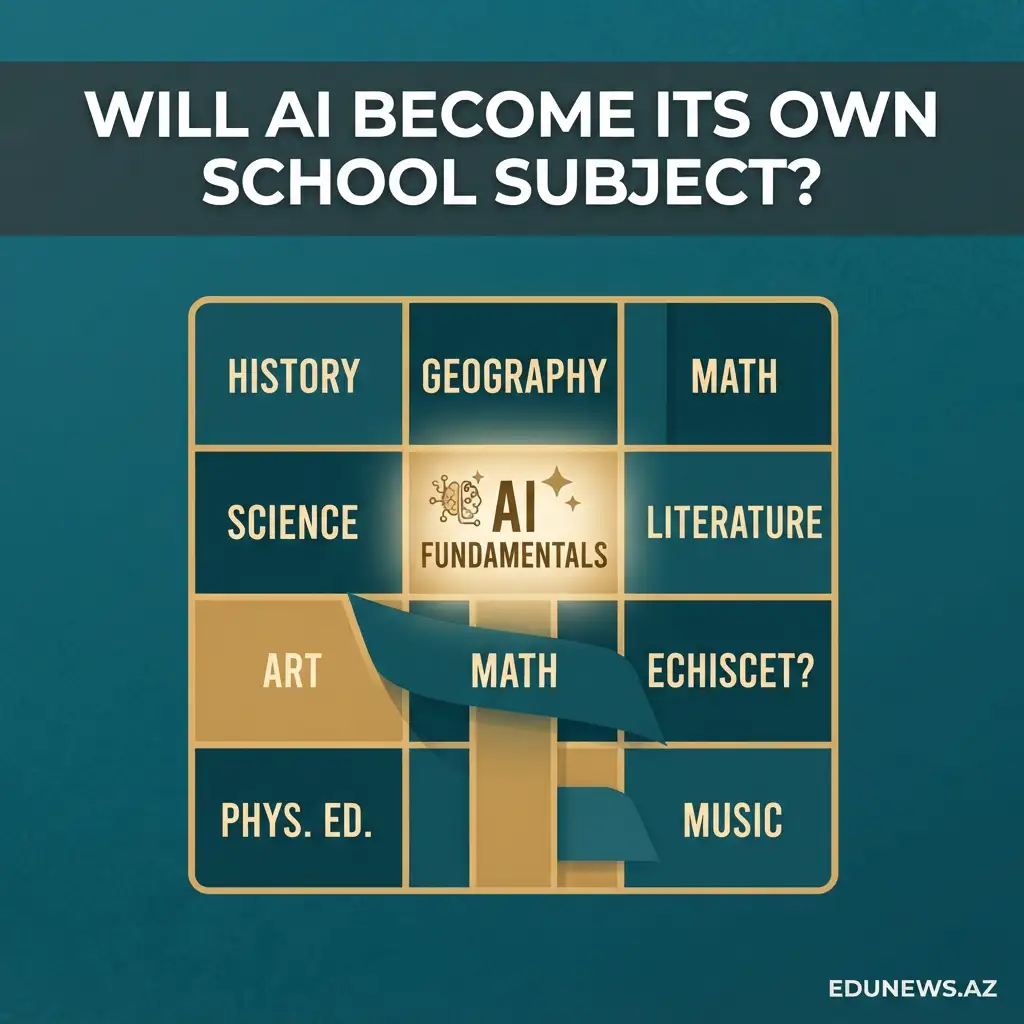
BAKU — Azerbaijan's Ministry of Science and Education addressed a question that's been circulating among teachers and parents for months: will artificial intelligence become its own dedicated subject in the school curriculum, the way physics or chemistry is? The Ministry's clarification, published today, lands at a moment when the same question is being answered very differently by education systems around the world — and Azerbaijan's approach turns out to sit somewhere in between the two extremes.
Compare the international landscape as it stands right now. Singapore has gone furthest: both of its flagship universities, the National University of Singapore and Nanyang Technological University, made AI literacy a graduation requirement for every undergraduate this year, regardless of major, backed by a campus-wide partnership with OpenAI. Japan took the opposite instinct — its Central Council for Education convened a formal government panel just last week specifically to study whether heavy AI use is eroding students' ability to think independently, with recommendations due by fiscal 2027. New York City's own Panel for Educational Policy faced public backlash this month after residents testified for nearly seven hours against the city's AI rollout in schools, with the panel's own technology adviser publicly calling for a two-year moratorium in the same meeting. In other words: there is no global consensus on whether AI belongs in the curriculum as its own subject, as an integrated skill across all subjects, or as something schools should actively slow down on introducing at all.
Azerbaijan's own policy groundwork for this decision has been building for over a year. The country's 2025-2028 AI Strategy, approved by presidential decree in March 2025, established AI as a national development priority spanning government, the economy, healthcare, and education simultaneously — not a standalone tech initiative confined to universities or IT ministries. That strategy sits alongside the Ministry's "Rəqəmsal bacarıqlar" (Digital Skills) program and a broader Digital Development Council created by presidential decree in February 2026, giving Azerbaijan a fairly unusual policy advantage compared to countries now scrambling to write AI-in-education rules from scratch: the government infrastructure and strategic framing were already in place well before this particular curriculum question needed answering.
Today's clarification appears to lean toward integration rather than a fully separate subject — closer to how Azerbaijan has already begun weaving AI into existing structures, including new vocational specialties and teacher-training programs reported throughout August, rather than carving out a dedicated weekly class period the way, say, a foreign language or history course occupies. That approach mirrors what education researchers have found works best when it's done well: a Digital Education Council global survey of 35 countries this year found AI adoption without coherent training support tends to produce the weakest outcomes, while structured, integrated approaches — where students learn to apply AI within the context of what they're already studying, rather than as an abstract standalone topic — correlate with stronger results.
There's a real tension underneath today's announcement worth naming directly. Azerbaijani teachers themselves are visibly split on the question: a Muallim.edu.az reader poll running for several weeks now shows 62.8% of respondents already using AI in their teaching process, 24.6% not using it, and 12.6% actively believing AI interferes with learning — numbers that have barely moved in weeks of continued voting, suggesting genuinely entrenched, not just undecided, positions among educators. A standalone AI subject would need dedicated teachers trained specifically to teach it — a much heavier lift than folding AI literacy into existing subjects taught by teachers who already have a classroom and a curriculum to adapt. Integration is administratively easier. Whether it's pedagogically sufficient, given how fast the technology itself keeps changing, is the open question neither Azerbaijan nor any other country chasing this issue has fully answered yet.
What happens next will likely depend on how Azerbaijan's approach performs against the two live experiments already running elsewhere: Singapore's bet that mandatory, integrated AI competency produces better-prepared graduates, and Japan's bet that the more urgent problem right now is protecting independent thinking from AI overreliance in the first place. Azerbaijan's own path — integration without full standalone-subject status, at least for now — reads as a deliberately middle position, one that keeps the door open to moving toward either extreme once more evidence comes in from the countries currently running the more aggressive experiments.