
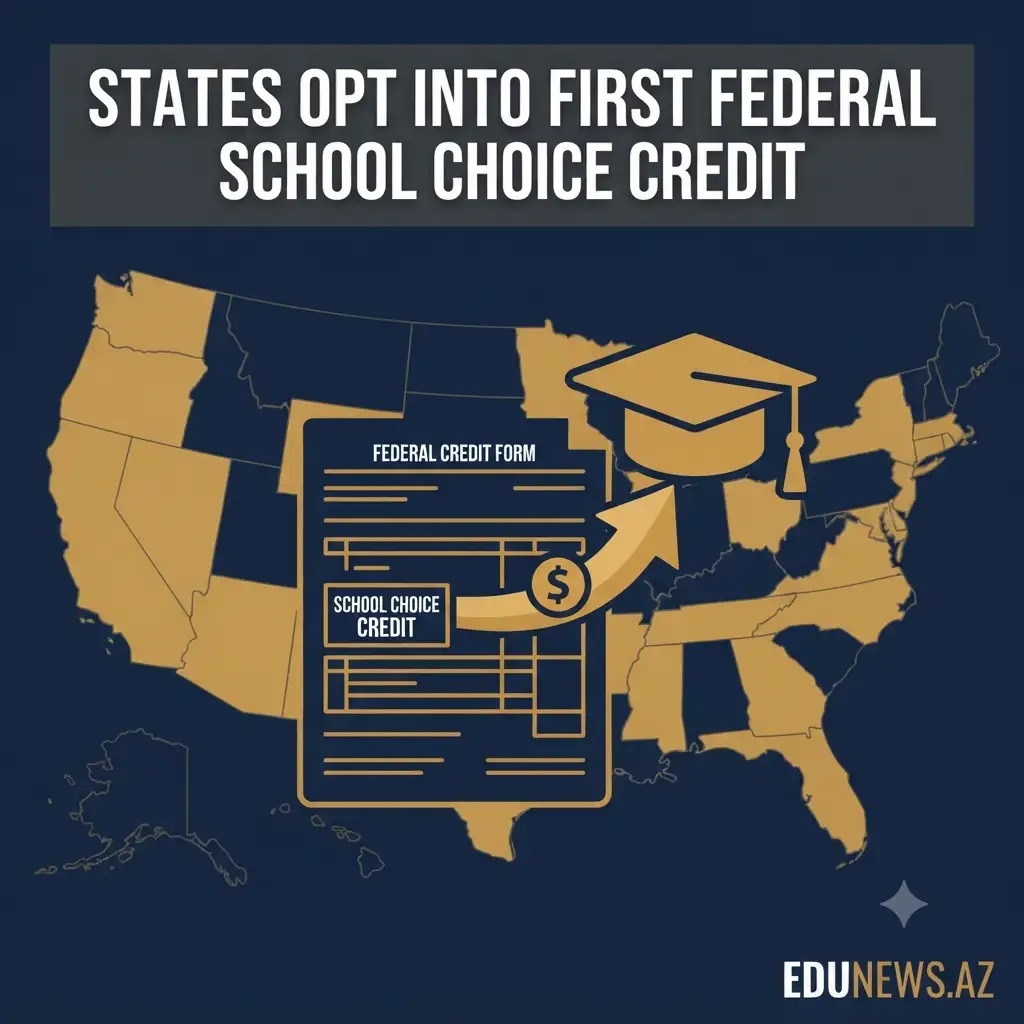
More Than Half of US States Opt Into First-Ever Federal School Choice Tax Credit
WASHINGTON — More than half of US states — 27 as of the most recent IRS count — have opted into the country's first nationally available federal school choice program, a tax credit that lets individual taxpayers claim up to $1,700 per year for donations to approved K-12 scholarship organizations. The program, created under the 2025 budget reconciliation law known as the One Big Beautiful Bill Act, takes effect January 1, 2027.
Under the mechanism, individual taxpayers — not corporations — can claim a 100% nonrefundable federal tax credit for contributions to qualifying nonprofit Scholarship Granting Organizations (SGOs), which then distribute the donated funds as scholarships to eligible K-12 students. Unlike some existing state-level voucher programs, the federal credit is not limited to private school tuition: SGOs can use the funds to cover expenses at public schools too, including tutoring, special education services, technology, and supplies, provided the receiving student's household earns no more than 300% of the area's median gross income.
The credit is unusual in federal tax policy for being both permanent and structurally uncapped at the national level — there is no overall dollar limit on how much total federal revenue the program can direct toward scholarships, only the $1,700-per-taxpayer annual limit on individual contributions. States had to formally elect to participate through an IRS advance-election process that opened January 1, 2026, and only students living in a state that has opted in are eligible to receive a scholarship funded through the program.
Politically, the rollout has scrambled some of the usual battle lines around school choice. Most states opting in lean Republican, many of which already run their own state-level tax credit scholarship programs. But Democratic governors in North Carolina and Colorado have also signaled intent to participate, while Democratic-led Hawaii, New Mexico, and Oregon initially indicated they would sit out before more recently saying they are waiting for further federal rules before deciding. Analysts at the nonpartisan think tank Third Way say the program's unusual design — allowing funds to support public-school students, not just private-school tuition — is part of what has complicated the normally predictable partisan calculus, particularly for Democratic officials who have traditionally opposed school choice measures on the grounds that they divert funding from public education, while supporters argue the credit represents a genuine expansion of options for lower- and middle-income families regardless of which type of school they choose.
With final Treasury Department and IRS rules on implementation still being finalized, the biggest open questions for the 2026-27 school year remain exactly which donations and expenses will qualify, and how quickly Scholarship Granting Organizations in each participating state can get certified and begin accepting contributions before the January 2027 launch date.